

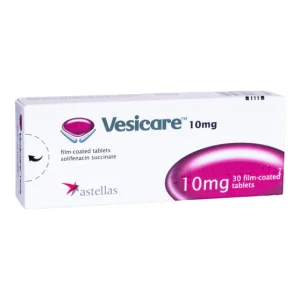
TM Owner Astellas Pharma
Vesicare 10mg Tablet
Global Shipping : Reliable Global Distribution Network
Express Delivery : Priority Shipping for Every Order
Secure Payments : Trusted Payment Protection System
 Disclaimer

Secure Handling
24/7 Worldwide Support

Global Access
Worldwide Access to Health

Cold-Chain Expert
Excellence in Cold-Chain

Trusted Supply
Certified Medical Supply
Indications & Clinical Uses
- Vesicare 10 mg tablets contain solifenacin succinate, a muscarinic receptor antagonist that relaxes the bladder, and are used in adults to treat overactive bladder with symptoms of urge urinary incontinence, urgency and urinary frequency.
- Treatment usually starts at 5 mg once daily and may be increased to 10 mg once daily if well tolerated, so the 10 mg tablet is the higher strength; do not confuse it with the 5 mg tablet or with Vesicare LS oral suspension, which is a separate product.
- In the US label, safety and effectiveness of the tablets have not been established in children.
- Vesicare is marketed in the US by Astellas Pharma US, Inc., the label used here is the US label (an EU or UK label cross-check was not done), and no withdrawal or discontinuation was found.
Side Effects
- The most common side effects in the US label, at 5 mg and 10 mg respectively, are dry mouth (10.9% and 27.6%), constipation (5.4% and 13.4%), blurred vision (3.8% and 4.8%) and urinary tract infection (2.8% and 4.8%).
- Serious reactions to report immediately are swelling of the face, lips, tongue or throat (angioedema) or allergic reactions, difficulty passing urine, severe constipation or abdominal symptoms, fast, irregular or pounding heartbeat, fainting, severe skin reactions, and heat prostration from reduced sweating in hot environments.
- Liver test abnormalities and drowsiness have also been reported.
- There is no boxed warning.
- Stop the tablets and seek emergency help if the face, lips or throat swell.
Precautions & Warnings
- Do not use Vesicare if you cannot empty your bladder (urinary retention), have gastric retention, have uncontrolled narrow-angle glaucoma, or are allergic to solifenacin or any ingredient.
- Use with caution with bladder outlet obstruction, reduced gut movement or controlled narrow-angle glaucoma.
- Do not use more than 5 mg daily with severe kidney impairment (creatinine clearance below 30 mL/min) or moderate liver impairment; use is not recommended in severe liver impairment or in people at high risk of QT prolongation.
- Do not drive or operate heavy machinery until you know how Vesicare affects you, and avoid overheating.
- There are no adequate human pregnancy studies, and it is not known whether solifenacin passes into breast milk.
- Store at 25 degrees Celsius in the closed container.
Avoid Interactions
- Increasing exposure or side effects: strong CYP3A4 inhibitors such as ketoconazole raise solifenacin levels (about 2.7-fold), so do not exceed 5 mg daily; medicines that prolong the QT interval are not recommended in people at high risk of QT prolongation.
- Reducing effectiveness: CYP3A4 enzyme inducers may lower solifenacin levels.
- The label reports no meaningful interaction with warfarin, oral contraceptives or digoxin.
- Tell your prescriber and pharmacist about all prescription medicines, over-the-counter products and supplements you use.
- Do not start or stop any medicine, including antifungal medicines, without checking first; if you start a strong CYP3A4 inhibitor while taking 10 mg, your dose needs to be reduced to no more than 5 mg daily.
References
Frequently Asked Questions
Vesicare (solifenacin succinate) treats overactive bladder in adults, easing urgency, frequent urination and urge incontinence. The 10 mg tablet is the higher dose; treatment usually starts at 5 mg once daily. Safety in children has not been established for the tablets.
Take one Vesicare tablet by mouth once daily, swallowed whole with water, with or without food. You usually start with 5 mg, and your prescriber may raise it to 10 mg if it is well tolerated. Do not exceed 5 mg with strong CYP3A4 inhibitors.
The most common Vesicare side effects are dry mouth (about 1 in 4 people on 10 mg), constipation, blurred vision and urinary tract infection. Get emergency help for swelling of the face, lips, tongue or throat, and call your provider if you cannot pass urine.
Avoid taking more than 5 mg of Vesicare (solifenacin) with strong CYP3A4 inhibitors such as ketoconazole, and avoid hot environments because reduced sweating can cause heat prostration. Do not drive until you know how it affects you. Tell your provider about all medicines you take.
Store Vesicare (solifenacin) tablets at 25°C in the closed container they came in. Short periods of storage between 15°C and 30°C are allowed. Keep the tablets in that container until you take them, with the lid closed each time. Follow the storage advice on your pharmacy label.
Vesicare (solifenacin) can cause blurred vision and drowsiness, so do not drive or use heavy machinery until you know how it affects you. It can also cause heat prostration by reducing sweating, so avoid overheating in hot weather. Wait until you know how the tablet affects you before returning to these activities.

Trusted & Reliable – Your Partner in Global Distribution.
We provide comprehensive lines of pharmaceutical products to support all your healthcare distribution needs.


