

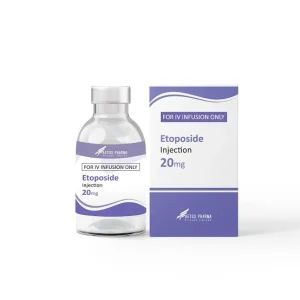
TM Owner Generic
VP-16 20mg/mL Injection
Global Shipping : Reliable Global Distribution Network
Express Delivery : Priority Shipping for Every Order
Secure Payments : Trusted Payment Protection System
 Disclaimer

Secure Handling
24/7 Worldwide Support

Global Access
Worldwide Access to Health

Cold-Chain Expert
Excellence in Cold-Chain

Trusted Supply
Certified Medical Supply
Indications & Clinical Uses
- VP-16 20 mg/mL is an older abbreviation for etoposide and is not a current brand name found on DailyMed; the information below comes from the Etoposide Injection, USP 20 mg/mL labels (Fresenius Kabi USA and Meitheal).
- Etoposide is a topoisomerase II inhibitor chemotherapy medicine.
- In combination with other approved chemotherapy agents it is used for refractory testicular tumours and as first-line treatment of small cell lung cancer.
- It is given only in hospital or clinic, by a healthcare provider experienced in cancer chemotherapy, as a slow intravenous infusion over 30 to 60 minutes after dilution to 0.2 to 0.4 mg/mL; it must not be given as a rapid injection.
- Vials contain 100 mg/5 mL, 500 mg/25 mL or 1 g/50 mL.
- Other etoposide products, such as oral capsules or etoposide phosphate, have different formulations and doses and must not be substituted for this injection.
Side Effects
- BOXED WARNING: etoposide should be given under the supervision of a qualified physician experienced in cancer chemotherapy, and severe myelosuppression (bone marrow suppression) with resulting infection or bleeding may occur.
- Low white blood cell counts affect 60 to 91 in 100 people (severe in 3 to 17), nausea and vomiting 31 to 43 in 100, and hair loss 8 to 66 in 100.
- Anaphylactic-type reactions occur in 0.7% to 2% of patients receiving intravenous etoposide, and too-rapid infusion can cause low blood pressure.
- Tell your care team at once about fever, chills, bleeding or bruising, breathing difficulty, wheezing, facial swelling or dizziness during or after the infusion.
- Rarely, acute leukaemia has been reported after treatment.
Precautions & Warnings
- Etoposide should be given only under the supervision of a physician experienced with cancer chemotherapy, in a setting able to manage severe myelosuppression and allergic reactions.
- Blood counts are checked periodically; white cell counts typically fall lowest 7 to 14 days after a dose and platelets 9 to 16 days after.
- It is contraindicated in people with hypersensitivity to etoposide or any ingredient; the injection contains benzyl alcohol, polysorbate 80, polyethylene glycol 300 and about 30.5% ethanol, which matters for sensitive patients.
- Etoposide can cause fetal harm (Pregnancy Category D), so avoid becoming pregnant; it is not known whether it passes into breast milk, so a decision must be made whether to stop nursing or the drug.
- Dose is reduced to 75% when creatinine clearance is 15 to 50 mL/min.
- Hospital pharmacy stores vials at 20°C to 25°C, protected from light.
Avoid Interactions
- Medicines that increase etoposide exposure or toxicity: high-dose cyclosporin A (concentrations above 2,000 ng/mL) increased etoposide exposure by 80% with oral etoposide and reduced its clearance; etoposide is metabolised through the CYP3A4 pathway, so medicines that affect CYP3A4 may change its levels; and other medicines that suppress the bone marrow may worsen low blood counts.
- Medicines that reduce efficacy: none were listed in the label sections reviewed.
- Etoposide must be diluted before use and must not be given by rapid intravenous injection.
- Tell your healthcare team about all prescription medicines, herbal products and supplements, and about any planned vaccinations, before treatment.
References
Frequently Asked Questions
VP-16 is another name for etoposide injection, a chemotherapy medicine used with other cancer drugs to treat refractory testicular tumours and, as first-line treatment, small cell lung cancer. It is given only in hospital or clinic by a healthcare provider experienced in cancer chemotherapy.
Etoposide (VP-16) is diluted and given as a slow intravenous infusion over 30 to 60 minutes by a healthcare provider, following the schedule for your cancer type. It must never be given as a rapid injection, because this can cause a sudden drop in blood pressure.
Common etoposide (VP-16) side effects include low white blood cell counts, nausea, vomiting and hair loss. Allergic reactions affect up to 2 in 100 patients receiving the infusion. Tell your care team at once about fever, chills, bleeding, wheezing, facial swelling or dizziness during or after the infusion.
Etoposide (VP-16) must not be used if you are allergic to it or its ingredients, and pregnancy should be avoided because it can harm an unborn baby. High-dose cyclosporin A raises etoposide levels. Tell your care team about every medicine and supplement you take before treatment.
Etoposide (VP-16) needs regular complete blood counts during treatment. White blood cells usually fall lowest 7 to 14 days after a dose and platelets 9 to 16 days after, raising the risk of infection or bleeding. Kidney function is also checked, because the dose is reduced when clearance is low.
Yes. Etoposide (VP-16) has a boxed warning: it must be given under the supervision of a physician experienced in cancer chemotherapy, and severe myelosuppression with resulting infection or bleeding may occur. Your blood counts are monitored throughout treatment, and it is given only in a hospital or clinic.

Trusted & Reliable – Your Partner in Global Distribution.
We provide comprehensive lines of pharmaceutical products to support all your healthcare distribution needs.


