

TM Owner Bayer
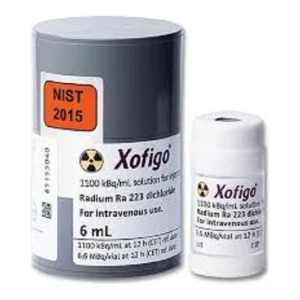
Xofigo 1100kBq/ml Injection
Global Shipping : Reliable Global Distribution Network
Express Delivery : Priority Shipping for Every Order
Secure Payments : Trusted Payment Protection System
 Disclaimer

Secure Handling
24/7 Worldwide Support

Global Access
Worldwide Access to Health

Cold-Chain Expert
Excellence in Cold-Chain

Trusted Supply
Certified Medical Supply
Indications & Clinical Uses
- Xofigo (radium Ra 223 dichloride) injection is an alpha-particle-emitting radiopharmaceutical.
- It is used to treat men with castration-resistant prostate cancer who have symptomatic bone metastases and no known visceral (organ) metastatic disease.
- It is given only in hospital or specialist settings by trained staff as an intravenous injection over about 1 minute, at 55 kBq per kg body weight every 4 weeks for 6 injections.
- Each 6 mL single-dose vial contains 6,600 kBq at a strength of 1,100 kBq/mL (the product sheet lists 100 kBq/mL, which does not match the label).
- Xofigo is not recommended in combination with abiraterone acetate plus prednisone or prednisolone outside clinical trials.
- Marketing authorisation holder is Bayer.
Side Effects
- The most common non-blood side effects (10% or more) are nausea (36%), diarrhoea (25%), vomiting (19%) and peripheral oedema.
- Blood test abnormalities are very common, including anaemia (93%), lymphocytopenia (72%), leukopenia (35%) and thrombocytopenia (31%).
- Serious effects include bone marrow suppression, which can cause infections or bleeding; tell your care team straight away about fever, unusual bruising or bleeding, or marked tiredness.
- Drink plenty of fluids, as advised by your care team.
- Other blood abnormalities listed in the label include neutropenia, so regular blood monitoring is part of treatment.
- Because the medicine is radioactive, follow the hygiene and radiation safety advice your care team gives you, and report any bleeding or signs of infection between visits.
- The US label has no boxed warning.
Precautions & Warnings
- Blood counts are checked before every injection, and treatment is stopped if counts do not recover within 6 to 8 weeks of the last dose.
- Xofigo can cause fetal harm and is not indicated for women.
- Men should use a condom, and their female partners should use effective contraception, during treatment and for 6 months after the last dose.
- The label lists no contraindications.
- Because it is radioactive, radiation protection (keeping exposure as low as reasonably achievable) applies: wash hands well, use the toilet several times and flush after use, and caregivers should wear gloves when handling body fluids.
- Xofigo is stored by the treating facility below 40 degrees C in its original container or equivalent radiation shielding.
- Do not confuse the dose, which is based on body weight and radioactive decay correction.
Avoid Interactions
- No formal clinical drug interaction studies have been performed with Xofigo.
- Combination with abiraterone acetate and prednisone or prednisolone increased fractures (28.6% versus 11.4%) and deaths (38.5% versus 35.5%) in a clinical study, and this combination is not recommended outside clinical trials.
- The reviewed label does not identify specific medicines that reduce the effectiveness of Xofigo.
- Tell your oncology team about all prescription medicines, over-the-counter products, herbal remedies and supplements, including bone-strengthening and prostate cancer treatments, before each injection so the treatment plan can be checked.
- Because no interaction studies exist, do not start, stop or change any prostate cancer or bone medicine without first discussing it with your oncology team.
References
Frequently Asked Questions
Xofigo (radium-223 dichloride) treats men with castration-resistant prostate cancer that has spread to the bones and is causing symptoms, but not to other organs. It is a radioactive medicine given by trained staff in a hospital setting. It is given as a course of six injections.
Xofigo (radium-223) is given as an intravenous injection over about 1 minute, once every 4 weeks for 6 injections. The dose is calculated from your body weight, at 55 kBq per kg. A trained healthcare team gives it in a specialist setting.
Common Xofigo side effects include nausea, diarrhoea, vomiting and swollen ankles or legs, and blood tests often show low blood counts. Bone marrow suppression can cause infection or bleeding. Tell your care team at once about fever, unusual bruising or bleeding.
Avoid combining Xofigo (radium-223) with abiraterone acetate plus prednisone or prednisolone outside a clinical trial, as this increased fractures and deaths in a study. Men should use a condom, and partners should use contraception, during treatment and for 6 months afterwards.
Your healthcare team checks your blood counts before each Xofigo (radium-223) injection, then gives it as a quick intravenous injection. Afterwards, follow the radiation safety advice: wash hands well, use the toilet several times and flush, and caregivers should wear gloves for body fluids.
Xofigo (radium-223) can suppress bone marrow, so blood counts are checked before every injection. Treatment is stopped if counts do not recover within 6 to 8 weeks. Anaemia and low white cell and platelet counts are very common. Report fever or unusual bleeding between visits.

Trusted & Reliable – Your Partner in Global Distribution.
We provide comprehensive lines of pharmaceutical products to support all your healthcare distribution needs.


