

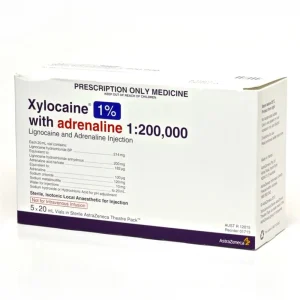
TM Owner Fresenius Kabi USA
Xylocaine 1% Injection
Global Shipping : Reliable Global Distribution Network
Express Delivery : Priority Shipping for Every Order
Secure Payments : Trusted Payment Protection System
 Disclaimer

Secure Handling
24/7 Worldwide Support

Global Access
Worldwide Access to Health

Cold-Chain Expert
Excellence in Cold-Chain

Trusted Supply
Certified Medical Supply
Indications & Clinical Uses
- Xylocaine 1% (lidocaine hydrochloride 10 mg/mL) injection is an amide-type local anaesthetic given by a doctor, dentist or other trained clinician; it is not for self-use.
- In the US, Xylocaine injection (Fresenius Kabi) is approved to produce local or regional anaesthesia or analgesia by infiltration, peripheral nerve block (such as brachial plexus and intercostal) and central neural techniques including epidural and caudal block, for surgical, dental and oral surgery, diagnostic, therapeutic and obstetrical procedures.
- Several Xylocaine presentations exist and must not be confused: plain solution, solutions with epinephrine (1:100,000 or 1:200,000), Xylocaine MPF single-dose vials that are methylparaben-free, and multiple-dose vials that contain methylparaben.
- Strengths range from 0.5% to 2%, so check that the vial says 1% and whether it contains epinephrine.
Side Effects
- Side effects are mostly dose-related and usually result from too much lidocaine reaching the bloodstream, for example after accidental injection into a vein.
- They include lightheadedness, tremors, convulsions and slowed or stopped breathing, and heart effects such as a slow heartbeat, low blood pressure and cardiac arrest.
- Methemoglobinemia, a serious condition in which blood carries less oxygen, can occur; signs include blue-grey skin, breathlessness and tiredness.
- Allergic reactions, including rare anaphylaxis, can occur.
- Versions with epinephrine contain sulfites that may cause allergic reactions in sensitive people.
- The label has no formal boxed warning, but it stresses that only clinicians trained in managing toxicity, with resuscitation equipment at hand, should use it.
- Tell your care team immediately if you feel dizzy, shaky or short of breath.
Precautions & Warnings
- Xylocaine must not be used in anyone with known hypersensitivity to amide-type local anaesthetics or to any ingredient.
- It must be given by clinicians trained to manage dose-related toxicity, with oxygen and resuscitation equipment immediately available, and the syringe should be aspirated before injecting to avoid injection into a blood vessel.
- Maximum adult doses are 4.5 mg per kg (up to 300 mg) without epinephrine and 7 mg per kg (up to 500 mg) with epinephrine; children receive reduced doses by age and weight.
- Methemoglobinemia risk is higher in G6PD deficiency and in infants under 6 months.
- Multiple-dose vials containing methylparaben must not be used for epidural or caudal block.
- Chondrolysis has been reported after continuous intra-articular infusion, which is not an approved use.
- In pregnancy, published data show no drug-associated birth defect risk, but local anaesthetics can cause maternal and fetal toxicity.
Avoid Interactions
- Medicines that increase toxicity or the effect: other local anaesthetics have additive toxic effects, and oxidising agents and other medicines that can cause methemoglobinemia raise that risk.
- For Xylocaine solutions containing epinephrine, MAO inhibitors, tricyclic antidepressants and ergot-type oxytocic drugs can cause severe high blood pressure, non-selective beta-blockers can cause high blood pressure and a slow heartbeat, and potent inhalation anaesthetics can trigger heart rhythm disturbances.
- The label lists no medicines that reduce its effect.
- Tell your healthcare provider about all medicines and supplements you use, and about any past reaction to local anaesthetics.
References
Frequently Asked Questions
Xylocaine 1% (lidocaine hydrochloride) is a local anaesthetic injection that numbs part of the body for surgical, dental, diagnostic and obstetric procedures. Clinicians use it for infiltration, nerve blocks and epidural or caudal block. It is given only by trained healthcare staff.
Xylocaine (lidocaine) is injected by a trained clinician near the nerves or tissue to be numbed, by infiltration, nerve block or epidural or caudal block. The amount depends on the procedure, your age, weight and condition. Adults get up to 4.5 mg per kg without epinephrine.
Xylocaine (lidocaine) side effects include lightheadedness, tremors, convulsions, slow breathing, slow heartbeat and low blood pressure, mostly when the dose is too high. Rare serious effects are methemoglobinemia and allergic reactions. Tell staff at once if you feel dizzy, shaky or short of breath.
Do not have Xylocaine if you are allergic to lidocaine or other amide-type local anaesthetics. Tell staff if you have G6PD deficiency or take MAO inhibitors, tricyclic antidepressants or beta-blockers, as these matter mainly for versions containing epinephrine. Epinephrine versions also contain sulfites.
Your clinician injects Xylocaine (lidocaine) and checks first that the needle is not in a blood vessel. Staff watch your heart and breathing, with resuscitation equipment nearby. Tell them straight away if you feel lightheaded, shaky or unwell, because these can be early signs of a too-high dose.
Published data and clinical use show no drug-associated birth defect risk with Xylocaine (lidocaine) in pregnancy, but local anaesthetics can cause maternal and fetal toxicity. Children get reduced doses based on age, weight and condition. Infants under 6 months have a higher risk of methemoglobinemia.

Trusted & Reliable – Your Partner in Global Distribution.
We provide comprehensive lines of pharmaceutical products to support all your healthcare distribution needs.


