

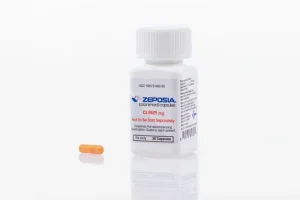
TM Owner Bristol Myers Squibb
Zeposia 0.92mg Capsule
Global Shipping : Reliable Global Distribution Network
Express Delivery : Priority Shipping for Every Order
Secure Payments : Trusted Payment Protection System
 Disclaimer

Secure Handling
24/7 Worldwide Support

Global Access
Worldwide Access to Health

Cold-Chain Expert
Excellence in Cold-Chain

Trusted Supply
Certified Medical Supply
Indications & Clinical Uses
- Zeposia 0.92mg (ozanimod hydrochloride) is a once-daily oral capsule, a sphingosine 1-phosphate (S1P) receptor modulator.
- In the US it is approved for relapsing forms of multiple sclerosis (MS) in adults and for moderately to severely active ulcerative colitis in adults.
- The 0.92 mg capsule is the maintenance dose: treatment always begins with a 7-day starter pack (0.23 mg once daily on days 1 to 4, then 0.46 mg once daily on days 5 to 7), and 0.92 mg once daily starts on day 8, so the 0.92 mg capsule must not be used to start treatment.
- People with mild to moderate hepatic impairment take 0.92 mg every other day after titration.
- Zeposia is self-administered by mouth, but an ECG and other checks are needed before the first dose.
- This description follows the US label.
Side Effects
- Zeposia has no boxed warning.
- In multiple sclerosis trials the most common side effects (4% or more) were upper respiratory infection (26%), raised liver enzymes (10%), orthostatic hypotension (a fall in blood pressure on standing), urinary tract infection, back pain and high blood pressure (each about 4%).
- In ulcerative colitis they were increased liver tests (5% to 11%), upper respiratory infection (5%) and headache (4% to 5%).
- Zeposia lowers blood lymphocytes to about 45% of baseline, so infections can be more frequent or serious.
- Serious effects include progressive multifocal leukoencephalopathy (PML), a slow heart rate after the first dose, liver injury as early as ten days after starting, macular oedema (swelling at the back of the eye) and posterior reversible encephalopathy syndrome (PRES).
- Report fever, new weakness or confusion, vision changes, yellow skin or eyes, or fainting promptly.
Precautions & Warnings
- Before starting, an ECG, complete blood count, liver tests, an eye examination (baseline fundus assessment) and a skin check are needed, and blood pressure and liver tests are monitored during treatment.
- Zeposia is contraindicated after a recent (within 6 months) heart attack, unstable angina, stroke, TIA or decompensated heart failure, in Class III/IV heart failure, in Mobitz type II or third-degree AV block, sick sinus syndrome or sinoatrial block without a pacemaker, in severe untreated sleep apnoea, and with monoamine oxidase (MAO) inhibitors.
- Withhold Zeposia at the first sign of PML.
- Women who could become pregnant should use effective contraception during treatment and for 3 months after stopping, as animal data show a risk of fetal harm; a pregnancy exposure registry exists.
- Avoid live attenuated vaccines during and for 3 months after treatment, and vaccinate at least 1 month before starting.
- If you miss a dose in the first 2 weeks, restart the titration; after that, continue as planned.
Avoid Interactions
- Medicines that increase risk or exposure: MAO inhibitors are contraindicated; strong CYP2C8 inhibitors such as gemfibrozil raise levels of the active metabolite by roughly 47% to 69% and are not recommended; Class Ia or III antiarrhythmics and QT-prolonging medicines may add to slow heart rhythm and torsades de pointes risk, so cardiology advice is recommended, and the label advises against starting Zeposia in people taking both a heart-rate-lowering calcium channel blocker and a beta blocker.
- Medicines that reduce effect: strong CYP2C8 inducers such as rifampin lower the active metabolite by roughly 55% to 60% and should be avoided.
- Live vaccines may not work and may cause infection, and other anti-neoplastic or immune-suppressing therapies may add to immune suppression.
- Tell your healthcare provider about all medicines and supplements you use.
References
Frequently Asked Questions
Zeposia (ozanimod) is a once-daily capsule that treats relapsing forms of multiple sclerosis and moderately to severely active ulcerative colitis in adults. It is an S1P receptor modulator. Treatment starts with a 7-day starter pack before moving to the 0.92 mg maintenance capsule.
Take Zeposia (ozanimod) by mouth once daily. Start with 0.23 mg on days 1 to 4 and 0.46 mg on days 5 to 7, then take 0.92 mg once daily from day 8. Do not start treatment with the 0.92 mg capsule, and do not skip the starter pack.
Common Zeposia side effects include upper respiratory infections, raised liver enzymes, headache, urinary infections, back pain and blood pressure changes. It can also slow the heart rate and cause infections, liver injury and eye swelling. Report fever, vision changes, yellow skin or eyes, or fainting straight away.
Do not take Zeposia (ozanimod) with MAO inhibitors, and avoid gemfibrozil and rifampin. Avoid live vaccines during treatment and for 3 months after stopping. Heart rhythm medicines, QT-prolonging drugs and combined beta blocker and calcium channel blocker use need cardiology advice.
If you miss a Zeposia (ozanimod) dose during the first 2 weeks, restart treatment with the titration starter regimen. If you miss a dose after the first 2 weeks, continue with your planned dose. Check with your healthcare provider if you are unsure.
Zeposia (ozanimod) may harm an unborn baby based on animal data, and there are no adequate human studies. If you could become pregnant, use effective contraception during treatment and for 3 months after your last dose. Tell your provider straight away if you become pregnant.

Trusted & Reliable – Your Partner in Global Distribution.
We provide comprehensive lines of pharmaceutical products to support all your healthcare distribution needs.


