

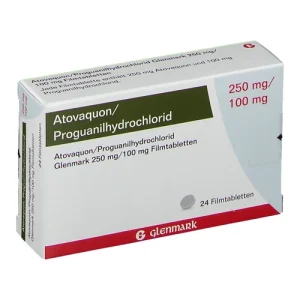
TM Owner Glenmark Pharmaceuticals
Atovaquone-Proguanil (Glenmark) 250 mg + 100 mg (adult); 62.5/25 mg (paed) Tablet
Global Shipping : Reliable Global Distribution Network
Express Delivery : Priority Shipping for Every Order
Secure Payments : Trusted Payment Protection System
 Disclaimer

Secure Handling
24/7 Worldwide Support

Global Access
Worldwide Access to Health

Cold-Chain Expert
Excellence in Cold-Chain

Trusted Supply
Certified Medical Supply
Indications & Clinical Uses
- Atovaquone-Proguanil (Glenmark) film-coated tablets combine atovaquone with proguanil hydrochloride, two antimalarial medicines that act together on the malaria parasite.
- Glenmark Pharmaceuticals Europe Limited holds the United Kingdom authorisation for the 250 mg/100 mg adult tablet, PL 25258/0064, and also markets the same combination as MaloffProtect; the 62.5 mg/25 mg paediatric tablet listed on this sheet is not part of that Glenmark authorisation and is supplied by other companies.
- The tablets are indicated for prophylaxis of Plasmodium falciparum malaria in adults and children weighing more than 40 kg, and for treatment of acute uncomplicated P. falciparum malaria in adults and children weighing 11 kg or more, including where chloroquine resistance is reported.
- The reference brand is Malarone from GlaxoSmithKline.
- They have no effect on the dormant liver forms of P. vivax and are not for severe or cerebral malaria.
Side Effects
- There is no boxed warning on the atovaquone and proguanil labelling.
- Common effects, in up to 1 in 10 people, are headache, stomach pain, diarrhoea, nausea, vomiting, loss of appetite, abnormal or vivid dreams, low mood, difficulty sleeping, dizziness, cough, fever, itching, rash, anaemia, low white cells and raised liver enzymes.
- Mouth ulcers, raised amylase, anxiety, palpitations and hair loss are uncommon, and hallucinations are rare.
- Serious but infrequent reactions include hepatitis, cholestasis and liver failure needing transplantation, Stevens-Johnson syndrome and erythema multiforme, angioedema and anaphylaxis, vasculitis, seizures, panic attacks and, in severe kidney impairment, pancytopenia.
- Stop the tablets and seek urgent care for a spreading rash with blistering or mouth sores, yellowing of the skin or eyes, swelling of the face or throat, or a fit.
Precautions & Warnings
- Take each dose with food or a milky drink at the same time each day; taken on an empty stomach much less atovaquone is absorbed and the tablets may fail to protect you.
- If you vomit within one hour of a dose, take a repeat dose.
- These tablets must not be used for prophylaxis if creatinine clearance is below 30 mL per minute, and must not be used at all if you are allergic to atovaquone or proguanil.
- They contain lactose and are unsuitable in galactose intolerance or lactase deficiency.
- Diarrhoea or vomiting reduces absorption, so blood-film monitoring is advised if this happens while treating malaria.
- Use in pregnancy only if the expected benefit to the mother outweighs the risk to the baby, and do not take them while breastfeeding.
- Folate supplementation may continue.
- Dizziness is reported, so do not drive if affected.
- Prophylaxis does not replace insect-bite precautions.
Avoid Interactions
- Efficacy is reduced, sometimes severely, by medicines that lower atovaquone levels: rifampicin cuts them by about half and rifabutin by about a third, and both should be avoided; metoclopramide lowers atovaquone by about half and is not recommended; efavirenz and ritonavir-boosted protease inhibitors can reduce atovaquone by as much as 75 percent; tetracycline reduces levels by around 40 percent; indinavir trough concentrations fall by about 23 percent.
- In the other direction, toxicity may increase: proguanil can potentiate warfarin and other coumarin anticoagulants, so the INR needs checking, and atovaquone can raise levels of etoposide and its metabolite.
- Food, especially a fatty meal or a milky drink, deliberately increases atovaquone absorption and is required with every dose rather than avoided.
- Tell the prescriber about every prescription medicine, herbal product and supplement before you travel.
References
- Atovaquone/Proguanil Hydrochloride 250 mg/100 mg film-coated tablets (Glenmark Pharmaceuticals Europe Ltd) - Summary of Product Characteristics, electronic Medicines Compendium
- MALARONE (atovaquone and proguanil hydrochloride) tablets - US Prescribing Information, DailyMed
- Atovaquone/Proguanil Hydrochloride 250 mg/100 mg Film-coated tablets (Viatris) - Summary of Product Characteristics, electronic Medicines Compendium
Frequently Asked Questions
Atovaquone-Proguanil (Glenmark) tablets prevent Plasmodium falciparum malaria in adults and children over 40 kg, and treat acute uncomplicated falciparum malaria in anyone weighing 11 kg or more. Each adult tablet holds atovaquone 250 mg with proguanil hydrochloride 100 mg. They work where chloroquine resistance is reported.
For prevention, take one Atovaquone-Proguanil tablet daily with food or a milky drink, starting 24 to 48 hours before entering the malaria area, throughout the stay and for 7 days after leaving. For treatment, adults take four tablets once daily for three days.
Common side effects of Atovaquone-Proguanil (atovaquone with proguanil) are headache, stomach pain, diarrhoea, nausea, vomiting, loss of appetite, vivid dreams, low mood and dizziness. Rarely it causes hepatitis, Stevens-Johnson syndrome, seizures or anaphylaxis. Stop and get urgent help for a blistering rash or yellow skin.
Avoid rifampicin, rifabutin, metoclopramide, efavirenz and ritonavir-boosted protease inhibitors with Atovaquone-Proguanil, as they can cut atovaquone levels by up to 75 percent and make the tablets fail. Never take a dose on an empty stomach. Avoid breastfeeding, and have your INR checked if you take warfarin.
Take the missed Atovaquone-Proguanil dose as soon as you remember, with food or a milky drink, then carry on at your usual time; never take two doses together. If you vomit within one hour of a dose, take a replacement dose straight away.
Yes. Atovaquone-Proguanil treats malaria in children weighing 11 kg or more, dosed by weight for three days: one adult tablet daily for 11 to 20 kg, two for 21 to 30 kg, three for 31 to 40 kg. For prevention the 250/100 mg tablet suits only children over 40 kg.

Trusted & Reliable – Your Partner in Global Distribution.
We provide comprehensive lines of pharmaceutical products to support all your healthcare distribution needs.


