

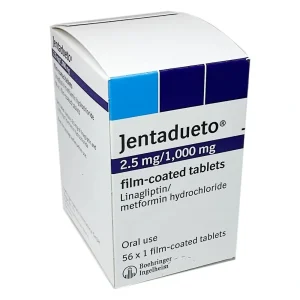
TM Owner Boehringer Ingelheim / Eli Lilly
Jentadueto 2.5mg/1000mg Tablet
Global Shipping : Reliable Global Distribution Network
Express Delivery : Priority Shipping for Every Order
Secure Payments : Trusted Payment Protection System
 Disclaimer

Secure Handling
24/7 Worldwide Support

Global Access
Worldwide Access to Health

Cold-Chain Expert
Excellence in Cold-Chain

Trusted Supply
Certified Medical Supply
Indications & Clinical Uses
- Jentadueto 2.5 mg/1000 mg film-coated tablets combine linagliptin, a DPP-4 inhibitor, with metformin hydrochloride, a biguanide.
- The combination is approved as an adjunct to diet and exercise to improve blood sugar control in adults with Type 2 diabetes.
- In the United States it is indicated for adults only and is not for Type 1 diabetes or diabetic ketoacidosis.
- The European Union authorisation, held since 19 July 2012, covers adults who are inadequately controlled on metformin alone, adults already taking linagliptin and metformin as separate tablets, and use in triple therapy with a sulfonylurea or with insulin.
- The United States label offers 2.5 mg/500 mg, 2.5 mg/850 mg and 2.5 mg/1000 mg tablets; the European Union markets the 850 mg and 1000 mg combinations.
- A separate prolonged-release product, Jentadueto XR, is a different once-daily formulation and is not interchangeable with these tablets.
Side Effects
- BOXED WARNING - LACTIC ACIDOSIS: postmarketing cases of metformin-associated lactic acidosis have caused death, hypothermia, low blood pressure and resistant slow heart rhythms.
- Risk rises with kidney impairment, age 65 or over, contrast dye procedures, low oxygen states, heavy alcohol use and liver impairment.
- Stop Jentadueto and get emergency care for unusual muscle pain, trouble breathing, unusual sleepiness, stomach pain with nausea or vomiting, or feeling cold or very weak; haemodialysis is recommended treatment.
- Everyday side effects are mild: diarrhoea and nasopharyngitis each affected about 6 percent of people in trials, and diarrhoea about 2 percent in European data.
- Low blood sugar, or hypoglycaemia, affects more than 1 in 10 when Jentadueto is combined with a sulfonylurea or insulin.
- Report severe joint pain, blistering skin, or severe ongoing abdominal pain radiating to the back.
Precautions & Warnings
- Kidney function must be checked before starting and at least yearly; Jentadueto is contraindicated if the eGFR is below 30 mL/min/1.73 m2, and also in metabolic acidosis including diabetic ketoacidosis and in people allergic to either ingredient.
- Treatment is stopped at the time of an iodinated contrast scan when eGFR is 30 to 60 and restarted after 48 hours if kidney function is stable, and is usually withheld around surgery.
- Watch for acute pancreatitis, severe disabling joint pain, bullous pemphigoid blistering and heart failure symptoms, and have vitamin B12 measured every 2 to 3 years because metformin can lower it.
- Take the tablets twice daily with meals to reduce stomach upset, and swallow them whole.
- Limit alcohol, which increases lactic acidosis risk.
- Hypoglycaemia can impair driving, especially when combined with a sulfonylurea or insulin.
Avoid Interactions
- Medicines that increase the risk of harm include carbonic anhydrase inhibitors such as topiramate, acetazolamide and zonisamide, which raise lactic acidosis risk; cationic drugs cleared by the kidney such as cimetidine, ranolazine, dolutegravir and vandetanib, which reduce metformin clearance; iodinated contrast media; and alcohol, which potentiates metformin's effect on lactate and must not be taken in excess.
- Insulin and sulfonylureas markedly increase the risk of low blood sugar and their dose often needs reducing.
- Medicines that reduce efficacy include strong P-glycoprotein and CYP3A4 inducers such as rifampicin, which lower linagliptin exposure so an alternative is preferred, and carbamazepine, phenytoin and St John's wort.
- Diuretics, corticosteroids and other drugs that raise blood sugar may reduce control.
- Tell your prescriber about every medicine and supplement you take.
References
Frequently Asked Questions
Jentadueto (linagliptin and metformin) treats Type 2 diabetes in adults alongside diet and exercise. It is used when metformin alone is not enough, when you already take both medicines separately, or with a sulfonylurea or insulin. It is not for Type 1 diabetes.
Jentadueto (linagliptin and metformin) is taken twice daily with meals to reduce stomach upset. Swallow the tablets whole. The maximum dose is 2.5 mg linagliptin with 1,000 mg metformin twice daily. Kidney function is checked before you start and at least once a year.
Common Jentadueto (linagliptin and metformin) side effects are diarrhoea and cold-like symptoms, each around 6 percent. Low blood sugar affects more than 1 in 10 when combined with a sulfonylurea or insulin. Report severe joint pain, skin blistering or severe stomach pain going through to the back.
Jentadueto (linagliptin and metformin) carries a boxed warning for metformin-associated lactic acidosis, which has caused deaths. Get emergency help for unusual muscle pain, trouble breathing, unusual sleepiness, stomach pain with vomiting, or feeling cold and very weak. Risk rises with kidney impairment, heavy alcohol use and contrast dye scans.
Avoid heavy alcohol with Jentadueto (linagliptin and metformin) because it raises lactic acidosis risk. Treatment is stopped around iodinated contrast scans and major surgery. Tell your prescriber before starting topiramate, cimetidine, dolutegravir or rifampicin, which alter how the two ingredients work.
Take the missed Jentadueto (linagliptin and metformin) dose with food as soon as you remember, unless your next dose is nearly due. In that case skip it and carry on as normal. Never take two doses together, as this increases stomach upset and lactic acidosis risk.

Trusted & Reliable – Your Partner in Global Distribution.
We provide comprehensive lines of pharmaceutical products to support all your healthcare distribution needs.


