

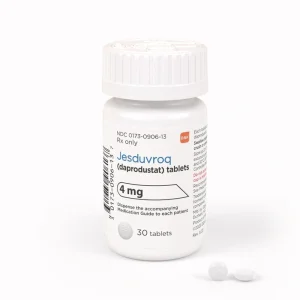
TM Owner GSK
Jesduvroq 1mg, 2mg, 4mg, 6mg or 8mg Tablet
Global Shipping : Reliable Global Distribution Network
Express Delivery : Priority Shipping for Every Order
Secure Payments : Trusted Payment Protection System
 Disclaimer

Secure Handling
24/7 Worldwide Support

Global Access
Worldwide Access to Health

Cold-Chain Expert
Excellence in Cold-Chain

Trusted Supply
Certified Medical Supply
Indications & Clinical Uses
- Jesduvroq contains daprodustat, an oral hypoxia-inducible factor prolyl hydroxylase inhibitor that prompts the body to make more of its own erythropoietin.
- It is approved in the United States, first licensed in February 2023, for the treatment of anaemia due to chronic kidney disease in adults who have been receiving dialysis for at least four months.
- It is not indicated for people with chronic kidney disease who are not on dialysis, is not a substitute for a red cell transfusion in urgent anaemia, and has not been shown to improve quality of life, fatigue or wellbeing.
- Jesduvroq is supplied as 1 mg, 2 mg, 4 mg, 6 mg and 8 mg film-coated tablets taken once daily; the maximum dose is 24 mg daily.
- There is no 300 mg tablet.
- Treatment is started and adjusted by a kidney specialist against haemoglobin results.
Side Effects
- BOXED WARNING - INCREASED RISK OF DEATH, MYOCARDIAL INFARCTION, STROKE, VENOUS THROMBOEMBOLISM AND THROMBOSIS OF VASCULAR ACCESS: Jesduvroq increases the risk of thrombotic vascular events, including major adverse cardiovascular events.
- Targeting a haemoglobin above 11 g/dL further increases these risks, and no trial has identified a haemoglobin target, dose or dosing strategy that avoids them.
- The commonest side effects, each affecting 1 in 10 people or more, are raised blood pressure, thrombotic vascular events and abdominal pain.
- Adjudicated thrombotic events occurred at 9.8 per 100 person-years.
- Stomach and gut erosions and bleeding, hospitalisation for heart failure and hypertensive crisis have also been reported.
- Get emergency help for chest pain, sudden weakness or trouble speaking, a swollen painful leg, loss of flow in a dialysis fistula or graft, or black or bloody stools.
Precautions & Warnings
- Haemoglobin is checked regularly and the dose adjusted to use the lowest level sufficient to reduce the need for transfusion; treatment should not continue beyond 24 weeks without a clinically meaningful haemoglobin rise.
- Jesduvroq is contraindicated with strong CYP2C8 inhibitors such as gemfibrozil and in uncontrolled high blood pressure, so blood pressure must be controlled before starting and monitored throughout.
- It is not recommended for people with active cancer, and it is not for chronic kidney disease patients who are not on dialysis.
- Report heart failure symptoms, indigestion or bleeding from the gut.
- Take one tablet once daily, with or without food, at about the same time each day; if a dose is missed, take it as soon as you remember unless the next dose is due the same day, and never double up.
- Store at 20 to 25 degrees Celsius.
Avoid Interactions
- Medicines that dangerously increase daprodustat exposure include strong CYP2C8 inhibitors: gemfibrozil raised exposure 18.6-fold and is contraindicated with Jesduvroq.
- Moderate CYP2C8 inhibitors and clopidogrel require the starting dose to be halved with closer haemoglobin monitoring.
- Other drugs that raise blood pressure, and any additional agent that increases clot risk, add to the thrombotic and hypertensive warnings already carried by this medicine.
- Medicines that reduce efficacy include CYP2C8 inducers such as rifampicin, which lower daprodustat levels and may require dose increases with monitoring.
- Iron supplements and phosphate binders can be taken without timing restrictions, and iron status should be kept adequate for the medicine to work.
- There is no grapefruit restriction on the label.
- Tell your prescriber and dialysis team about every medicine, herbal product and supplement you take, including anything bought over the counter.
References
Frequently Asked Questions
Jesduvroq (daprodustat) treats anaemia caused by chronic kidney disease in adults who have been on dialysis for at least four months. It is an oral tablet that helps the body make more of its own erythropoietin. It is not approved for kidney patients who are not on dialysis.
Jesduvroq (daprodustat) is taken as one tablet once daily, with or without food, at about the same time each day. Tablets come in 1 mg, 2 mg, 4 mg, 6 mg and 8 mg strengths, and the maximum dose is 24 mg daily. Doses are adjusted against haemoglobin results.
Jesduvroq (daprodustat) carries a boxed warning for increased risk of death, heart attack, stroke, blood clots in the veins and clotting of dialysis access. Aiming for a haemoglobin above 11 g/dL raises these risks further, and no dose or target avoids them.
The most common Jesduvroq (daprodustat) side effects, each in 1 in 10 people or more, are raised blood pressure, blood clotting events and abdominal pain. Stomach erosions and bleeding also occur. Seek emergency help for chest pain, sudden weakness, a swollen painful leg or black stools.
Never take gemfibrozil with Jesduvroq (daprodustat); this strong CYP2C8 inhibitor raises drug levels 18.6-fold and is contraindicated. Clopidogrel and moderate CYP2C8 inhibitors need the dose halving. Jesduvroq must not be started if your blood pressure is uncontrolled, and it is not recommended in active cancer.
Haemoglobin is measured regularly during Jesduvroq (daprodustat) treatment so the dose can be set at the lowest level that avoids transfusion. Blood pressure is monitored at every visit, and iron status is kept adequate. Treatment should not continue beyond 24 weeks without a meaningful haemoglobin rise.

Trusted & Reliable – Your Partner in Global Distribution.
We provide comprehensive lines of pharmaceutical products to support all your healthcare distribution needs.


