

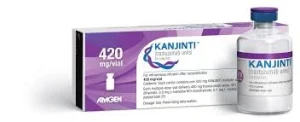
TM Owner Amgen
Kanjinti 420mg Vial
Global Shipping : Reliable Global Distribution Network
Express Delivery : Priority Shipping for Every Order
Secure Payments : Trusted Payment Protection System
 Disclaimer

Secure Handling
24/7 Worldwide Support

Global Access
Worldwide Access to Health

Cold-Chain Expert
Excellence in Cold-Chain

Trusted Supply
Certified Medical Supply
Indications & Clinical Uses
- Kanjinti 420 mg is trastuzumab-anns, a biosimilar of Herceptin supplied as a multiple-dose vial of powder that the pharmacy reconstitutes for intravenous infusion in hospital; note that the UK presentations are listed as discontinued on the electronic Medicines Compendium, although Kanjinti remains FDA-approved in the United States and holds a current EU marketing authorisation.
- Kanjinti treats HER2-overexpressing breast cancer, both as adjuvant therapy after surgery, alone or with chemotherapy, and for metastatic disease with paclitaxel or as a single agent after previous chemotherapy.
- It also treats HER2-overexpressing metastatic stomach or gastro-oesophageal junction adenocarcinoma with cisplatin and a fluoropyrimidine.
- HER2 status must be confirmed by a validated test before treatment.
- Kanjinti must never be substituted for or with ado-trastuzumab emtansine (Kadcyla) or fam-trastuzumab deruxtecan (Enhertu), which are different medicines with different doses and toxicities.
Side Effects
- Very common Kanjinti side effects are fever, chills, headache, nausea, diarrhoea, cough, rash, tiredness and infections; in gastric cancer regimens low white cells, anaemia and low platelets are also common.
- Kanjinti carries a BOXED WARNING covering cardiomyopathy, infusion reactions, embryo-fetal toxicity and pulmonary toxicity.
- Trastuzumab can weaken the heart's pumping action and cause heart failure, sometimes months after treatment, so report breathlessness, a night-time cough, swollen ankles, rapid weight gain, palpitations or dizziness at once.
- Serious infusion reactions including anaphylaxis, angioedema, bronchospasm and low blood pressure usually occur during or shortly after the first infusion; tell the nurse immediately about flushing, chills, wheeze, chest tightness or feeling faint.
- Pulmonary toxicity such as pneumonitis, pulmonary fibrosis and acute respiratory distress syndrome has been fatal.
- Exposure in pregnancy causes low amniotic fluid, underdeveloped lungs, skeletal abnormalities and newborn death.
Precautions & Warnings
- Heart function (left ventricular ejection fraction) must be measured before Kanjinti starts, at about every three months during treatment, and for at least two years after the final dose; treatment is withheld for a fall of 16 percentage points or more, or for an ejection fraction below the normal range together with a fall of 10 points or more.
- Kanjinti is given as an intravenous infusion only and must never be given as an intravenous push or bolus.
- Pregnancy status is checked before treatment, effective contraception is needed during treatment and for seven months after the last dose, and breastfeeding is not advised in that period.
- Tell the team about existing heart disease, high blood pressure, lung disease or previous anthracycline chemotherapy.
- The reconstituted multiple-dose 420 mg vial contains benzyl alcohol and is not used in patients hypersensitive to it.
- Unopened vials are refrigerated at 2°C to 8°C and must not be frozen.
Avoid Interactions
- The risk of heart damage rises sharply when trastuzumab is given with or soon after anthracyclines such as doxorubicin or epirubicin, or with cyclophosphamide, so these are usually separated in time and the heart is monitored for at least seven months after Kanjinti ends.
- Taxanes such as paclitaxel and docetaxel raise trastuzumab blood levels somewhat, and chemotherapy combinations increase the risk of low white cells and infection.
- Kanjinti must never be substituted for, or used interchangeably with, ado-trastuzumab emtansine or fam-trastuzumab deruxtecan.
- In the pharmacy, Kanjinti must not be mixed with or diluted in dextrose (glucose 5%) solution, which causes protein aggregation; 0.9% sodium chloride is used instead.
- Live vaccines are generally avoided during and shortly after chemotherapy-containing regimens, so check before any immunisation.
- Tell your oncology team about every medicine, herbal product and supplement you take.
References
Frequently Asked Questions
Kanjinti (trastuzumab-anns) is a biosimilar of Herceptin used to treat HER2-positive breast cancer, both after surgery and when it has spread, and HER2-positive metastatic stomach cancer. HER2 status must be confirmed by a laboratory test first. A specialist gives it as an intravenous infusion.
Kanjinti is given by intravenous infusion either weekly or every three weeks, depending on the regimen. The first dose takes about 90 minutes; later infusions can take 30 minutes if tolerated. Adjuvant breast cancer treatment usually lasts 52 weeks. It is never given as a rapid injection.
Common Kanjinti side effects are fever, chills, headache, nausea, diarrhoea, cough, rash and tiredness. Its boxed warning covers heart muscle damage, infusion reactions, lung toxicity and harm to an unborn baby. Report breathlessness, swollen ankles, a night-time cough, palpitations or wheeze during an infusion straight away.
Avoid pregnancy during Kanjinti (trastuzumab-anns) treatment and for seven months after the last dose, because it can cause fatal harm to a baby. Anthracyclines such as doxorubicin add to the risk of heart damage. Kanjinti must not be diluted in dextrose, and live vaccines need checking first.
Your heart's pumping strength (left ventricular ejection fraction) is measured by echocardiogram or MUGA scan before Kanjinti starts, roughly every three months during treatment, and for at least two years afterwards. Treatment is paused if the ejection fraction drops significantly.
No. Kanjinti (trastuzumab-anns) must never be substituted for or with ado-trastuzumab emtansine (Kadcyla) or fam-trastuzumab deruxtecan (Enhertu). These are different HER2 medicines with different doses and toxicities, and swapping them has caused serious harm. Kanjinti is a biosimilar of Herceptin only.

Trusted & Reliable – Your Partner in Global Distribution.
We provide comprehensive lines of pharmaceutical products to support all your healthcare distribution needs.


