

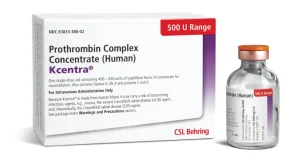
TM Owner CSL Behring
Kcentra 500 IU Injection
Global Shipping : Reliable Global Distribution Network
Express Delivery : Priority Shipping for Every Order
Secure Payments : Trusted Payment Protection System
 Disclaimer

Secure Handling
24/7 Worldwide Support

Global Access
Worldwide Access to Health

Cold-Chain Expert
Excellence in Cold-Chain

Trusted Supply
Certified Medical Supply
Indications & Clinical Uses
- Kcentra 500 units is a four-factor prothrombin complex concentrate made from human plasma, supplying clotting Factors II, VII, IX and X with the natural anticoagulants Proteins C and S.
- It is a hospital-only product, given by a clinician as an intravenous infusion, for the urgent reversal of acquired clotting factor deficiency caused by vitamin K antagonist (warfarin) treatment in adults who have acute major bleeding or who need an urgent surgical or invasive procedure.
- Vitamin K is given at the same time so that the reversal is maintained.
- The dose is expressed in units of Factor IX and is never measured by volume or by number of vials: it is calculated from the pre-treatment INR and body weight, 25 units/kg for an INR of 2 to under 4, 35 units/kg for an INR of 4 to 6 and 50 units/kg for an INR above 6, with maximum doses of 2,500, 3,500 and 5,000 units.
- Weight above 100 kg does not increase the dose, and repeat dosing is not recommended.
Side Effects
- In the Kcentra studies the reactions reported in about 3 or more of every 100 people treated were headache and low blood pressure (each about 7%), nausea and vomiting (about 6%), anaemia (about 6%), fast heartbeat (about 5%) and atrial fibrillation (about 4%).
- Kcentra carries a BOXED WARNING: both fatal and non-fatal arterial and venous thromboembolic complications have been reported in clinical trials and after marketing, including stroke, pulmonary embolism and deep vein thrombosis.
- Tell the treating team immediately about sudden weakness or numbness, trouble speaking or seeing, chest pain, breathlessness, wheezing, or pain and swelling in an arm or leg.
- Allergic reactions, including severe anaphylactic reactions, can occur, and the infusion is stopped at once if they do.
- Because Kcentra is made from human plasma, a very small risk of transmitting infectious agents cannot be excluded.
Precautions & Warnings
- Kcentra must not be given to anyone who has had a severe allergic or anaphylactic reaction to it or its ingredients, to anyone with disseminated intravascular coagulation, or to anyone with known heparin-induced thrombocytopenia, because the product contains heparin.
- In people who have had a blood clot, heart attack or stroke in the previous three months the benefit must be weighed carefully against the risk of a further clot, and everyone is watched for signs of thrombosis during and after treatment.
- Vitamin K must be given alongside Kcentra, otherwise the reversal is only temporary.
- The infusion runs at about 0.12 mL/kg per minute, to a maximum of 8.4 mL/min, and the reconstituted solution is used within 4 hours.
- Anticoagulant treatment is restarted only when the healthcare team judges it safe.
- Tell the team if you are pregnant or breastfeeding.
Avoid Interactions
- Kcentra has not been studied formally for interactions with other medicines, so the treating team needs a full list of everything you take, including supplements.
- The thrombotic risk described in the boxed warning may be added to by other prothrombotic treatments, so antifibrinolytic medicines such as tranexamic acid, activated prothrombin complex concentrates and recombinant Factor VIIa are combined with Kcentra only when the team judges it necessary.
- Because Kcentra contains heparin, it must not be used in anyone with known heparin-induced thrombocytopenia, and it may affect heparin-sensitive clotting tests.
- Its reversal effect is opposed by continuing warfarin, heparins or direct oral anticoagulants, and by antiplatelet medicines, which is why restarting them is a clinical decision.
- At pharmacy level, Kcentra must not be mixed with any other medicinal product and is infused through a separate line.
References
Frequently Asked Questions
Kcentra (four-factor prothrombin complex concentrate) urgently reverses warfarin and other vitamin K antagonists in adults with major bleeding or who need urgent surgery. It replaces clotting Factors II, VII, IX and X. Vitamin K is always given at the same time to keep the reversal going.
Kcentra is given by a clinician as an intravenous infusion in hospital, at about 0.12 mL/kg per minute. The dose is counted in units of Factor IX, not in millilitres or vials, and is worked out from your INR and weight: 25, 35 or 50 units/kg, capped at 5,000 units.
The commonest side effects of Kcentra are headache, low blood pressure, nausea and vomiting, anaemia, fast heartbeat and atrial fibrillation. Get urgent help for sudden weakness, numbness, slurred speech, chest pain, breathlessness, or a painful swollen leg, as these can signal a clot.
Kcentra must be avoided if you have disseminated intravascular coagulation or known heparin-induced thrombocytopenia, because this prothrombin complex concentrate contains heparin. Tell the team about tranexamic acid, other clotting factor products and all anticoagulants. Kcentra is never mixed with other medicines in the same line.
During a Kcentra infusion the team checks your blood pressure, heart rate and INR, and watches for allergic reactions and clotting signs. The reconstituted prothrombin complex concentrate must be used within 4 hours. Repeat dosing is not recommended, and warfarin is restarted only when your team decides.
Kcentra has a boxed warning for fatal and non-fatal arterial and venous blood clots, including stroke, pulmonary embolism and deep vein thrombosis. Tell staff at once about chest pain, breathlessness, sudden weakness or leg swelling. Clot risk is highest if you had a clot in the last three months.

Trusted & Reliable – Your Partner in Global Distribution.
We provide comprehensive lines of pharmaceutical products to support all your healthcare distribution needs.


