

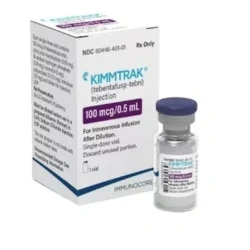
TM Owner Immunocore
Kimmtrak 100mcg/0.5ml Concentrate for solution for IV infusion
Global Shipping : Reliable Global Distribution Network
Express Delivery : Priority Shipping for Every Order
Secure Payments : Trusted Payment Protection System
 Disclaimer

Secure Handling
24/7 Worldwide Support

Global Access
Worldwide Access to Health

Cold-Chain Expert
Excellence in Cold-Chain

Trusted Supply
Certified Medical Supply
Indications & Clinical Uses
- Kimmtrak is a single-dose vial containing 100 micrograms of tebentafusp-tebn in 0.5 mL, a bispecific protein that binds a gp100 peptide displayed by melanoma cells and at the same time recruits the patient's own T cells to attack them.
- It is approved for adults with unresectable or metastatic uveal melanoma, the form of melanoma that starts in the eye, and only for patients whose blood test shows they are HLA-A*02:01-positive; the genetic test must be done before treatment, because the medicine cannot work without that tissue type.
- Kimmtrak is diluted and given by a healthcare professional as an intravenous infusion over 15 to 20 minutes once a week, using a dedicated line and a low protein-binding 0.2 micron filter.
- The dose is stepped up to reduce reactions: 20 micrograms on day 1, 30 micrograms on day 8, then 68 micrograms weekly from day 15 onwards.
Side Effects
- Kimmtrak carries a BOXED WARNING: cytokine release syndrome, which may be serious or life-threatening, occurred in patients receiving Kimmtrak, and patients must be monitored for at least 16 hours after each of the first three infusions and then as clinically indicated.
- Cytokine release syndrome affected 89% of patients and was grade 2 or worse in 77%.
- Other very common effects are rash in 83%, fever in 76%, itching in 69%, tiredness in 64%, nausea in 49%, chills in 48%, abdominal pain in 45%, swelling in 45%, low blood pressure in 39%, dry skin in 31%, headache in 31% and vomiting in 30%.
- Skin reactions of some kind occurred in 91% and raised liver enzymes in 65%.
- Tell the team immediately about fever, chills, dizziness, light-headedness, breathlessness, a fast heartbeat or a spreading rash, as these can be the first signs of cytokine release syndrome.
Precautions & Warnings
- The first three Kimmtrak infusions must be given in a healthcare setting equipped to manage cytokine release syndrome, with at least 16 hours of monitoring after each; later doses may be given in an outpatient unit with 30 minutes of monitoring only if no grade 2 or worse low blood pressure occurred with the previous three doses.
- Treatment is restricted to adults confirmed HLA-A*02:01-positive by a validated test.
- Cytokine release syndrome is managed with fluids, corticosteroids and supportive care, and severe cases may require stopping.
- Liver enzymes are monitored throughout, and skin reactions may require the dose to be withheld or stopped.
- Tebentafusp may harm an unborn baby, so effective contraception is needed during treatment and for one week after the final dose, and breastfeeding must be avoided during treatment and for one week afterwards.
- Store vials at 2°C to 8°C in the original carton, protected from light; do not freeze or shake.
Avoid Interactions
- No formal interaction studies are described, but the label gives an important pharmacological warning.
- Things that increase risk of toxicity: the rise in inflammatory cytokines that Kimmtrak causes can temporarily suppress CYP450 liver enzymes, which means blood levels of medicines cleared by those enzymes may rise, particularly narrow-margin drugs such as warfarin, ciclosporin and some antiepileptics, so these should be monitored closely around the first doses when cytokine release is most likely.
- Combining Kimmtrak with other medicines that lower blood pressure can worsen the hypotension seen in 39% of patients.
- Things that reduce benefit: routine use of corticosteroids or paracetamol before a dose is not a substitute for the required monitoring.
- At pharmacy level, Kimmtrak is given through a dedicated intravenous line and must not be mixed with other medicines.
- Tell your team about all medicines and supplements.
References
Frequently Asked Questions
Kimmtrak (tebentafusp) treats adults with unresectable or metastatic uveal melanoma, a melanoma that starts inside the eye. It works only in people who are HLA-A*02:01-positive, so a blood test for that tissue type must be done before treatment can start.
Kimmtrak (tebentafusp) is given as a drip into a vein over 15 to 20 minutes once a week. The dose is stepped up: 20 micrograms on day 1, 30 micrograms on day 8, then 68 micrograms weekly from day 15. A healthcare professional gives every dose.
Kimmtrak (tebentafusp) has a boxed warning for cytokine release syndrome, which can be serious or life-threatening and affected 89% of patients. The first three infusions must be given where this can be managed, with at least 16 hours of monitoring after each one.
Cytokine release syndrome affects 89% of people on Kimmtrak (tebentafusp), with rash in 83%, fever in 76%, itching in 69% and tiredness in 64%. Low blood pressure occurs in 39% and raised liver enzymes in 65%. Report fever, chills, dizziness or breathlessness at once.
Tell your team about warfarin, ciclosporin and antiepileptics before Kimmtrak (tebentafusp), because cytokine release can raise their blood levels. Other blood pressure-lowering medicines can worsen hypotension. Avoid pregnancy: use contraception during treatment and for one week after the last dose.
Only adults with unresectable or metastatic uveal melanoma who test HLA-A*02:01-positive can receive Kimmtrak (tebentafusp). Without that tissue type the medicine cannot engage the tumour, so the blood test comes first. Breastfeeding is not advised during treatment or for one week after the final dose.

Trusted & Reliable – Your Partner in Global Distribution.
We provide comprehensive lines of pharmaceutical products to support all your healthcare distribution needs.


