

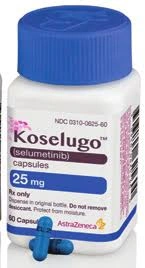
TM Owner AstraZeneca
Koselugo 25mg Capsule
Global Shipping : Reliable Global Distribution Network
Express Delivery : Priority Shipping for Every Order
Secure Payments : Trusted Payment Protection System
 Disclaimer

Secure Handling
24/7 Worldwide Support

Global Access
Worldwide Access to Health

Cold-Chain Expert
Excellence in Cold-Chain

Trusted Supply
Certified Medical Supply
Indications & Clinical Uses
- Koselugo 25 mg capsules contain selumetinib, an oral MEK1/2 inhibitor used to treat neurofibromatosis type 1 (NF1) in patients who have symptomatic plexiform neurofibromas that cannot be removed by surgery.
- In the United States it is approved from 1 year of age in both adults and children; in the European Union the capsules are approved from 3 years of age, with an openable granule formulation for children aged 1 to under 7 years and for anyone who cannot swallow capsules.
- The dose is 25 mg per square metre of body surface area twice daily, about 12 hours apart, and it is recalculated as a child grows.
- Capsules are swallowed whole with water and the current label allows them to be taken with or without food.
- Treatment is supervised by a specialist.
Side Effects
- Koselugo (selumetinib) has no boxed warning.
- Very common side effects in children, each affecting more than 4 in 10 patients, are vomiting (62%), acne-like rash (60%), diarrhoea (56%), raised blood creatine phosphokinase (54%), nausea (52%), infection of the nail fold (50%), dry skin (44%) and fever (44%), with mouth soreness and weakness also frequent; in adults rash, acne-like dermatitis and diarrhoea are commonest.
- Serious reactions that must be recognised include weakening of the heart muscle with breathlessness or ankle swelling, eye problems such as blurred vision, dark spots or loss of vision caused by retinal vein occlusion or retinal detachment, severe diarrhoea or colitis, and muscle breakdown with very high creatine phosphokinase, dark urine and severe muscle pain.
- The capsules contain vitamin E, which can increase bleeding, so report new bruising.
Precautions & Warnings
- Heart function is assessed with an echocardiogram before Koselugo is started and regularly during treatment, and eye examinations are done before treatment and whenever vision changes.
- Report blurred vision, dark spots or eye pain straight away.
- Koselugo is contraindicated in severe liver impairment and in anyone allergic to selumetinib, and the dose is reduced in moderate liver impairment.
- Creatine phosphokinase is monitored and severe diarrhoea is treated early to avoid dehydration.
- Each 25 mg capsule contains 36 mg of vitamin E as TPGS, so avoid vitamin E supplements and take care with anticoagulant or antiplatelet medicines, because the risk of bleeding rises.
- Selumetinib can harm an unborn baby: pregnancy should be excluded before treatment, effective contraception used during treatment and for the period your specialist advises afterwards, and breastfeeding avoided.
Avoid Interactions
- Avoid strong and moderate CYP3A4 inhibitors with Koselugo, including clarithromycin, itraconazole, ketoconazole, erythromycin and ritonavir, and avoid fluconazole and other strong CYP2C19 inhibitors, because they raise selumetinib levels and the risk of side effects; if one cannot be avoided, the Koselugo dose is reduced.
- Grapefruit, grapefruit juice and Seville oranges have a similar effect and should be avoided, and the granules must not be mixed with them.
- Strong and moderate CYP3A4 inducers such as rifampicin, phenytoin, carbamazepine and St John's wort lower selumetinib levels and can make treatment less effective.
- Do not take vitamin E supplements, because the capsules already contain vitamin E, and take care with warfarin, other anticoagulants and antiplatelet medicines, since bleeding risk increases and extra clotting checks may be needed.
References
Frequently Asked Questions
Koselugo (selumetinib) treats neurofibromatosis type 1 in people with symptomatic plexiform neurofibromas that cannot be removed by surgery. It is approved from age 1 in the United States and from age 3 for the capsules in the European Union, where granules cover younger children.
Koselugo capsules are taken twice a day, about 12 hours apart, at a dose of 25 mg per square metre of body surface area. Swallow them whole with water, with or without food. Do not open or chew the capsules, and the dose is recalculated as a child grows.
The commonest Koselugo (selumetinib) side effects in children are vomiting, acne-like rash, diarrhoea, raised creatine phosphokinase, nausea, nail-fold infection, dry skin and fever. Report blurred vision, dark spots, breathlessness, ankle swelling, severe muscle pain or dark urine urgently, as these can signal eye, heart or muscle damage.
Avoid grapefruit, grapefruit juice and Seville oranges with Koselugo, along with strong CYP3A4 inhibitors such as clarithromycin and itraconazole and the antifungal fluconazole. Avoid rifampicin, phenytoin and St John's wort, which make it less effective. Do not take vitamin E supplements: the capsules already contain vitamin E.
An echocardiogram checks the heart's pumping before Koselugo starts and regularly during treatment, and eye examinations are done at the start and whenever vision changes. Blood tests follow creatine phosphokinase and liver function, and height and weight are rechecked so the selumetinib dose stays correct.
No. Koselugo (selumetinib) has no boxed warning in its US label. Its most important risks are weakening of the heart muscle, eye problems including retinal vein occlusion, severe diarrhoea and muscle breakdown with raised creatine phosphokinase, all managed by scheduled monitoring and dose reduction.

Trusted & Reliable – Your Partner in Global Distribution.
We provide comprehensive lines of pharmaceutical products to support all your healthcare distribution needs.


