

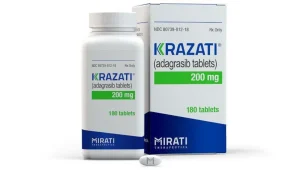
TM Owner Mirati Therapeutics
Krazati 200mg Tablet
Global Shipping : Reliable Global Distribution Network
Express Delivery : Priority Shipping for Every Order
Secure Payments : Trusted Payment Protection System
 Disclaimer

Secure Handling
24/7 Worldwide Support

Global Access
Worldwide Access to Health

Cold-Chain Expert
Excellence in Cold-Chain

Trusted Supply
Certified Medical Supply
Indications & Clinical Uses
- Krazati 200 mg film-coated tablets contain adagrasib, an oral targeted medicine that locks the mutated KRAS G12C protein in its inactive form.
- It is approved for adults whose tumour carries a KRAS G12C mutation, confirmed by an approved test, in two settings: as a single agent for locally advanced or metastatic non-small cell lung cancer after prior systemic therapy, and in combination with cetuximab for locally advanced or metastatic colorectal cancer after previous treatment with fluoropyrimidine, oxaliplatin and irinotecan chemotherapy.
- Both uses were granted accelerated approval, which means continued approval depends on confirmatory trials.
- The dose is 600 mg, that is three 200 mg tablets, taken by mouth twice daily, swallowed whole with or without food at about the same times each day, and continued until the disease progresses or side effects become unacceptable.
- Patients take Krazati themselves at home under oncology supervision.
Side Effects
- Side effects are frequent.
- In lung cancer, nausea affects about 70 percent of people, diarrhoea 69 percent, vomiting 57 percent, tiredness 55 percent, musculoskeletal pain 38 percent, liver injury 37 percent, reduced kidney function 33 percent, swelling 30 percent, loss of appetite 29 percent and breathlessness 26 percent; with cetuximab for bowel cancer, rash affects about 84 percent.
- The label carries no boxed warning.
- The serious reactions to recognise are severe diarrhoea, vomiting and dehydration, gastrointestinal bleeding, bowel obstruction or colitis, hepatotoxicity, QT-interval prolongation that can cause dangerous heart rhythms (6 percent had a QTc of 501 ms or more), and interstitial lung disease or pneumonitis, which was fatal in one patient.
- Report black or bloody stools, severe abdominal pain, yellowing of the skin or eyes, fainting, palpitations, or any new cough or breathlessness urgently.
Precautions & Warnings
- Liver blood tests should be checked before and during treatment, and an ECG and blood electrolytes, especially potassium and magnesium, should be monitored because adagrasib causes concentration-dependent QTc prolongation.
- Krazati should be avoided in people with a history of long QT syndrome or significant heart disease unless the specialist accepts the risk, and it must be interrupted or stopped for new or worsening breathlessness or cough until interstitial lung disease has been excluded.
- Swallow the tablets whole; if a dose is missed by more than four hours, skip it and take the next one at the usual time, and do not double up.
- If you vomit after a dose, do not take a replacement.
- Adagrasib can harm an unborn baby and may reduce fertility in both sexes; do not breastfeed during treatment or for one week after the last dose.
Avoid Interactions
- Avoid strong CYP3A4 inhibitors until Krazati has reached steady state, because they raise adagrasib levels and toxicity, and avoid strong CYP3A4 inducers at any time, since they lower adagrasib levels and can make treatment fail.
- Adagrasib itself inhibits CYP3A4, so avoid sensitive CYP3A4, CYP2C9 and CYP2D6 substrates and P-glycoprotein substrates, or have their doses and levels adjusted.
- Avoid other medicines that prolong the QT interval, including some antiarrhythmics, antipsychotics, antidepressants and antibiotics, because the effects add together.
- Tell your oncology team about every prescription medicine, over-the-counter product, vitamin and herbal supplement, especially St John's wort, and ask before starting any new antibiotic or antifungal.
- Correct low potassium and magnesium before and during treatment, since these worsen QT prolongation, and report persistent vomiting or diarrhoea that could deplete them.
References
Frequently Asked Questions
Krazati (adagrasib) treats adults whose cancer carries a KRAS G12C mutation. It is used alone for advanced or metastatic non-small cell lung cancer after earlier treatment, and with cetuximab for advanced bowel cancer after fluoropyrimidine, oxaliplatin and irinotecan. A test must confirm the mutation first.
Take 600 mg of Krazati, which is three 200 mg tablets, twice a day by mouth. Swallow the tablets whole, with or without food, at about the same times each day. Treatment continues until the cancer progresses or side effects become unacceptable. Keep the desiccant in the bottle.
The commonest side effects of Krazati (adagrasib) are nausea, diarrhoea, vomiting, tiredness, muscle and bone pain, and abnormal liver tests, each affecting over a third of people. Report black or bloody stools, severe stomach pain, yellow skin or eyes, fainting, palpitations, or new cough or breathlessness urgently.
Avoid strong CYP3A4 inducers such as St John's wort, which make Krazati less effective, and strong CYP3A4 inhibitors early in treatment, which increase toxicity. Avoid other medicines that prolong the QT interval. Do not breastfeed during treatment or for one week after the last dose, and avoid pregnancy.
If a Krazati dose is more than four hours late, skip it and take the next dose at the usual time. Never take two doses together to catch up. If you vomit after taking adagrasib, do not take a replacement dose; wait until the next scheduled one.
Krazati (adagrasib) needs liver blood tests before and during treatment, plus ECGs and checks of potassium and magnesium, because it prolongs the QT interval in a dose-related way. Low potassium or magnesium must be corrected. Treatment is paused for new breathlessness or cough until lung inflammation is ruled out.

Trusted & Reliable – Your Partner in Global Distribution.
We provide comprehensive lines of pharmaceutical products to support all your healthcare distribution needs.


