

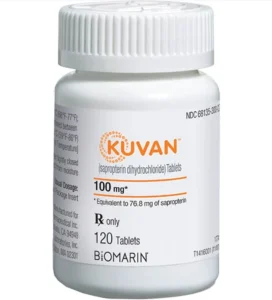
TM Owner BioMarin
Kuvan 100mg Tablet
Global Shipping : Reliable Global Distribution Network
Express Delivery : Priority Shipping for Every Order
Secure Payments : Trusted Payment Protection System
 Disclaimer

Secure Handling
24/7 Worldwide Support

Global Access
Worldwide Access to Health

Cold-Chain Expert
Excellence in Cold-Chain

Trusted Supply
Certified Medical Supply
Indications & Clinical Uses
- Kuvan 100 mg tablets contain sapropterin dihydrochloride, a synthetic form of tetrahydrobiopterin (BH4), the natural cofactor of the enzyme phenylalanine hydroxylase.
- Kuvan is approved to reduce blood phenylalanine (Phe) levels in adult and paediatric patients aged one month and older who have hyperphenylalaninaemia due to BH4-RESPONSIVE phenylketonuria (PKU), and it must be used together with a phenylalanine-restricted diet - it does not replace dietary management.
- Only a proportion of people with PKU respond to BH4, so responsiveness is formally tested: blood Phe is measured after about one week and periodically for up to a month, and Kuvan is discontinued if there is no response after one month at 20 mg/kg daily.
- It is manufactured by BioMarin and is also supplied as 100 mg and 500 mg powder for oral solution; the tablets and the powders are different presentations of the same medicine.
Side Effects
- In placebo-controlled studies the reactions reported in at least 4% of patients were headache (15%), runny nose (11%), throat pain (10%), diarrhoea (8%), vomiting (8%), cough and nasal congestion.
- Kuvan carries NO boxed warning - noted so the absence is not mistaken for an omission.
- The reactions that matter most are hypersensitivity including anaphylaxis, with wheezing, breathlessness, coughing, low blood pressure, flushing, nausea and rash, in which case Kuvan must be stopped; and hypophenylalaninaemia, meaning blood phenylalanine falling too low, which occurred in about a quarter of young children under 7 years receiving 20 mg/kg daily.
- Gastritis and oesophagitis have been reported, so tell your healthcare provider about persistent upper abdominal pain, heartburn or indigestion.
- Seek urgent help for any sudden rash, swelling of the face or throat, wheeze or faintness after a dose.
Precautions & Warnings
- Blood phenylalanine must be monitored regularly throughout treatment, because levels that are too high risk neurological damage while levels that fall too low risk protein catabolism; children under 7 years given 20 mg/kg daily are the group most likely to become hypophenylalaninaemic.
- Continue the prescribed phenylalanine-restricted diet unchanged unless your metabolic team advises otherwise.
- Kuvan is discontinued if there is no meaningful fall in blood Phe after one month at 20 mg/kg daily.
- Use caution in anyone taking levodopa, because seizures and over-stimulation have been reported, and monitor neurological status.
- Monitor blood pressure if a PDE-5 inhibitor is also taken.
- Take Kuvan with a meal, preferably at the same time each day, to improve absorption.
- Store the 100 mg tablets at 20 C to 25 C, with excursions permitted between 15 C and 30 C, in the tightly closed container and protected from moisture.
Avoid Interactions
- Medicines that can INCREASE risk alongside Kuvan include levodopa, where seizures, excitability and irritability have been reported and neurological status should be watched, and the PDE-5 inhibitors sildenafil, tadalafil and vardenafil, which relax blood vessels as sapropterin does, so blood pressure should be monitored.
- Medicines that can REDUCE the body's own BH4 and so complicate control include folate-pathway inhibitors such as methotrexate, valproic acid, phenobarbital and trimethoprim; if these are necessary, blood phenylalanine should be checked more frequently.
- Digoxin showed no clinically meaningful interaction at therapeutic doses.
- Tablets may be swallowed whole, or dissolved in 120 to 240 mL of water or apple juice and drunk within 15 minutes, or crushed into a small amount of soft food.
- Tell your metabolic team about every prescription medicine, over-the-counter product and supplement you take.
References
Frequently Asked Questions
Kuvan (sapropterin) lowers blood phenylalanine in adults and children aged one month and older who have BH4-responsive phenylketonuria, or PKU. It is a synthetic form of the cofactor tetrahydrobiopterin. It is always used alongside a phenylalanine-restricted diet, never instead of one.
Take Kuvan (sapropterin) once daily with a meal, preferably at the same time each day. Tablets can be swallowed whole, dissolved in 120 to 240 mL of water or apple juice and drunk within 15 minutes, or crushed into soft food. Starting doses are 10 to 20 mg/kg.
The most common Kuvan (sapropterin) side effects are headache (15%), runny nose (11%), sore throat (10%), diarrhoea and vomiting (8% each), cough and blocked nose. Kuvan has no boxed warning. Stop it and get urgent help for rash, facial swelling, wheeze or faintness, which can mean anaphylaxis.
Do not relax your phenylalanine-restricted diet while taking Kuvan (sapropterin) unless your metabolic team says so. Take care with levodopa, which has caused seizures and over-stimulation, and with sildenafil, tadalafil or vardenafil, which can lower blood pressure. Methotrexate, valproate, phenobarbital and trimethoprim need closer Phe monitoring.
Blood phenylalanine is checked about a week after starting Kuvan (sapropterin) and periodically for up to a month, then regularly throughout treatment. Levels that are too high risk nerve damage, and levels that fall too low also cause harm, especially in children under 7 taking 20 mg/kg daily.
No. Kuvan (sapropterin) works only in BH4-responsive PKU, which is a minority of patients. Response is tested by measuring blood phenylalanine over the first month of treatment. If there is no meaningful fall after one month at 20 mg/kg daily, Kuvan is stopped.

Trusted & Reliable – Your Partner in Global Distribution.
We provide comprehensive lines of pharmaceutical products to support all your healthcare distribution needs.


