

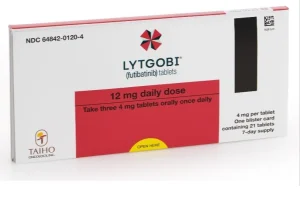
TM Owner Taiho Pharma
Lytgobi 4mg Tablet
Global Shipping : Reliable Global Distribution Network
Express Delivery : Priority Shipping for Every Order
Secure Payments : Trusted Payment Protection System
 Disclaimer

Secure Handling
24/7 Worldwide Support

Global Access
Worldwide Access to Health

Cold-Chain Expert
Excellence in Cold-Chain

Trusted Supply
Certified Medical Supply
Indications & Clinical Uses
- Lytgobi 4 mg tablets (futibatinib) is an oral, irreversible fibroblast growth factor receptor (FGFR1-4) kinase inhibitor.
- It is approved in the United States, under accelerated approval, for adults with previously treated, unresectable, locally advanced, or metastatic intrahepatic cholangiocarcinoma (a bile duct cancer) whose tumour carries an FGFR2 gene fusion or rearrangement, confirmed by an FDA-approved test.
- The total daily dose is 20 mg, taken once a day as a combination of tablets, including this 4 mg strength, with or without food.
- Continued approval for this use may depend on results of ongoing confirmatory trials, as is standard for an accelerated approval.
- Taiho's futibatinib programme originated in Japan and is approved in the US; EU/UK approval status could not be independently confirmed in this review, so availability outside the US and Japan should be checked locally.
- Lytgobi is a specialist cancer medicine prescribed and monitored by an oncologist.
Side Effects
- Very common side effects (occurring in 20% or more of patients) include nail toxicity (nail bed inflammation or loss), musculoskeletal pain, constipation, diarrhoea, fatigue, dry mouth, hair loss, mouth sores, abdominal pain, dry skin, joint pain, altered taste, dry eye, nausea, reduced appetite, urinary tract infection, hand-foot skin reactions, and vomiting.
- Two effects need closer monitoring: retinal pigment epithelial detachment, which is why an eye examination with optical coherence tomography is required before starting and periodically during treatment, and hyperphosphataemia (high blood phosphate), which affects most patients and may need dietary phosphate restriction, phosphate-lowering medicine, or a dose reduction.
- Lytgobi carries no boxed warning.
- Contact your cancer care team promptly for new or worsening vision changes, blurred vision, eye pain, or severe diarrhoea or vomiting you cannot control.
Precautions & Warnings
- Before starting Lytgobi, a baseline eye examination and blood phosphate level are required, with eye checks repeated every two months for the first six months and then every three months, and phosphate monitored throughout treatment.
- Lytgobi can cause fetal harm, so women who could become pregnant and men with partners who could become pregnant must use effective contraception during treatment and for at least one week after the last dose; breastfeeding should be avoided during treatment and for one week afterwards.
- No formal dose-adjustment guidance exists for severe hepatic or renal impairment, so these patients need closer monitoring.
- Lytgobi is taken orally at home once prescribed, but treatment is started and monitored by an oncology specialist, with regular blood tests and eye examinations scheduled as part of routine cancer-care visits.
Avoid Interactions
- Lytgobi is metabolised mainly by CYP3A4, so strong or moderate CYP3A4 inhibitors (such as ketoconazole, itraconazole, or clarithromycin) can raise futibatinib levels and increase side effects, while strong or moderate CYP3A4 inducers (such as rifampin, carbamazepine, phenytoin, or St John's Wort) can lower its levels and reduce effectiveness — both combinations should be avoided or managed with dose adjustment and closer monitoring.
- Because Lytgobi raises blood phosphate, combining it with phosphate-containing supplements or other medicines that affect phosphate or calcium balance needs extra monitoring.
- Grapefruit and grapefruit juice should be avoided, as they can also affect CYP3A4 metabolism.
- Tell your oncologist and pharmacist about every prescription medicine, over-the-counter product, vitamin, and herbal supplement you take, since new medicines started during treatment can change how Lytgobi works.
References
Frequently Asked Questions
Lytgobi (futibatinib) treats adults with previously treated intrahepatic cholangiocarcinoma, a bile duct cancer, whose tumour has an FGFR2 gene fusion or rearrangement. It is approved in the US under accelerated approval and blocks the FGFR pathway that drives tumour growth. A specific test confirms the FGFR2 change before starting.
Take Lytgobi (futibatinib) by mouth once a day, usually as a 20 mg total dose made up of tablets like this 4 mg strength. You can take it with or without food, at about the same time each day, and swallow the tablets whole.
Very common effects include nail problems, joint and muscle pain, diarrhoea, fatigue, mouth sores, dry skin, and taste changes. Lytgobi can also raise blood phosphate and cause retinal changes, so regular eye exams and phosphate blood tests are required. Report new vision changes or severe diarrhoea promptly.
Avoid grapefruit and grapefruit juice, and tell your oncologist about all other medicines, since strong CYP3A4 inhibitors or inducers (like ketoconazole or rifampin) change Lytgobi levels. Effective contraception is required during treatment and for one week after the last dose, for both women and men.
Lytgobi can cause retinal pigment detachment and high blood phosphate, so you need an eye exam with imaging before starting, every two months for six months, then every three months, plus regular phosphate blood tests throughout treatment. Your dose may be adjusted based on these results.
No. Lytgobi (futibatinib) can harm a developing baby, so effective contraception is required during treatment and for at least one week after the final dose, for both women and their partners. Breastfeeding should also be avoided during treatment and for one week afterwards.

Trusted & Reliable – Your Partner in Global Distribution.
We provide comprehensive lines of pharmaceutical products to support all your healthcare distribution needs.


