

TM Owner Pfizer
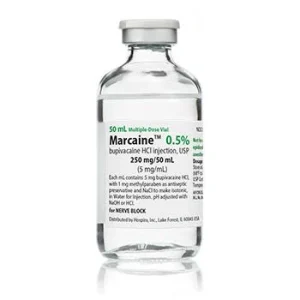
Marcaine 0.50% Injection
Global Shipping : Reliable Global Distribution Network
Express Delivery : Priority Shipping for Every Order
Secure Payments : Trusted Payment Protection System
 Disclaimer

Secure Handling
24/7 Worldwide Support

Global Access
Worldwide Access to Health

Cold-Chain Expert
Excellence in Cold-Chain

Trusted Supply
Certified Medical Supply
Indications & Clinical Uses
- Marcaine (bupivacaine hydrochloride) injection is an amide-type local anaesthetic, supplied as 0.25%, 0.5% and 0.75% solutions; the product sheet's 0.5% strength is the mid-range concentration.
- In the US label, it is approved for local infiltration, peripheral nerve block, caudal and epidural block, and retrobulbar block in adults, to produce local or regional anaesthesia or analgesia for surgery, dental and oral procedures, diagnostic and therapeutic procedures, and obstetric procedures.
- Marcaine is not approved for spinal (intrathecal) anaesthesia, for intravenous regional anaesthesia (Bier block), or for obstetric paracervical block.
- It is not indicated for use in children under 12 years, since safety and effectiveness have not been established in this age group.
- Marcaine is given only by, or under the supervision of, a clinician trained in regional anaesthesia, in a setting with resuscitation equipment available; patients do not self-administer this medicine.
Side Effects
- Marcaine carries a boxed warning: cardiac arrest with difficult or unsuccessful resuscitation, sometimes fatal, has occurred when the 0.75% concentration was used for epidural anaesthesia in obstetric patients, so that strength must never be used for obstetric epidural anaesthesia.
- Common reactions after correct administration include low blood pressure, nausea, and transient numbness or tingling at the injection site.
- More serious reactions, most often linked to unintentionally high blood levels or accidental injection into a blood vessel, include restlessness, anxiety, ringing in the ears, blurred vision, tremors and, in severe cases, seizures, plus cardiac effects such as irregular heartbeat, a sudden drop in blood pressure, or cardiac arrest.
- Allergic reactions are rare with amide anaesthetics like Marcaine, though sulfite sensitivity can occur with epinephrine-containing formulations.
- Seek immediate help for chest pain, palpitations, severe dizziness, breathing difficulty or seizure-like symptoms during or after the injection.
Precautions & Warnings
- Marcaine must never be given as an intravenous bolus; epidural and other regional techniques require careful aspiration before and during injection to avoid accidental intravascular injection, which can rapidly cause seizures or cardiac arrest.
- The 0.75% concentration is contraindicated for obstetric epidural anaesthesia because of the boxed cardiac arrest warning, and Marcaine must not be used for intravenous regional anaesthesia (Bier block) or obstetric paracervical block.
- It is contraindicated in patients with known hypersensitivity to amide-type local anaesthetics.
- Dose-related toxicity affecting the heart and central nervous system can occur, so the lowest effective dose and rate should be used, with resuscitation equipment and trained staff always available.
- Caution is needed in patients with heart block, impaired cardiovascular function, or liver disease, which can slow drug clearance.
- Chondrolysis has been reported after continuous intra-articular infusion, a use for which Marcaine is not approved.
- It should be stored at 20°C to 25°C, with excursions permitted between 15°C and 30°C, and solutions containing epinephrine must not be autoclaved.
Avoid Interactions
- Using Marcaine with other local anaesthetics, or with structurally related amide-type medicines, can have additive toxic effects on the heart and nervous system.
- Combining it with monoamine oxidase inhibitors (MAOIs) or tricyclic antidepressants, or with ergot-type medicines when the formulation contains epinephrine, can cause severe, prolonged high blood pressure.
- Non-selective beta-blockers taken with epinephrine-containing Marcaine can lead to unopposed high blood pressure and a slow heart rate.
- Potent inhalation general anaesthetics used together with epinephrine-containing Marcaine can increase the risk of serious heart rhythm disturbances.
- Antiarrhythmic drugs with local-anaesthetic-like activity may add to bupivacaine's cardiac effects and should be used cautiously together.
- Because Marcaine is given by a healthcare provider, the clinical team is responsible for checking the patient's full medicine list, including antidepressants, heart medicines and other anaesthetics, before the injection is given.
References
Frequently Asked Questions
Marcaine (bupivacaine hydrochloride) is a local anaesthetic used for surgery, dental work and other procedures. It's given by injection for local infiltration, nerve blocks, caudal or epidural anaesthesia, and in childbirth. It's not approved for use in children under 12.
A clinician injects Marcaine into or around the treatment site, using infiltration, a nerve block, or an epidural or caudal injection, depending on the procedure. You don't take it yourself. The dose and concentration (0.25%, 0.5% or 0.75%) depend on the procedure.
Marcaine carries a boxed warning: the 0.75% strength must never be used for epidural anaesthesia in childbirth, as it has caused fatal cardiac arrest. Other effects include low blood pressure, dizziness, tremor and, rarely, seizures or irregular heartbeat if it enters a blood vessel.
Marcaine shouldn't be combined with other local anaesthetics, MAOIs or tricyclic antidepressants, or non-selective beta-blockers, as these raise the risk of toxic heart and blood pressure effects. Your care team reviews your full medicine list before giving it.
A trained clinician injects Marcaine slowly, checking (aspirating) first to make sure the needle isn't in a blood vessel, since accidental intravascular injection can cause seizures or cardiac arrest. You'll be monitored throughout the procedure for heart rate and blood pressure.
Marcaine is used in obstetric anaesthesia, but the 0.75% concentration must never be used for epidural anaesthesia in labour because of a boxed warning for fatal cardiac arrest; lower concentrations are used instead under close monitoring.

Trusted & Reliable – Your Partner in Global Distribution.
We provide comprehensive lines of pharmaceutical products to support all your healthcare distribution needs.


