

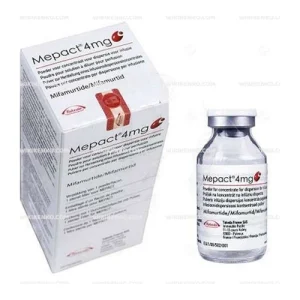
TM Owner Esteve Pharmaceuticals S.A. (current EU marketing authorisation holder)
Mifamurtide 4mg Powder for concentrate for suspension for infusion (IV infusion only - must not be given as a bolus injection)
Global Shipping : Reliable Global Distribution Network
Express Delivery : Priority Shipping for Every Order
Secure Payments : Trusted Payment Protection System
 Disclaimer

Secure Handling
24/7 Worldwide Support

Global Access
Worldwide Access to Health

Cold-Chain Expert
Excellence in Cold-Chain

Trusted Supply
Certified Medical Supply
Indications & Clinical Uses
- Mifamurtide (brand name Mepact) 4 mg is not approved by the FDA in the United States; it is authorised in the European Union, where it is used together with post-operative multi-agent chemotherapy for high-grade resectable non-metastatic osteosarcoma (a bone cancer) in patients aged 2 to 30 years, after complete surgical removal of the tumour.
- It is administered only in a hospital or specialist oncology setting and is never self-administered.
- Mifamurtide is a synthetic form of muramyl tripeptide that activates macrophages and monocytes as part of the immune response against cancer cells.
- It is given as an intravenous infusion, never as a bolus injection - the label is explicit that it must never be given as a bolus - twice weekly for 12 weeks, then once weekly for a further 24 weeks.
Side Effects
- There is no boxed warning for mifamurtide, but very common reactions (affecting more than 1 in 10 patients) include fever, chills, and fatigue occurring during or shortly after each infusion, along with nausea, vomiting, diarrhea, headache, dizziness, fast heartbeat, high or low blood pressure, loss of appetite, breathlessness, cough, muscle and joint pain, back pain, sweating, and anaemia.
- Common reactions include low white blood cell counts, low platelets, fever with neutropenia, rash, blurred vision, and hearing changes.
- Because it is given with chemotherapy, infections including sepsis can occur; report fever lasting more than 8 hours after an infusion promptly, as this needs urgent evaluation for infection.
- Seek immediate help for severe breathing difficulty, chest pain, or signs of a severe allergic reaction during an infusion.
Precautions & Warnings
- Mifamurtide must be given only as a 1-hour intravenous infusion after reconstitution and dilution by trained staff - it must never be given as a bolus injection.
- Patients with a history of asthma or chronic obstructive pulmonary disease should receive preventive bronchodilator treatment, as respiratory reactions can occur; severe reactions require stopping treatment.
- Close monitoring is advised in patients with unstable cardiovascular disease, a history of thrombosis or vasculitis, or autoimmune or chronic inflammatory conditions, as inflammatory flares such as arthritis have been reported.
- Mifamurtide is contraindicated with ciclosporin, other calcineurin inhibitors, or high-dose non-steroidal anti-inflammatory drugs (NSAIDs), because these block the immune-activating mechanism the drug depends on.
- It is not recommended during pregnancy, and effective contraception is required for women of childbearing potential during treatment.
- Store unopened vials refrigerated at 2°C to 8°C, protected from light; use the reconstituted, diluted solution within 6 hours at room temperature.
Avoid Interactions
- Mifamurtide must not be used together with ciclosporin or other calcineurin inhibitors, or with high-dose NSAIDs (cyclooxygenase inhibitors), because these suppress the macrophage-activating effect that mifamurtide depends on for its anticancer action - this combination is contraindicated, not just cautioned against.
- Chronic or routine use of corticosteroids should also be avoided during treatment for the same reason, as steroids can blunt the immune response mifamurtide relies on.
- When given alongside doxorubicin chemotherapy, the two should be administered at separate times as directed by the treating oncology team.
- Tell the treating team about all other medicines, including over-the-counter pain relievers, since occasional low-dose NSAID use for pain or fever should be discussed rather than assumed to be safe.
References
Frequently Asked Questions
Mifamurtide, brand name Mepact, treats high-grade osteosarcoma, a bone cancer, in patients aged 2 to 30 after surgery to remove the tumor. It is given with chemotherapy and is authorised in the European Union; it is not approved by the FDA in the United States.
Mifamurtide is given only as a 1-hour intravenous infusion in a hospital or cancer center, never as a bolus injection and never self-administered. The schedule is twice weekly for 12 weeks, then once weekly for a further 24 weeks, alongside chemotherapy.
Very common effects include fever, chills, fatigue, nausea, vomiting, headache, and fast heartbeat during or after infusions. Report fever lasting more than 8 hours after a dose right away, as this needs urgent checking for infection. There is no boxed warning for this medicine.
Avoid ciclosporin, other calcineurin inhibitors, and high-dose NSAIDs - these are contraindicated because they block the immune activity mifamurtide depends on. Routine corticosteroid use should also be avoided during treatment. Tell your oncology team about every medicine you take, including pain relievers.
Each mifamurtide dose is reconstituted, diluted, and given as an intravenous infusion over about 1 hour under hospital supervision. You'll be monitored for fever, chills, and blood pressure changes during and after the infusion, and for breathing problems if you have asthma or COPD.
Unopened mifamurtide vials are kept refrigerated at 2°C to 8°C, protected from light, and must never be frozen. After the powder is mixed and diluted for infusion, it must be used within 6 hours and kept at room temperature, not refrigerated.

Trusted & Reliable – Your Partner in Global Distribution.
We provide comprehensive lines of pharmaceutical products to support all your healthcare distribution needs.


