

TM Owner Teva Pharmaceuticals
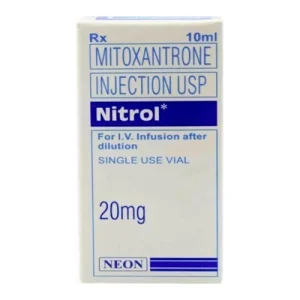
Mitoxantrone 20mg/10ml Vial
Global Shipping : Reliable Global Distribution Network
Express Delivery : Priority Shipping for Every Order
Secure Payments : Trusted Payment Protection System
 Disclaimer

Secure Handling
24/7 Worldwide Support

Global Access
Worldwide Access to Health

Cold-Chain Expert
Excellence in Cold-Chain

Trusted Supply
Certified Medical Supply
Indications & Clinical Uses
- Mitoxantrone 20 mg/10 mL (mitoxantrone hydrochloride, 2 mg/mL concentrate) is a topoisomerase-II-inhibiting anthracenedione-class chemotherapy drug, originally marketed as Novantrone.
- It has two distinct approved uses: in combination with other chemotherapy drugs as initial treatment of acute nonlymphocytic leukaemia (ANLL) in adults, and, on its own, to reduce neurologic disability and the frequency of clinical relapses in adults with secondary progressive, progressive-relapsing, or worsening relapsing-remitting multiple sclerosis (MS).
- It is not indicated for primary progressive MS.
- Mitoxantrone is also used, in combination with corticosteroids, for pain related to advanced hormone-refractory prostate cancer.
- Because of cumulative heart and bone marrow toxicity, lifetime dosing is capped, particularly in MS.
- It is given only by intravenous infusion at a hospital or specialist infusion unit, under the supervision of a physician experienced in the use of cytotoxic chemotherapy; it is never self-administered.
Side Effects
- Mitoxantrone carries a boxed warning covering several risks.
- It must be given by slow intravenous infusion into a freely flowing line by an experienced physician; it must never be given subcutaneously, intramuscularly, intra-arterially, or intrathecally, as intrathecal use has caused severe, permanent injury, and leakage from the vein (extravasation) can cause serious local tissue damage.
- Myelosuppression (low blood counts) requires frequent blood count monitoring, with dosing normally withheld if the neutrophil count is too low (except in ANLL treatment).
- Congestive heart failure, sometimes fatal, can occur during treatment or months to years afterward, and risk rises with cumulative dose - heart function is checked before every dose.
- Mitoxantrone also increases the risk of secondary acute myeloid leukaemia, in both cancer and MS patients.
- Other common effects in MS trials included nausea (about 76%), hair thinning, menstrual changes or amenorrhoea, and urinary tract infection.
- Report breathlessness, swelling, palpitations, unusual bleeding, fever, or infection promptly.
Precautions & Warnings
- Baseline and pre-dose cardiac assessment, including an ECG and measurement of left ventricular ejection fraction (LVEF), is required before every dose in MS patients, who should not receive mitoxantrone if their baseline LVEF is below the normal range; cumulative lifetime dose in MS is capped, commonly at 140 mg/m².
- Mitoxantrone is contraindicated in patients with known hypersensitivity to it.
- Liver impairment usually rules out its use in MS patients and requires caution and dose adjustment in cancer patients.
- Any active infection should be treated before or during therapy because of the added infection risk from low white cell counts.
- Mitoxantrone can cause fetal harm; women of childbearing potential require a pregnancy test before each dose when treated for MS and should use effective contraception, and breastfeeding should be stopped before treatment starts.
- Mitoxantrone turns urine a blue-green colour for 24 hours after a dose and can tinge the whites of the eyes blue, which is harmless but should be expected.
Avoid Interactions
- Tell the treating specialist about all other medicines being used, including over-the-counter products and supplements, before each mitoxantrone infusion.
- Mitoxantrone must not be mixed in the same infusion as heparin, since a precipitate can form; it should not be mixed with other drugs in the same syringe or line unless compatibility has been confirmed by the pharmacy.
- Combining mitoxantrone with other cardiotoxic drugs, including anthracyclines such as doxorubicin, can increase the cumulative risk of heart damage, so prior anthracycline exposure is taken into account when calculating lifetime dose limits.
- Using mitoxantrone with other bone-marrow-suppressing drugs or radiotherapy increases the risk of severe low blood counts and infection.
- Live vaccines should generally be avoided during treatment because the immune system is weakened.
- No other clinically significant drug interactions have been identified in post-marketing experience, but any new medicine should still be discussed with the treating team before it is started.
References
Frequently Asked Questions
Mitoxantrone treats certain worsening forms of multiple sclerosis, is combined with other drugs as initial therapy for acute nonlymphocytic leukaemia, and is used with corticosteroids for pain from advanced hormone-resistant prostate cancer. It is not approved for primary progressive MS or for use in children.
Mitoxantrone is given only as a slow intravenous infusion into a freely running drip line, by a specialist at a hospital or infusion unit. It must never be injected under the skin, into a muscle, an artery, or the spinal fluid, since that can cause severe, permanent injury.
Mitoxantrone's boxed warning covers potentially fatal heart failure, severe low blood counts, and an increased risk of secondary leukaemia; report breathlessness, swelling, palpitations, fever, or unusual bleeding urgently. Nausea, hair thinning, and menstrual changes or missed periods are also common.
Tell your care team about every other medicine you take, since mitoxantrone must never be mixed with heparin in the same infusion bag. Avoid live vaccines and other heart-toxic chemotherapy drugs, such as doxorubicin, unless your specialist has specifically planned that combination.
You will have an ECG and a heart-pumping-strength (ejection fraction) test before every infusion, especially if treated for MS, because cumulative doses can cause heart failure during treatment or years afterward. Regular blood counts are also checked before each dose to catch low counts early.
Mitoxantrone is not established as safe in children and can harm an unborn baby, so a pregnancy test is required before each MS dose and effective contraception is advised during treatment. Breastfeeding should stop before treatment begins and not resume without medical advice.

Trusted & Reliable – Your Partner in Global Distribution.
We provide comprehensive lines of pharmaceutical products to support all your healthcare distribution needs.


