

TM Owner Astellas Pharma
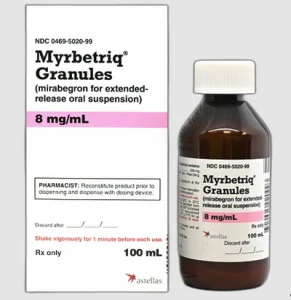
Myrbetriq Granules 24mg Granules
Global Shipping : Reliable Global Distribution Network
Express Delivery : Priority Shipping for Every Order
Secure Payments : Trusted Payment Protection System
 Disclaimer

Secure Handling
24/7 Worldwide Support

Global Access
Worldwide Access to Health

Cold-Chain Expert
Excellence in Cold-Chain

Trusted Supply
Certified Medical Supply
Indications & Clinical Uses
- Myrbetriq Granules 24 mg (mirabegron) is an oral-suspension granule formulation, distinct from the Myrbetriq 50 mg tablet, indicated specifically for neurogenic detrusor overactivity (NDO) in children aged 3 years and older, across all body weights; it is not approved for adult overactive bladder.
- NDO is bladder muscle overactivity caused by an underlying neurological condition such as spina bifida, and is often managed alongside intermittent catheterisation.
- Like the tablet, mirabegron granules work as a beta-3 adrenergic agonist that relaxes the bladder muscle to increase how much urine it can hold before contracting.
- The unit-dose packets are mixed with water to make a suspension the child drinks or receives via feeding tube, once daily, with or without food.
- Mirabegron was first developed and approved by Astellas Pharma in Japan.
Side Effects
- Myrbetriq Granules has no boxed warning.
- The most common side effects reported in children are similar to those seen with mirabegron tablets: raised blood pressure, headache, urinary tract infection, nasal or throat symptoms, constipation and diarrhoea.
- Angioedema of the face, lips, tongue or throat is a rare but serious reaction that can occur after any dose and needs immediate emergency treatment if it affects breathing or swallowing.
- Because mirabegron can raise blood pressure, children on this medicine should have it checked periodically.
- Watch for signs of difficulty passing urine, which may mean urinary retention, particularly in children who catheterise.
- Contact the child's healthcare provider promptly for a severe headache, palpitations, or new swelling of the face or throat.
Precautions & Warnings
- Myrbetriq Granules must not be given to a child known to be hypersensitive to mirabegron.
- It is not recommended in children with severe uncontrolled high blood pressure, and blood pressure should be measured before starting and periodically during treatment.
- Because many children with NDO use antimuscarinic bladder medicines or intermittent catheterisation, watch for urinary retention when mirabegron is combined with these measures.
- The dry granule packets should be kept in their pouch until they are mixed with water for use, and the reconstituted suspension should be stored at 20°C to 25°C and any unused portion discarded after 28 days.
- Use in children under 3 years, or in pregnancy and breastfeeding if relevant to an adolescent patient, should be discussed individually with the prescriber, as data are limited.
Avoid Interactions
- Mirabegron in Myrbetriq Granules moderately inhibits the CYP2D6 enzyme, which can raise blood levels of medicines broken down this way, such as desipramine or metoprolol, so doses of those drugs may need review.
- It also increases digoxin exposure, so the lowest effective digoxin dose should be used with monitoring if the two are combined.
- Strong CYP3A4 inhibitors may further increase mirabegron levels.
- Combining Myrbetriq Granules with heart-rhythm medicines such as flecainide or propafenone should be done cautiously because of a theoretical increased arrhythmia risk.
- Tell the child's prescriber about every other medicine, including any antimuscarinic bladder drug used together, before starting or changing Myrbetriq Granules treatment.
References
Frequently Asked Questions
Myrbetriq Granules (mirabegron) treats neurogenic detrusor overactivity in children aged 3 and older, whatever their weight. Unlike the Myrbetriq 50 mg tablet, it is not used for adult overactive bladder; it is the pediatric oral-suspension form of the same medicine.
Each unit-dose packet of Myrbetriq Granules is mixed with water to make a suspension, then given once daily by mouth or feeding tube, with or without food. Keep unopened packets in their protective pouch until you are ready to mix and give the dose.
Common effects in children include raised blood pressure, headache, urinary tract infection and constipation. Rarely, it causes angioedema, swelling of the face, lips or throat. Seek emergency care straight away if your child has breathing or swallowing difficulty.
Avoid use if your child has severe uncontrolled high blood pressure. Tell the prescriber about digoxin, metoprolol, desipramine or heart-rhythm drugs like flecainide, since mirabegron can raise their levels. Blood pressure should be checked regularly during treatment.
Store the dry, unmixed packets in their pouch at room temperature. Once mixed with water, keep the suspension at 20°C to 25°C and discard any unused portion after 28 days. Do not use suspension that has passed this 28-day limit, even if it looks fine.
No. Both contain mirabegron, but Myrbetriq Granules is made only for neurogenic detrusor overactivity in children of any weight, while the 50 mg tablet covers adult overactive bladder and NDO in children weighing 35 kg or more. They are not interchangeable without prescriber advice.

Trusted & Reliable – Your Partner in Global Distribution.
We provide comprehensive lines of pharmaceutical products to support all your healthcare distribution needs.


