

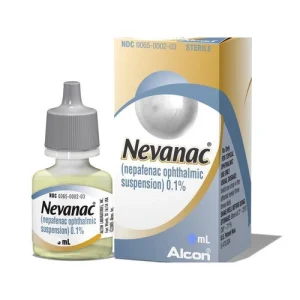
TM Owner Novartis Pharmaceuticals Corporation (EU MAH: Novartis Europharm Limited)
Nevanac 0.10% Eye Drop
Global Shipping : Reliable Global Distribution Network
Express Delivery : Priority Shipping for Every Order
Secure Payments : Trusted Payment Protection System
 Disclaimer

Secure Handling
24/7 Worldwide Support

Global Access
Worldwide Access to Health

Cold-Chain Expert
Excellence in Cold-Chain

Trusted Supply
Certified Medical Supply
Indications & Clinical Uses
- Nevanac 0.1% eye drops contain nepafenac, a topical non-steroidal anti-inflammatory prodrug that is converted in the eye to amfenac.
- It is approved for the treatment of pain and inflammation associated with cataract surgery, and, in the European Union, also for reducing the risk of macular oedema associated with cataract surgery in patients with diabetes.
- Treatment is usually started one day before surgery and continued through the first two postoperative weeks, applied as one drop into the affected eye three times daily.
- Nevanac is prescribed and its use overseen by an ophthalmologist or other eye-care specialist around the time of surgery; it is not a general-purpose eye drop for unrelated eye pain or infection.
- The current DailyMed listing and EU marketing authorisation are held by Novartis; ophthalmic products from this line are also associated with Alcon in some markets.
Side Effects
- Common reactions affecting between 5 and 10 percent of patients include capsular opacity, decreased visual acuity, a foreign-body or sticky sensation in the eye, and increased pressure inside the eye.
- Less common reactions, in 1 to 5 percent, include conjunctival oedema, corneal oedema, dry eye and eye pain.
- Nepafenac can slow or delay corneal healing, and, rarely, cause serious corneal problems including thinning, erosion or perforation, particularly with prolonged use, in patients with diabetes or dry eye, after repeated eye surgery, or when used together with topical corticosteroids.
- Because it can interfere with platelet function, it may increase bleeding time with ocular surgery.
- Contact the eye-care specialist promptly for worsening eye pain, changes in vision, redness that does not settle, or if the eye surface looks damaged; stop the drops and seek urgent review if these occur.
Precautions & Warnings
- Nevanac must not be used by anyone with a known hypersensitivity to nepafenac or to other non-steroidal anti-inflammatory drugs (NSAIDs), including people in whom aspirin, other NSAIDs or nepafenac have previously triggered asthma, hives or severe rhinitis.
- Contact lenses should be removed before each dose and not reinserted until the eye-care specialist advises, since the drops are not meant to be used over lenses.
- Use nepafenac eye drops for the shortest period the surgeon recommends, since prolonged use raises the risk of corneal complications, and use with added caution alongside topical corticosteroids.
- Tell the specialist about diabetes, dry eye disease, rheumatoid arthritis, or previous eye surgery, as these increase the risk of delayed corneal healing.
- There is limited experience in pregnancy and breastfeeding, so Nevanac should be used only if the eye-care specialist judges it necessary.
- Store the bottle as directed and discard it four weeks after opening.
Avoid Interactions
- Tell the eye-care specialist about every other eye drop and medicine being used, including any other topical NSAID or corticosteroid, since using these together with Nevanac increases the risk of delayed corneal healing and bleeding at the ocular surface.
- At the concentrations reached in the eye, nepafenac does not meaningfully inhibit the liver enzymes that metabolise most oral medicines, so significant systemic drug interactions are not expected.
- Nevanac can generally be used together with other classes of eye drops, such as beta-blockers, carbonic anhydrase inhibitors, alpha-agonists, cycloplegics and mydriatics, provided each drop is given at least five minutes apart from the others so one does not wash out the previous one.
- People taking oral blood thinners or antiplatelet medicines should mention this before eye surgery, since NSAID eye drops can add to bleeding risk at the operative site.
References
Frequently Asked Questions
Nevanac (nepafenac) 0.1% eye drops treat pain and inflammation after cataract surgery. In the EU it is also used to lower the risk of macular oedema after cataract surgery in people with diabetes. Treatment usually starts the day before surgery and continues for about two weeks afterward.
Put one drop of Nevanac into the operated eye three times a day, starting the day before cataract surgery and continuing through the first two postoperative weeks, or as your eye specialist directs. Remove contact lenses before each dose and wait for advice before reinserting them.
Common effects include eye discomfort, a sticky or foreign-body feeling, blurred vision and slightly raised eye pressure. Rarely, nepafenac slows corneal healing or causes serious corneal damage, especially with prolonged use. Tell your specialist promptly about worsening pain, vision changes or a surface that looks damaged.
Don't use Nevanac if you're allergic to aspirin or other NSAIDs, or if these have triggered asthma or hives before. Avoid wearing contact lenses while using the drops, and use Nevanac with extra caution together with steroid eye drops, since combining them raises the risk of delayed corneal healing.
Space Nevanac at least five minutes apart from any other eye drop, such as a beta-blocker, glaucoma drop or dilating drop, so each one has time to be absorbed rather than washed away. Follow the specific order your eye-care specialist gives you after surgery.
There is limited experience using Nevanac in pregnancy or while breastfeeding, so it should only be used if your eye-care specialist decides it is necessary, usually for the short course needed around cataract surgery. Tell your specialist if you are or might be pregnant before starting treatment.

Trusted & Reliable – Your Partner in Global Distribution.
We provide comprehensive lines of pharmaceutical products to support all your healthcare distribution needs.


