

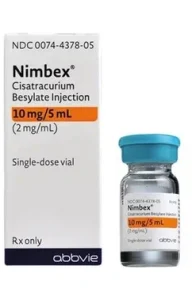
TM Owner AbbVie
Nimbex 2mg/mL Injection
Global Shipping : Reliable Global Distribution Network
Express Delivery : Priority Shipping for Every Order
Secure Payments : Trusted Payment Protection System
 Disclaimer

Secure Handling
24/7 Worldwide Support

Global Access
Worldwide Access to Health

Cold-Chain Expert
Excellence in Cold-Chain

Trusted Supply
Certified Medical Supply
Indications & Clinical Uses
- Nimbex 2 mg/mL injection contains cisatracurium besylate, a non-depolarising neuromuscular blocking agent that produces temporary skeletal muscle relaxation and paralysis.
- It is used in adults and children as an adjunct to general anaesthesia, to make it easier to insert a breathing tube (tracheal intubation) and to provide muscle relaxation during surgery, and to facilitate mechanical ventilation in intensive care.
- Nimbex is given only in hospital, by intravenous injection or infusion, by an anaesthetist, intensivist or other clinician experienced in the use of neuromuscular blocking drugs, with equipment for airway management, artificial ventilation and resuscitation immediately available.
- It does not provide sedation, pain relief or loss of consciousness on its own, so it is always used together with adequate anaesthesia or sedation.
Side Effects
- Because Nimbex causes temporary paralysis of the muscles, including the muscles of breathing, patients receiving it must have their breathing fully supported by a clinician until the drug's effect wears off or is reversed.
- Reported reactions include low or high blood pressure, slow or fast heart rate, and skin flushing or rash, which can reflect histamine release, particularly at higher doses given quickly.
- Bronchospasm has been reported rarely.
- Muscle weakness can persist for a period after the last dose, especially with prolonged infusions in intensive care, and prolonged neuromuscular blockade has been described in critically ill patients.
- Because Nimbex is given only in a monitored hospital setting under direct clinical supervision, any adverse reaction is recognised and managed immediately by the treating team.
Precautions & Warnings
- Nimbex must be given only by, or under the direct supervision of, clinicians experienced in the use of neuromuscular blocking agents, with facilities for tracheal intubation, artificial ventilation, oxygen delivery and cardiopulmonary resuscitation immediately available; it must never be given outside this controlled setting.
- Nimbex has no effect on consciousness or pain and must always be accompanied by adequate anaesthesia or sedation.
- Use with caution in myasthenia gravis and other neuromuscular disorders, where sensitivity to neuromuscular blockers is altered, and in patients with severe electrolyte disturbances, burns, or neuromuscular disease, which can change the dose needed.
- The vial's cap and ferrule should be kept intact and the product stored in a way that avoids selection errors between different neuromuscular blocking agents, since mix-ups can be fatal.
- There is no boxed warning on the current US label.
Avoid Interactions
- Several classes of drugs increase or prolong the neuromuscular blockade produced by Nimbex, including volatile inhalational anaesthetics, aminoglycoside and certain other antibiotics, magnesium salts, quinidine, procainamide, calcium-channel blockers and lithium; doses and monitoring are adjusted accordingly by the anaesthesia team.
- Prior or concurrent use of other non-depolarising neuromuscular blockers can alter the onset and depth of block.
- Chronic use of anticonvulsants such as phenytoin or carbamazepine may reduce the effect of cisatracurium.
- Nimbex must not be mixed or diluted with alkaline solutions such as sodium thiopental in the same syringe or line, as this causes precipitation.
- As with all hospital-administered medicines, the treating team reviews every other drug you are taking, including regular prescription medicines, before and during anaesthesia.
References
Frequently Asked Questions
Nimbex (cisatracurium besylate) is a muscle relaxant used during general anaesthesia to ease insertion of a breathing tube and keep muscles relaxed during surgery, and to help mechanical ventilation in intensive care. It is given only in hospital by an anaesthetist or intensive-care clinician.
Nimbex is given by intravenous injection or continuous infusion, dosed by your body weight, only by a clinician trained in neuromuscular blocking drugs with airway and resuscitation equipment on hand. You will always receive anaesthesia or sedation alongside it, since Nimbex itself does not sedate you.
Nimbex can cause changes in blood pressure or heart rate, and flushing or rash from histamine release, especially with rapid higher doses. Because it paralyses breathing muscles, your breathing is fully supported by machine until the effect wears off. Muscle weakness can persist briefly afterward, especially after prolonged ICU infusions.
Nimbex must never be given outside a monitored setting with resuscitation equipment available, and must always be combined with adequate anaesthesia. It should not be mixed with alkaline drugs like thiopental in the same line, and your care team checks other medicines, such as certain antibiotics, that intensify its effect.
In intensive care, Nimbex is often given as a continuous infusion to keep a ventilated patient's muscles relaxed. The team continuously monitors the depth of muscle block, heart rate and blood pressure, and adjusts or stops the infusion as your breathing and condition allow.
Yes, Nimbex is approved for tracheal intubation in children aged 1 month and older and for surgical muscle relaxation in children aged 2 to 12 years, with the dose carefully adjusted for age and body weight by the treating anaesthetist throughout the procedure.

Trusted & Reliable – Your Partner in Global Distribution.
We provide comprehensive lines of pharmaceutical products to support all your healthcare distribution needs.


