

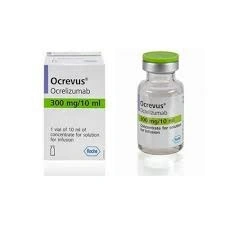
TM Owner Roche
Ocrevus 300mg Injection
Global Shipping : Reliable Global Distribution Network
Express Delivery : Priority Shipping for Every Order
Secure Payments : Trusted Payment Protection System
 Disclaimer

Secure Handling
24/7 Worldwide Support

Global Access
Worldwide Access to Health

Cold-Chain Expert
Excellence in Cold-Chain

Trusted Supply
Certified Medical Supply
Indications & Clinical Uses
- Ocrevus 300 mg concentrate for solution for infusion contains ocrelizumab, a monoclonal antibody that targets CD20-positive B cells, from the disease-modifying multiple sclerosis (MS) therapy class.
- It is approved for adults with relapsing forms of MS, including clinically isolated syndrome, relapsing-remitting disease and active secondary progressive disease, and for primary progressive MS; the European label specifies primary progressive MS with imaging features of inflammatory activity, while the US label does not add that qualifier.
- In the US, Ocrevus is also approved for relapsing-remitting MS in children aged 10 years and older weighing at least 25 kg; this paediatric use is not currently part of the EU label.
- Ocrevus is a hospital- or infusion-centre-administered medicine only: it is never self-injected and is given as an intravenous infusion under medical supervision, with pre-medication to reduce infusion reactions.
Side Effects
- The most common side effects of Ocrevus are upper respiratory tract infections and infusion reactions, which can affect more than 1 in 10 people and typically occur during or within 24 hours of an infusion as fever, chills, rash, throat irritation, flushing or nausea.
- Other common effects include skin infections, lower respiratory tract infections, depression, back pain and pain in the arms or legs.
- Serious reactions to watch for include signs of serious infection (fever, persistent cough, unusual tiredness), symptoms suggesting progressive multifocal leukoencephalopathy such as new weakness, vision changes, confusion or personality change, and symptoms of liver injury such as yellowing skin or dark urine.
- There is no boxed warning on the current US label for Ocrevus.
- Because it is only given by infusion in a monitored clinical setting, report any reaction during or shortly after your infusion to the treating team immediately.
Precautions & Warnings
- Ocrevus is contraindicated in people with active hepatitis B infection and in anyone who has had a life-threatening infusion reaction to it.
- Before each infusion, patients are screened for infections and hepatitis B, and pre-medicated with a corticosteroid and an antihistamine to reduce infusion reactions; live or live-attenuated vaccines should be completed at least 4 weeks before starting treatment and must not be given during treatment.
- Ocrevus increases the risk of serious infections and has been associated with progressive multifocal leukoencephalopathy (PML), a rare but serious brain infection, immune-mediated colitis, reduced immunoglobulin levels, and an increased risk of malignancy, particularly breast cancer; regular monitoring is required.
- Ocrevus must only be given by intravenous infusion, never as an injection or bolus, in a setting with resuscitation equipment available.
- It is not recommended during pregnancy or breastfeeding, and effective contraception is advised during and for 6 months after the last infusion.
Avoid Interactions
- Ocrevus should not be combined with other medicines that suppress the immune system, including other disease-modifying MS therapies, chronic corticosteroids or immunosuppressants, as this increases the risk of serious infection; when switching from another immunosuppressive MS therapy, its likely duration of effect and additive immune impact are considered before starting Ocrevus.
- Live or live-attenuated vaccines are contraindicated during treatment and should be given at least 4 weeks beforehand; Ocrevus may reduce the effectiveness of non-live (inactivated) vaccines, so vaccination status should be brought up to date at least 6 weeks before starting where possible.
- Because Ocrevus is administered only by healthcare professionals as an infusion, it is not mixed with other medications in the same infusion line.
- Tell the treating team about all medicines, including over-the-counter products and supplements, before each infusion.
References
Frequently Asked Questions
Ocrevus (ocrelizumab) treats relapsing forms of multiple sclerosis and primary progressive MS in adults. In the US it is also approved for relapsing-remitting MS in children aged 10 and older weighing at least 25 kg; this paediatric use is not part of the EU label.
Ocrevus is given as an intravenous infusion in a hospital or infusion centre, never self-injected. After two starter infusions two weeks apart, maintenance infusions are given once every 6 months, each taking about 2 to 3.5 hours with pre-medication beforehand.
The most common side effects of Ocrevus are infusion reactions and upper respiratory infections, affecting more than 1 in 10 people. Report fever, persistent cough, new weakness, vision changes or confusion promptly, as these can signal serious infection or, rarely, a brain infection called PML.
Avoid live or live-attenuated vaccines while on Ocrevus and for months afterward; complete any needed live vaccines at least 4 weeks before your first infusion. Avoid combining Ocrevus with other immunosuppressant or MS therapies unless your neurologist directs it, as this raises infection risk.
Before each Ocrevus infusion you are screened for infection and given a corticosteroid and antihistamine to lower the chance of an infusion reaction. The infusion itself runs over 2 to 3.5 hours, and you are monitored for at least an hour afterward.
The current US Ocrevus label does not carry a boxed warning, but it does list serious risks under Warnings and Precautions, including infection, progressive multifocal leukoencephalopathy (PML), reduced immunoglobulins, and an increased risk of malignancy, particularly breast cancer, which require regular monitoring.

Trusted & Reliable – Your Partner in Global Distribution.
We provide comprehensive lines of pharmaceutical products to support all your healthcare distribution needs.


