

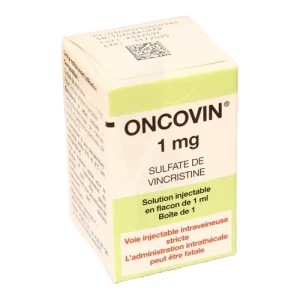
TM Owner Eli Lilly
Oncovin 1mg/ml Vial
Global Shipping : Reliable Global Distribution Network
Express Delivery : Priority Shipping for Every Order
Secure Payments : Trusted Payment Protection System
 Disclaimer

Secure Handling
24/7 Worldwide Support

Global Access
Worldwide Access to Health

Cold-Chain Expert
Excellence in Cold-Chain

Trusted Supply
Certified Medical Supply
Indications & Clinical Uses
- Oncovin (vincristine sulfate) 1 mg/mL, the original Eli Lilly brand of this vinca-alkaloid chemotherapy, has been discontinued in the United States (listed as "discontinued" in the FDA Orange Book, confirmed not withdrawn for safety or effectiveness) and its licence was formally withdrawn in Ireland in 2000; generic vincristine sulfate injection, carrying the same warnings, is now used in its place.
- It is a cytotoxic chemotherapy that blocks cancer cell division and is given only by a hospital-based oncology healthcare provider, as part of combination regimens, for acute lymphoblastic leukaemia, Hodgkin lymphoma, non-Hodgkin lymphoma, rhabdomyosarcoma, neuroblastoma and Wilms tumour, in children and adults.
- It is not a stand-alone treatment, and dosing is individualised to body surface area and liver function.
- This content is based on the current vincristine sulfate injection label, since no Oncovin-branded prescribing information remains active.
Side Effects
- The most common effects of Oncovin (vincristine) are hair loss, affecting most patients, and dose-related nerve damage causing tingling, numbness, weakness, jaw pain and loss of reflexes in the hands and feet; these usually improve gradually after treatment ends but can take weeks or months.
- Constipation is very common and can progress to severe bowel slowing or obstruction, so a bowel regimen is usually started before treatment.
- Low blood sodium, mild nausea and temporary hair thinning also occur.
- Seek urgent medical attention for severe abdominal pain or inability to pass stool, breathing difficulty, hoarseness or voice change, seizures, fever or signs of infection, or pain, redness or swelling where the drip is running, which can mean the drug has leaked outside the vein.
- Vincristine is for intravenous use only: if it is ever given into the spinal fluid (intrathecal route) the result is almost always fatal, so every dose is specially labelled and checked before administration.
Precautions & Warnings
- Oncovin (vincristine) carries a boxed warning: it is for intravenous use only, and giving it intrathecally (into the spinal fluid) is almost always fatal — a well-recognised, preventable medication error.
- Every syringe and infusion bag is clearly labelled "FOR INTRAVENOUS USE ONLY — FATAL IF GIVEN BY OTHER ROUTES", and vincristine is diluted into an infusion bag rather than a syringe, so it cannot be mistaken for a drug intended for spinal injection.
- It should be avoided, or used only with extreme caution, in people with Charcot-Marie-Tooth disease or other pre-existing nerve disorders, and the dose is reduced in people with liver impairment or raised bilirubin.
- It can harm an unborn baby, so effective contraception is needed during and after treatment, and it should not be used while breastfeeding.
- It suppresses the immune system, so live vaccines should be avoided, and blood counts and neurological function are monitored throughout.
- It is given only in a hospital or clinic equipped to manage chemotherapy administration and extravasation.
Avoid Interactions
- Tell your healthcare provider about all medicines and supplements before starting Oncovin (vincristine).
- Strong CYP3A4 or P-glycoprotein inhibitors — including itraconazole, ketoconazole, clarithromycin, ritonavir and grapefruit juice — raise vincristine levels and increase the risk of severe nerve damage, so doses may be adjusted or these medicines avoided.
- Giving L-asparaginase before vincristine can reduce vincristine's clearance and add to its toxicity, so the two are given in a specific order and timing.
- Phenytoin levels can fall during treatment and are monitored.
- Other neurotoxic medicines may add to vincristine's nerve-damage risk.
- Live vaccines, such as MMR, yellow fever or oral polio, should be avoided during and after treatment because the immune system is suppressed.
- Vincristine must never be mixed or given with anything intended for spinal (intrathecal) use, and pharmacy staff dispense it only in a specially labelled infusion bag, never a syringe, to prevent fatal misadministration.
References
Frequently Asked Questions
Oncovin (vincristine sulfate) is a chemotherapy medicine used with other drugs to treat cancers such as acute leukaemia, Hodgkin and non-Hodgkin lymphoma, neuroblastoma, rhabdomyosarcoma and Wilms tumour. The Oncovin brand itself is discontinued; you'll usually receive generic vincristine sulfate, with the same effect and warnings, given at a hospital or cancer centre.
Oncovin (vincristine) is given only as a slow injection into a vein, usually once a week, by a trained oncology healthcare provider. It must never be given by any other route: if it enters the spinal fluid (intrathecal injection) it is almost always fatal, so every dose is specially labelled and checked before use.
The most common effects of Oncovin (vincristine) are hair loss, constipation, and nerve-related symptoms like tingling, numbness or weakness in the hands and feet. Get urgent help for severe constipation, breathing trouble, voice changes, seizures, fever, or pain and swelling where the drip is running, which can mean the drug is leaking outside the vein.
Avoid grapefruit juice and strong CYP3A4 inhibitors such as itraconazole, ketoconazole and clarithromycin, which raise Oncovin (vincristine) levels and nerve-damage risk. Avoid live vaccines, since your immune system is weakened. Tell your care team about every medicine you take, as L-asparaginase and phenytoin both interact with vincristine.
Before each dose of Oncovin (vincristine), your healthcare provider checks blood counts, liver function and looks for nerve symptoms such as tingling or reflex changes, since doses are lowered for liver impairment. The infusion site is watched closely, because leakage outside the vein can damage tissue and needs immediate treatment.
Oncovin (vincristine) must only be injected into a vein. Giving it into the spinal fluid (intrathecal route) is a well-known, almost always fatal medication error, so every vial and syringe is labelled "for intravenous use only" and pharmacies dispense it in an infusion bag, never a syringe that could be confused with a spinal injection.

Trusted & Reliable – Your Partner in Global Distribution.
We provide comprehensive lines of pharmaceutical products to support all your healthcare distribution needs.


