

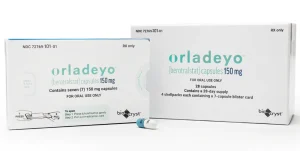
TM Owner BioCryst
Orladeyo 150mg Tablet
Global Shipping : Reliable Global Distribution Network
Express Delivery : Priority Shipping for Every Order
Secure Payments : Trusted Payment Protection System
 Disclaimer

Secure Handling
24/7 Worldwide Support

Global Access
Worldwide Access to Health

Cold-Chain Expert
Excellence in Cold-Chain

Trusted Supply
Certified Medical Supply
Indications & Clinical Uses
- Orladeyo 150 mg capsules contain berotralstat (as the hydrochloride salt, not "dihydrochloride" as sometimes written), an oral plasma kallikrein inhibitor used for routine prevention of attacks of hereditary angioedema (HAE) in adults and children.
- In the United States, Orladeyo capsules are approved from age 2 (with an oral pellet formulation available for younger or lower-weight patients); the European label currently covers adults and adolescents aged 12 and over, so the approved age range differs between the two markets.
- Orladeyo is a preventive, daily treatment and is not approved to treat an acute HAE attack that has already started - a separate rescue medicine is still needed for breakthrough attacks.
- It is manufactured by BioCryst Pharmaceuticals and taken once daily with food.
Side Effects
- There is no boxed warning for Orladeyo.
- The most common side effects, each affecting roughly 1 in 10 patients or more, are gastrointestinal: abdominal pain, vomiting, diarrhoea, and gastroesophageal reflux (heartburn); these tend to occur early in treatment, become less frequent over time, and often resolve without stopping the medicine.
- Back pain has also been reported.
- Orladeyo can prolong the heart's QT interval at doses higher than the recommended 150 mg daily, so it should never be taken above the prescribed dose.
- A case of markedly elevated liver enzymes has been reported after a single dose.
- Seek medical advice for severe or persistent stomach pain, vomiting or diarrhoea, or for palpitations or fainting, and never take an extra dose to try to prevent or treat an acute attack.
Precautions & Warnings
- Orladeyo has no formal contraindications, but the dose must not exceed 150 mg once daily because of QT-prolongation risk at higher exposures; do not take extra capsules to try to stop an acute attack, and always keep a separate on-demand HAE treatment available for breakthrough episodes.
- The dose should be reduced to 110 mg once daily in patients with moderate to severe liver impairment, and Orladeyo is not recommended in patients with end-stage kidney disease (creatinine clearance below 15 mL/min) because it has not been studied in this group.
- Dose reduction to 110 mg is also needed when Orladeyo is taken with P-glycoprotein or BCRP inhibitors.
- There is limited human data on use in pregnancy and breastfeeding, so it should be used only if the expected benefit outweighs any potential risk.
Avoid Interactions
- Orladeyo is contraindicated with lonafarnib, and should be avoided with P-glycoprotein inducers such as rifampin and St John's Wort, which can substantially reduce berotralstat levels and its ability to prevent HAE attacks.
- P-glycoprotein or BCRP inhibitors raise berotralstat levels and require a reduced Orladeyo dose of 110 mg once daily.
- Orladeyo itself inhibits CYP2D6 and P-glycoprotein, so it can raise blood levels of other drugs cleared by these pathways; your healthcare provider may need to monitor for side effects or adjust the dose of those medicines.
- Tell your healthcare provider and pharmacist about every prescription medicine, over-the-counter product, herbal remedy and supplement you take, and take Orladeyo with food each day at a consistent time to keep levels steady.
References
Frequently Asked Questions
Orladeyo (berotralstat) is a daily oral medicine that prevents attacks of hereditary angioedema (HAE) in patients aged 2 and over. It is not for treating an attack that has already started - you still need a separate rescue medicine for that.
Take one 150 mg Orladeyo capsule (or the age-appropriate pellet dose) once daily with food, at about the same time each day. Never take more than the prescribed dose, even during an active HAE attack.
Abdominal pain, vomiting, diarrhoea and heartburn are the most common effects, usually easing after the first weeks. Orladeyo can prolong the heart's QT interval at higher-than-recommended doses, so stay at the prescribed 150 mg dose.
Avoid lonafarnib, which is contraindicated, and P-glycoprotein inducers like rifampin or St John's Wort, which reduce Orladeyo's effect. Tell your healthcare provider about all other medicines, since some need dose adjustment alongside Orladeyo.
Take the missed dose as soon as you remember that day, then resume your normal once-daily schedule; do not double up. Missing doses can leave you less protected against HAE attacks.
Orladeyo can prolong the heart's QT interval if taken above the recommended 150 mg daily dose, so never exceed this amount, including during an attack. Report irregular heartbeat, palpitations or fainting to your healthcare provider.

Trusted & Reliable – Your Partner in Global Distribution.
We provide comprehensive lines of pharmaceutical products to support all your healthcare distribution needs.


