

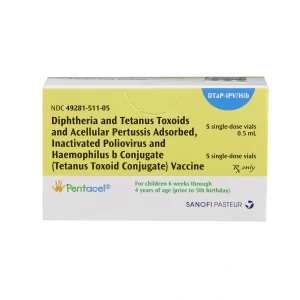
TM Owner Sanofi Pasteur
Pentacel 0.5mL Injection
Global Shipping : Reliable Global Distribution Network
Express Delivery : Priority Shipping for Every Order
Secure Payments : Trusted Payment Protection System
 Disclaimer

Secure Handling
24/7 Worldwide Support

Global Access
Worldwide Access to Health

Cold-Chain Expert
Excellence in Cold-Chain

Trusted Supply
Certified Medical Supply
Indications & Clinical Uses
- Pentacel, made by Sanofi Pasteur, is a combination vaccine that protects young children in one injection against five diseases: diphtheria, tetanus, pertussis (whooping cough), poliomyelitis (polio), and invasive disease caused by Haemophilus influenzae type b (Hib), such as meningitis and epiglottitis.
- It is approved in the US for children from 6 weeks through 4 years of age (before the 5th birthday), given as a 4-dose primary series, usually at 2, 4, 6 and 15-18 months, following national immunisation schedules.
- Pentacel is given only by a healthcare provider as an intramuscular injection; it is not a treatment for active infection and does not replace catch-up Hib or DTaP vaccination for children who have missed doses or are older than the approved age range.
Side Effects
- The most common reactions after Pentacel are fussiness or irritability and inconsolable crying, each reported in over half of infants, along with fever, loss of appetite and drowsiness.
- Injection-site tenderness and swelling of the arm or leg occur in around a third of doses; fever of 38.0°C or higher is reported in roughly 6-16% of doses, depending on which dose in the series.
- Rare but serious reactions include prolonged crying lasting 3 hours or more, high fever above 40.5°C, a brief collapse or unresponsive episode, and, very rarely, seizures.
- There is no boxed warning on this label.
- Seek urgent medical care for difficulty breathing, widespread rash, swelling of the face or throat, or any of the severe reactions above.
Precautions & Warnings
- Do not give Pentacel to a child who has had a severe allergic reaction to a previous dose or to any vaccine component, or who developed encephalopathy (brain dysfunction) within 7 days of a previous pertussis-containing vaccine with no other identifiable cause.
- Vaccination should be delayed in children with an evolving, unstable neurological condition, including uncontrolled epilepsy, until the condition is stabilised.
- Extra caution and a discussion with the provider are needed if a previous dose caused a fever of 40.5°C or higher, collapse or shock-like state, persistent crying lasting 3 hours or more, or a seizure within 3 days.
- Premature infants should be monitored for breathing pauses (apnea) for 48-72 hours after vaccination if born very early.
- Pentacel is given by intramuscular injection only, never intravenously.
- A moderate or severe acute illness, with or without fever, is usually a reason to postpone vaccination until recovery.
Avoid Interactions
- Pentacel can generally be given at the same visit as other routine childhood vaccines, such as pneumococcal, rotavirus, hepatitis B, or measles-mumps-rubella vaccines, but each vaccine must be given at a separate injection site and never mixed in the same syringe with Pentacel.
- Vaccines and medicines that suppress the immune system, including corticosteroids, chemotherapy, or radiation therapy, can reduce the immune response to Pentacel, so tell the vaccinating provider about any such treatment the child is receiving.
- If a child has recently received antibody-containing blood products or immune globulin, this may also reduce the vaccine's effectiveness.
- There is no dietary restriction before or after vaccination.
- Tell the healthcare provider about all medicines, supplements and other vaccines the child has recently received or is scheduled to receive, so timing can be planned correctly.
References
Frequently Asked Questions
Pentacel is a combination vaccine from Sanofi Pasteur that protects young children against diphtheria, tetanus, whooping cough (pertussis), polio, and Haemophilus influenzae type b (Hib) disease. It is approved for children aged 6 weeks through 4 years, given as part of routine immunisation.
Pentacel is usually given as 4 injections in the arm or leg, typically at 2, 4, 6 and 15-18 months of age. Your child's healthcare provider will follow the recommended national immunisation schedule and confirm exact timing at each visit.
Most infants become fussy or cry after Pentacel, and many get soreness or swelling where the shot was given, plus fever or reduced appetite. Rare reactions include a very high fever, prolonged crying over 3 hours, or a brief collapse - seek care if these occur.
Do not give Pentacel if your child had a severe allergic reaction to a previous dose, or encephalopathy after a past pertussis vaccine. Tell the provider about any immune-suppressing treatment your child receives, as this can lower the vaccine's protection.
Yes, but very premature infants are usually monitored for breathing pauses (apnea) for 48-72 hours after each Pentacel dose while still in hospital. Discuss your baby's individual risk and vaccination timing with the treating healthcare provider well beforehand.
Yes, Pentacel is often given at the same visit as other routine childhood vaccines like pneumococcal or rotavirus vaccine. Each vaccine is injected at a separate site and is never mixed in the same syringe as Pentacel itself.

Trusted & Reliable – Your Partner in Global Distribution.
We provide comprehensive lines of pharmaceutical products to support all your healthcare distribution needs.


