

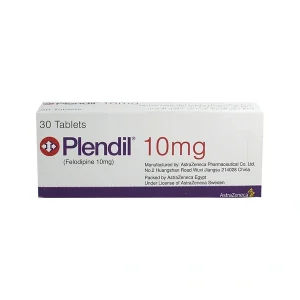
TM Owner AstraZeneca
Plendil 10mg Tablet
Global Shipping : Reliable Global Distribution Network
Express Delivery : Priority Shipping for Every Order
Secure Payments : Trusted Payment Protection System
 Disclaimer

Secure Handling
24/7 Worldwide Support

Global Access
Worldwide Access to Health

Cold-Chain Expert
Excellence in Cold-Chain

Trusted Supply
Certified Medical Supply
Indications & Clinical Uses
- Plendil 10 mg is an extended-release (prolonged-release) tablet containing felodipine, a dihydropyridine blood pressure medicine.
- The US felodipine extended-release label lists treatment of hypertension (high blood pressure) to lower blood pressure and reduce cardiovascular event risk.
- The harmonised EU Plendil labelling, held by AstraZeneca, approves it for hypertension and stable angina pectoris (activity- or stress-induced), whereas the Canadian Plendil monograph lists mild to moderate essential hypertension.
- Vasospastic angina was removed as an EU indication.
- Plendil is taken once daily; the Canadian monograph gives a maintenance range of 2.5 mg to 10 mg daily with a maximum of 10 mg.
- Information here is based on the US generic felodipine label, the Canadian Plendil monograph and the EU Plendil referral outcome.
Side Effects
- The most common side effects of felodipine are ankle or leg swelling (peripheral oedema, roughly 2% to 17% depending on dose and age), headache (about 11% to 15%) and flushing or a feeling of warmth (about 4% to 8%).
- Palpitations, dizziness and nausea also occur.
- The label says felodipine can cause a significant drop in blood pressure and, rarely, fainting; less than 0.5% of patients had serious events such as heart attack, fainting, angioedema (swelling of the face, lips or throat) or irregular heartbeat.
- Swelling is dose-related and more likely at higher doses.
- Plendil has no boxed warning on the US felodipine label.
- Seek urgent medical help for chest pain, fainting, a fast or irregular heartbeat or swelling of the face or throat, and report persistent ankle swelling to your healthcare provider.
Precautions & Warnings
- Do not take Plendil if you are allergic to felodipine or other dihydropyridines.
- In the EU and Canada it is contraindicated in pregnancy (animal studies showed fetal digital anomalies), and the EU list also includes decompensated heart failure, acute myocardial infarction and unstable angina; the Canadian monograph also contraindicates use during lactation.
- The US label classes it as pregnancy Category C and says it is not known whether it passes into breast milk.
- Use caution with poor heart pumping function, because felodipine can cause low blood pressure, fainting or reduced blood flow to the heart, and it does not protect against problems if a beta-blocker is stopped suddenly.
- In liver impairment clearance falls to about 60% of normal, so treatment starts at 2.5 mg daily and is closely monitored.
- Tell your healthcare provider about all your conditions before starting.
Avoid Interactions
- Grapefruit juice roughly doubles felodipine blood levels and should be avoided.
- Medicines that block CYP3A4 raise levels: itraconazole increased exposure about 8-fold and erythromycin about 2.5-fold, and the Canadian Plendil monograph contraindicates strong CYP3A4 inhibitors such as ketoconazole, clarithromycin and ritonavir, with a warning about acute kidney injury when combined with clarithromycin in people over 65.
- Anticonvulsants such as phenytoin, carbamazepine and phenobarbital sharply reduce felodipine levels (by about 94% in the monograph), so another blood pressure medicine may be needed.
- Tacrolimus blood levels may rise, so they should be monitored and the dose adjusted.
- Always tell your healthcare provider and pharmacist about every prescription medicine, non-prescription product and supplement you use.
References
Frequently Asked Questions
Plendil (felodipine) is a tablet that lowers high blood pressure. In the EU it is also approved for stable angina triggered by activity or stress. It is taken once daily. The Canadian monograph lists mild to moderate essential hypertension only.
Plendil (felodipine) is an extended-release tablet taken once daily. The Canadian monograph starts at 5 mg daily, with a usual range of 2.5 mg to 10 mg and a maximum of 10 mg daily. In liver problems the starting dose is 2.5 mg. Your healthcare provider sets your dose.
The most common Plendil (felodipine) side effects are ankle or leg swelling, headache and flushing. Palpitations, dizziness and nausea also occur. Swelling is dose-related and more likely at higher doses. Get urgent help for chest pain, fainting, an irregular heartbeat or swelling of the face or throat.
Avoid grapefruit juice with Plendil (felodipine), because it roughly doubles blood levels. Itraconazole, ketoconazole, clarithromycin and ritonavir also raise levels, and phenytoin, carbamazepine and phenobarbital sharply lower them. Tell your provider if you take tacrolimus, as its levels may rise.
Plendil (felodipine) can be used in liver impairment only with care. Liver disease slows clearance to about 60% of normal, so treatment starts at 2.5 mg daily and is monitored closely. The Canadian monograph sets a maximum of 10 mg daily. Tell your provider about any liver condition.
No. Plendil (felodipine) is contraindicated in pregnancy in the EU and Canada, because animal studies showed fetal digital anomalies. The Canadian monograph also contraindicates breastfeeding. The US label calls it pregnancy Category C. Tell your healthcare provider straight away if you are or may be pregnant.

Trusted & Reliable – Your Partner in Global Distribution.
We provide comprehensive lines of pharmaceutical products to support all your healthcare distribution needs.


