

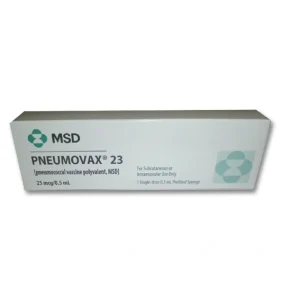
TM Owner Merck Sharp & Dohme LLC
Pneumovax 23 25mcg each/0.5mL Injection
Global Shipping : Reliable Global Distribution Network
Express Delivery : Priority Shipping for Every Order
Secure Payments : Trusted Payment Protection System
 Disclaimer

Secure Handling
24/7 Worldwide Support

Global Access
Worldwide Access to Health

Cold-Chain Expert
Excellence in Cold-Chain

Trusted Supply
Certified Medical Supply
Indications & Clinical Uses
- Pneumovax 23 (pneumococcal vaccine polyvalent) 25 mcg each/0.5 mL is a polysaccharide vaccine containing 25 micrograms of each of 23 Streptococcus pneumoniae serotypes (1, 2, 3, 4, 5, 6B, 7F, 8, 9N, 9V, 10A, 11A, 12F, 14, 15B, 17F, 18C, 19F, 19A, 20, 22F, 23F and 33F), held by Merck Sharp & Dohme LLC.
- Under the US label it is approved for active immunization to prevent pneumococcal disease caused by these serotypes in people aged 50 years and older, and in people aged 2 years and older who are at increased risk of pneumococcal disease.
- It is given as a single 0.5 mL dose by a healthcare provider, by intramuscular or subcutaneous injection only, into the deltoid muscle or the lateral mid-thigh.
- It is not self-administered.
- This summary follows the US label; EU and UK labels were not reviewed.
Side Effects
- In clinical trials after a first dose, the most common reactions to Pneumovax 23 were injection-site pain or soreness (about 60% of people), injection-site swelling (about 20%), headache (about 18%), injection-site redness (about 16%), tiredness or weakness (about 13%) and muscle pain (about 12%).
- Reaction rates were generally higher after revaccination.
- Reports since approval include Guillain-Barre syndrome, low platelet counts (thrombocytopenia) and severe allergic-type (anaphylactoid) reactions.
- The current US label carries no boxed warning.
- A severe allergic reaction such as anaphylaxis to any component is a contraindication to the vaccine.
- Seek urgent medical help for difficulty breathing, swelling of the face or throat, or sudden weakness or numbness after vaccination, and tell your healthcare provider about any reaction that is severe or does not settle.
Precautions & Warnings
- Vaccination with Pneumovax 23 should be deferred during a moderate or severe acute illness.
- Caution and appropriate care are advised in people with severely compromised heart or lung function, in whom a systemic reaction would pose a significant risk.
- People who are immunocompromised may have a diminished response to the vaccine.
- Pneumovax 23 does not replace antibiotic prophylaxis, and it may not prevent pneumococcal meningitis in people with a chronic cerebrospinal fluid leak.
- It must be given by intramuscular or subcutaneous injection only.
- Human data from clinical trials in pregnancy have not established the presence or absence of a vaccine-associated risk, and it is unknown whether the vaccine passes into breast milk, so the benefits of breastfeeding and of vaccination should be weighed together.
- Routine revaccination of immunocompetent people who have already received a 23-valent pneumococcal vaccine is not recommended.
Avoid Interactions
- No interactions with tablets, capsules or other medicines are listed in the label.
- Things that can increase or complicate the immune response: a reduced immune response was seen when Pneumovax 23 was given at the same time as Zostavax (zoster vaccine live), so the label suggests separating the two vaccines by at least 4 weeks.
- Data on giving Pneumovax 23 together with other vaccines are limited.
- Things that can reduce protection: an impaired immune system (immunocompromise) can weaken the response to the vaccine, so discuss timing with your healthcare provider if you are on, or about to start, treatment that affects immunity.
- In the US label, Pneumovax 23 given at least 8 weeks after Prevnar 13 produced non-inferior immune responses for shared serotypes, so follow the national schedule for the order and interval.
- Tell your healthcare provider about all vaccines, medicines and supplements you use.
References
Frequently Asked Questions
Pneumovax 23 (pneumococcal vaccine polyvalent) helps prevent pneumococcal disease caused by 23 types of Streptococcus pneumoniae bacteria. In the US it is approved for people aged 50 and older, and for anyone aged 2 and older at increased risk of pneumococcal disease. It is a preventive vaccine, given by a healthcare provider.
Pneumovax 23 is given as a single 0.5 mL injection into a muscle or under the skin, never elsewhere. A healthcare provider gives it in the upper arm (deltoid) or the outer mid-thigh. You do not give it yourself. Your provider decides whether any further pneumococcal vaccine dose is needed.
The most common Pneumovax 23 side effects in trials were injection-site pain (about 60%), swelling (about 20%), headache, redness, tiredness and muscle pain. Rarely, severe allergic reactions occur. Get urgent help for trouble breathing or swelling of the face or throat. The label has no boxed warning.
Do not have Pneumovax 23 if you have had a severe allergic reaction, such as anaphylaxis, to any of its components. Delay it during a moderate or severe illness. If you are due to have Zostavax, the label suggests spacing the two vaccines at least 4 weeks apart.
In the US label, Pneumovax 23 given at least 8 weeks after Prevnar 13 gave non-inferior immune responses for shared serotypes. Your healthcare provider follows your national schedule to set the interval between pneumococcal conjugate vaccine and Pneumovax 23, so ask which order applies to you.
Pneumovax 23 human pregnancy data have not established whether there is a vaccine-associated risk. It is not known whether the vaccine passes into breast milk. Discuss with your healthcare provider whether vaccination is needed now, weighing the benefits of vaccination and of breastfeeding.

Trusted & Reliable – Your Partner in Global Distribution.
We provide comprehensive lines of pharmaceutical products to support all your healthcare distribution needs.


