

TM Owner Akorn, Inc.
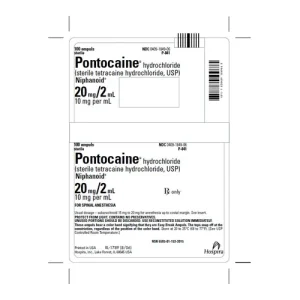
Pontocaine 1% Injection
Global Shipping : Reliable Global Distribution Network
Express Delivery : Priority Shipping for Every Order
Secure Payments : Trusted Payment Protection System
 Disclaimer

Secure Handling
24/7 Worldwide Support

Global Access
Worldwide Access to Health

Cold-Chain Expert
Excellence in Cold-Chain

Trusted Supply
Certified Medical Supply
Indications & Clinical Uses
- Pontocaine is the historic US brand name for tetracaine hydrochloride injection, a long-acting ester-type local anaesthetic.
- The Pontocaine HCl injection brand has been discontinued in the United States; the information here is based on the current generic tetracaine hydrochloride injection label (Akorn), the direct successor product, and cross-checked against Pontocaine-specific patient information.
- Tetracaine 1% injection is indicated for the production of spinal anaesthesia for surgical and other procedures expected to last two to three hours.
- It works by blocking nerve conduction in the spinal region after injection into the cerebrospinal fluid.
- It is given only by a clinician trained in regional anaesthesia techniques, in a setting equipped to manage cardiovascular and respiratory emergencies, and is never a product a patient handles or self-administers.
Side Effects
- Because tetracaine acts on the central nervous system and cardiovascular system, effects can include nervousness, dizziness, blurred vision and tremors, and, at higher exposure, seizures and respiratory arrest; on the cardiovascular side, effects can include a drop in blood pressure, slow heart rate and, rarely, cardiac arrest, especially if it is accidentally given into a blood vessel.
- Spinal anaesthesia commonly causes a headache afterward (post-spinal headache) and can cause meningismus (neck stiffness with headache and light sensitivity).
- Allergic reactions, including rare but serious anaphylaxis, can occur.
- This product carries no boxed warning on its current label, but methemoglobinemia has been reported with ester-type local anaesthetics, particularly in people with glucose-6-phosphate dehydrogenase (G6PD) deficiency; report unusual blue-grey skin colour, fatigue or breathlessness.
Precautions & Warnings
- Tetracaine spinal injection must only be given where resuscitation equipment, oxygen and staff trained to manage cardiac and respiratory emergencies are immediately available, because of the risk of profound blood pressure drop and cardiorespiratory depression.
- Blood pressure is monitored frequently during and after the injection, and hypotension is treated promptly.
- It must not be used in anyone hypersensitive to tetracaine, other ester-type local anaesthetics or para-aminobenzoic acid (PABA)-related compounds, or in anyone for whom the spinal anaesthesia technique itself is unsuitable.
- Use with caution in patients with abnormal plasma esterase activity and in patients with G6PD deficiency, because of the methemoglobinemia risk.
- Store the ampoules under refrigeration and protect them from light; do not use if the solution is discoloured or contains particles.
Avoid Interactions
- Tetracaine can interfere with the antibacterial action of sulfonamide medicines, because its breakdown product, para-aminobenzoic acid, blocks how sulfonamides work; this combination should be avoided.
- Other medicines or conditions that promote methemoglobinemia — including certain antibiotics such as dapsone and nitrofurantoin, and some antimalarials — add to tetracaine's own methemoglobinemia risk and should be used cautiously together.
- Combining tetracaine with other local anaesthetics or with drugs that depress the heart or blood pressure can increase the risk of cardiovascular depression during the procedure.
- Tell the anaesthesia team about every medicine, supplement and any known G6PD deficiency or sulfa allergy before the procedure.
- Do not mix tetracaine with other drugs in the same syringe.
References
Frequently Asked Questions
Pontocaine is the brand name for tetracaine, a local anaesthetic injected into the spinal fluid to produce spinal anaesthesia for surgery lasting about two to three hours. The Pontocaine HCl injection brand is discontinued in the US; current supply is the generic tetracaine HCl injection.
Pontocaine (tetracaine) is injected into the spinal fluid by an anaesthesia clinician immediately before your procedure. You do not give it yourself. Your position and blood pressure are watched closely during and after the injection.
Common effects include a headache after the procedure, low blood pressure and slow heart rate. Serious but rarer risks include seizures, breathing problems and methemoglobinemia, a blood-oxygen problem more likely in people with G6PD deficiency. There is no boxed warning on the current label.
Tell them about any allergy to local anaesthetics or sulfa drugs, G6PD deficiency, heart or lung disease, and every medicine you take, since sulfonamide antibiotics and other methemoglobinemia-causing drugs interact with tetracaine. Avoid combining it with other local anaesthetics without medical supervision.
The Pontocaine HCl brand itself has been discontinued in the US, but the same medicine, tetracaine hydrochloride injection, remains available generically (Akorn) for spinal anaesthesia. This is a manufacturer discontinuation of the brand name, not a safety-related withdrawal.
Spinal anaesthesia with tetracaine typically provides surgical numbness for about two to three hours, depending on the dose and any additives used. Sensation returns gradually afterward, and you should avoid injury to numb areas until feeling fully recovers.

Trusted & Reliable – Your Partner in Global Distribution.
We provide comprehensive lines of pharmaceutical products to support all your healthcare distribution needs.


