

TM Owner Eli Lilly
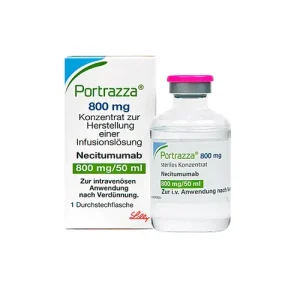
Portrazza 800mg/50ml Vial
Global Shipping : Reliable Global Distribution Network
Express Delivery : Priority Shipping for Every Order
Secure Payments : Trusted Payment Protection System
 Disclaimer

Secure Handling
24/7 Worldwide Support

Global Access
Worldwide Access to Health

Cold-Chain Expert
Excellence in Cold-Chain

Trusted Supply
Certified Medical Supply
Indications & Clinical Uses
- Portrazza 800 mg/50 mL (necitumumab) is a recombinant human IgG1 monoclonal antibody that blocks the epidermal growth factor receptor (EGFR).
- It is approved in the United States, in combination with the chemotherapy drugs gemcitabine and cisplatin, as a first-line treatment for adults with metastatic squamous non-small cell lung cancer (NSCLC); it is not indicated for non-squamous NSCLC, where trials showed increased toxicity and death without added benefit.
- Portrazza's European Union marketing authorisation was allowed to lapse by Eli Lilly in February 2021 for commercial reasons (low demand), not for safety concerns, so it is no longer sold in the EU, though it remains an approved, actively marketed US treatment.
- Portrazza is given only in a hospital or cancer clinic by intravenous infusion; patients do not administer it themselves.
Side Effects
- Portrazza carries a boxed warning for cardiopulmonary arrest and sudden death, which occurred in about 3% of patients receiving it with gemcitabine and cisplatin, and for hypomagnesemia (low blood magnesium), which develops in most patients (around 83%) and is severe in roughly 1 in 5.
- Very common reactions include skin rash (44%), vomiting (29%), diarrhoea (16%) and acne-like dermatitis (15%).
- Blood clots in the veins or arteries occur more often than with chemotherapy alone.
- Infusion-related reactions can happen during treatment.
- Seek urgent medical attention for chest pain, irregular heartbeat, sudden collapse, muscle cramps or weakness (signs of low magnesium), leg swelling, or sudden breathlessness, and attend all scheduled blood tests.
Precautions & Warnings
- Because of the risk of cardiac arrest and hypomagnesemia, blood magnesium, potassium and calcium are checked before every dose and monitored for at least 8 weeks after the last infusion, with replacement given as needed.
- Portrazza is contraindicated in patients with a history that makes these risks unacceptable, and treatment is interrupted or stopped for severe skin reactions, blood clots, infusion reactions, or worsening heart or lung problems.
- It can cause harm to an unborn baby, so it must not be used in pregnancy, and effective contraception is required during and for a period after treatment; it is not known to be safe during breastfeeding.
- Portrazza is for intravenous infusion only, given over 60 minutes under clinical supervision, and is never given as a rapid injection or self-administered at home.
Avoid Interactions
- Portrazza has not been formally studied for pharmacokinetic drug-drug interactions, but its main risks are increased by other factors that lower magnesium or affect the heart, so medicines that also cause hypomagnesemia, such as diuretics or proton pump inhibitors, should be discussed with the oncology team.
- It is combined specifically with gemcitabine and cisplatin as part of its approved regimen; giving it with other EGFR-targeted therapies or in non-squamous NSCLC is not supported by the label.
- Tell the cancer team about every other medicine and supplement being taken, including over-the-counter magnesium or potassium supplements, so electrolyte monitoring can be adjusted.
- Portrazza must not be mixed or co-infused with other drugs in the same line.
References
Frequently Asked Questions
Portrazza (necitumumab) is given with the chemotherapy drugs gemcitabine and cisplatin as a first-line treatment for metastatic squamous non-small cell lung cancer in adults. It targets EGFR on cancer cells and is not approved for non-squamous NSCLC, a different lung cancer type.
A cancer clinic team gives Portrazza by intravenous infusion over about 60 minutes, on days 1 and 8 of each 3-week chemotherapy cycle. You do not give it to yourself; treatment continues until the cancer progresses or side effects become unmanageable.
Portrazza has a boxed warning for cardiopulmonary arrest and sudden death, seen in about 3% of patients, and for low blood magnesium, which affects most patients and can be severe. Rash, vomiting and diarrhoea are also common; report chest pain or muscle cramps urgently.
Your care team checks magnesium, potassium and calcium before each infusion and for at least 8 weeks after your last dose, because Portrazza commonly causes low magnesium. Levels are corrected with supplements if needed, and heart monitoring may also be used.
Yes in the United States, where it remains FDA-approved and actively marketed. Its European Union authorisation lapsed in February 2021 because Eli Lilly did not renew it for commercial reasons, not safety, so Portrazza is no longer sold in the EU.
No. Necitumumab, the active ingredient in Portrazza, can harm an unborn baby, so it is not used during pregnancy and effective contraception is required during treatment and afterward. It is also not known to be safe while breastfeeding, so discuss feeding plans with your care team.

Trusted & Reliable – Your Partner in Global Distribution.
We provide comprehensive lines of pharmaceutical products to support all your healthcare distribution needs.


