

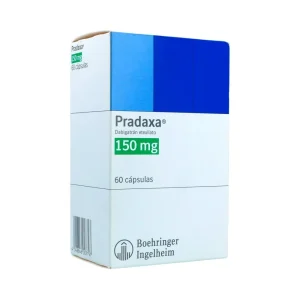
TM Owner Boehringer Ingelheim
Pradaxa 150mg Capsule
Global Shipping : Reliable Global Distribution Network
Express Delivery : Priority Shipping for Every Order
Secure Payments : Trusted Payment Protection System
 Disclaimer

Secure Handling
24/7 Worldwide Support

Global Access
Worldwide Access to Health

Cold-Chain Expert
Excellence in Cold-Chain

Trusted Supply
Certified Medical Supply
Indications & Clinical Uses
- Pradaxa 150 mg capsules contain dabigatran etexilate mesilate, an oral direct thrombin inhibitor (a type of anticoagulant, or 'blood thinner') from Boehringer Ingelheim.
- In adults, Pradaxa is used to reduce the risk of stroke and blood clots in people with non-valvular atrial fibrillation (an irregular heart rhythm not caused by heart valve disease), and to treat deep vein thrombosis (DVT) and pulmonary embolism (PE) and reduce the risk of their recurrence, usually started after 5 to 10 days of an injectable anticoagulant.
- Pradaxa is also approved, in other strengths and forms, for treating and preventing recurrent blood clots in children aged 3 months and older, and in the European Union for preventing blood clots after elective hip replacement surgery.
- It is taken twice daily by mouth and the capsule must not be opened, chewed or crushed.
Side Effects
- Pradaxa carries a boxed warning: stopping Pradaxa or any oral anticoagulant early increases the risk of stroke or other blood clots, and stopping it around a spinal or epidural procedure (or a spinal puncture) can cause a spinal or epidural blood clot leading to long-term or permanent paralysis — seek urgent help for new back pain, numbness, weakness or loss of bladder or bowel control after such a procedure.
- Very common side effects (more than 1 in 10 people) include stomach upset, heartburn and abdominal pain.
- Because Pradaxa thins the blood, bleeding is the main everyday risk: watch for unusual bruising, nosebleeds, blood in urine or stool, black or tarry stools, or bleeding that will not stop, and get emergency care for severe bleeding, sudden weakness, or a severe headache.
- Never stop Pradaxa without talking to your prescriber first.
Precautions & Warnings
- Pradaxa is contraindicated in active pathological bleeding, in people with a mechanical prosthetic heart valve, and in known hypersensitivity to dabigatran.
- Kidney function must be checked before starting and monitored during treatment, since dabigatran is cleared by the kidneys and the dose may need reducing, or the drug avoided, in moderate-to-severe renal impairment.
- Pradaxa must not be stopped or interrupted for surgery or dental work without your prescriber's instructions, and special care and timing are needed around spinal or epidural anaesthesia or a lumbar puncture because of the risk of spinal bleeding.
- Tell your prescriber about any planned surgery, a fall or injury, or signs of bleeding.
- Pradaxa is not recommended in pregnancy unless clearly necessary, with effective contraception advised for women who could become pregnant, and it is not recommended while breastfeeding.
- Use extra caution in people over 75 and those with low body weight, and always carry an anticoagulant alert card.
Avoid Interactions
- Pradaxa's blood levels are increased by P-glycoprotein (P-gp) inhibitors such as ketoconazole, dronedarone, verapamil, amiodarone and ticagrelor, raising bleeding risk, and reduced by P-gp inducers such as rifampicin and St John's Wort, which can lower protection against clots.
- Combining Pradaxa with other anticoagulants, aspirin, NSAIDs (like ibuprofen), clopidogrel or other antiplatelet drugs, or SSRI/SNRI antidepressants further increases bleeding risk and should only be done under close medical supervision.
- Tell your healthcare provider and pharmacist about every prescription and over-the-counter medicine, herbal product and supplement you take, including St John's Wort.
- Do not start or stop any new medicine, including pain relievers, without checking first, and always mention Pradaxa before any surgery, dental treatment or spinal injection.
References
Frequently Asked Questions
Pradaxa (dabigatran) is a blood-thinning capsule that lowers stroke risk in adults with non-valvular atrial fibrillation and treats or prevents recurrent deep vein thrombosis (DVT) and pulmonary embolism (PE). It is also used to treat and prevent recurrent blood clots in children aged 3 months and older.
Take Pradaxa capsules whole, twice daily about 12 hours apart, with or without food. Never open, chew or crush the capsule, since this greatly increases how much dabigatran your body absorbs. Do not stop taking it without talking to your prescriber first.
Pradaxa carries a boxed warning: stopping it early raises your risk of stroke or clots, and stopping it around a spinal injection or epidural can cause a spinal blood clot and paralysis. Bleeding is the main everyday risk — get urgent help for severe or unusual bleeding.
Avoid aspirin, NSAIDs like ibuprofen, other blood thinners and antiplatelet drugs unless your prescriber says otherwise, since combining them raises bleeding risk. Also avoid St John's Wort and rifampicin, which can make Pradaxa less effective, and don't stop it suddenly.
Take the missed Pradaxa dose as soon as you remember, up to 6 hours before your next scheduled dose; otherwise skip it and continue your normal twice-daily schedule. Never take a double dose to make up for a missed one.
No. Pradaxa capsules are not interchangeable milligram-for-milligram with other dabigatran formulations, such as paediatric oral pellets, without your prescriber's guidance, because absorption differs between forms. Always take the exact strength and formulation your prescriber has written on your prescription label.

Trusted & Reliable – Your Partner in Global Distribution.
We provide comprehensive lines of pharmaceutical products to support all your healthcare distribution needs.


