

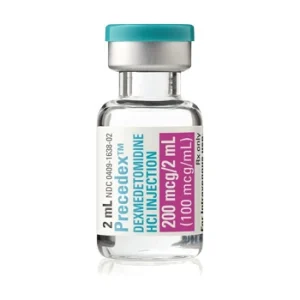
TM Owner Pfizer
Precedex 200mcg/2mL Injection
Global Shipping : Reliable Global Distribution Network
Express Delivery : Priority Shipping for Every Order
Secure Payments : Trusted Payment Protection System
 Disclaimer

Secure Handling
24/7 Worldwide Support

Global Access
Worldwide Access to Health

Cold-Chain Expert
Excellence in Cold-Chain

Trusted Supply
Certified Medical Supply
Indications & Clinical Uses
- Precedex (dexmedetomidine hydrochloride) 200 mcg/2 mL is a concentrated injection of a selective alpha-2 adrenergic agonist used for sedation.
- This particular presentation is the Precedex concentrate, which must be diluted before use; it is not the same as the ready-to-use Precedex premixed in 0.9% sodium chloride, and the two must not be confused.
- Once diluted to 4 mcg/mL, Precedex is used to sedate intubated, mechanically ventilated adults in the intensive care unit for up to 24 hours, and to sedate non-intubated adults before or during surgical and other procedures.
- It is also used for procedural sedation in non-intubated children aged 1 month to under 18 years undergoing non-invasive procedures.
- Precedex is given only by continuous intravenous infusion in a hospital intensive care unit or operating room, by staff skilled in managing critically ill or anesthetized patients; it is never self-administered or used at home.
Side Effects
- The most common effects of Precedex are related to its action on blood pressure and heart rate: hypotension (low blood pressure) affects roughly a quarter of patients, and bradycardia (slow heart rate), dry mouth, transient hypertension during the loading dose, and nausea are also common.
- Significant bradycardia and, rarely, sinus arrest can occur, especially with rapid administration or in patients with a healthy resting heart rate; the infusion rate is reduced or stopped if this happens.
- Precedex has no FDA boxed warning.
- Continuous cardiac and blood pressure monitoring is required throughout the infusion because of these effects.
- Diabetes insipidus has been reported rarely; urine output is monitored during prolonged use.
- Because Precedex causes sedation, patients are monitored closely as they wake; any breathing difficulty, chest discomfort or very slow pulse is reported to the care team immediately, though as a hospital-administered medicine this monitoring is carried out by staff rather than the patient.
Precautions & Warnings
- This 200 mcg/2 mL vial is a concentrate and must be diluted with 0.9% sodium chloride to a final concentration of 4 mcg/mL before it is given; it must never be given undiluted or as a rapid bolus.
- Precedex is not approved for infusions longer than 24 hours in the ICU setting; tolerance and reduced effect (tachyphylaxis) can develop with prolonged use.
- Use with caution in elderly, hypovolemic or diabetic patients, and in those with advanced heart block or severe ventricular dysfunction, since hypotension and bradycardia can be more pronounced.
- Precedex is given only by continuous intravenous infusion under continuous cardiac and hemodynamic monitoring in an intensive care unit or operating room setting; it has no home or take-home use.
- Rare cases of drug-induced hyperthermia have been reported that may not respond to standard cooling measures.
- Use in pregnancy or breastfeeding is decided by the treating team based on clinical need, since Precedex is used only in acute, monitored hospital settings.
Avoid Interactions
- Combining Precedex with anesthetics, sedatives, hypnotics or opioids increases sedative and cardiovascular effects, so doses of both Precedex and the other agent are usually reduced when they are used together, and this is managed by the anesthesia or intensive care team.
- Other medicines that lower heart rate or blood pressure, such as beta-blockers, can add to the risk of bradycardia and hypotension when given with Precedex.
- Because Precedex is only ever given as a hospital infusion, the treating team reviews the patient's full medicine list, including any recent anesthetic or sedative drugs, before starting the infusion.
- The concentrate vial must only be diluted with 0.9% sodium chloride injection to reach the correct 4 mcg/mL strength; it should not be mixed with other drugs in the same syringe or line.
- Strict aseptic technique is required whenever Precedex is prepared or handled.
References
Frequently Asked Questions
Precedex (dexmedetomidine) sedates intubated adults on a ventilator in intensive care for up to 24 hours, and sedates adults and children aged 1 month and older before or during surgery and other procedures. This 200 mcg/2 mL vial is a concentrate that must be diluted before use.
Precedex is given as one continuous intravenous infusion, usually starting with a loading dose over about 10 minutes, then a lower maintenance rate adjusted to your sedation level. It is given continuously, not as repeated separate doses, and only in a monitored hospital unit.
Low blood pressure affects roughly a quarter of people on Precedex, and slow heart rate (bradycardia), dry mouth, brief high blood pressure during the loading dose, and nausea are also common. Rarely, heart rate can drop severely; your care team continuously monitors your heart and blood pressure.
Yes. This is the Precedex concentrate (100 mcg/mL) and must be diluted with 0.9% sodium chloride to 4 mcg/mL before infusion; it must never be given undiluted or as a rapid injection. This differs from ready-to-use Precedex bags, which need no further dilution.
Your heart rate, blood pressure and breathing are continuously monitored throughout a Precedex infusion, since it can cause slow heart rate and low blood pressure. Nursing or anesthesia staff adjust the infusion rate based on how sedated you are and how your vital signs respond.
Precedex is approved for ICU sedation for up to 24 hours; longer use can reduce its effect (tachyphylaxis) and is not recommended in that setting. For procedural sedation, infusion length depends on the procedure and is decided by the treating anesthesia or medical team.

Trusted & Reliable – Your Partner in Global Distribution.
We provide comprehensive lines of pharmaceutical products to support all your healthcare distribution needs.


