

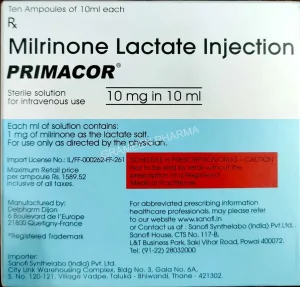
TM Owner Sanofi
Primacor 1mg/mL Injection
Global Shipping : Reliable Global Distribution Network
Express Delivery : Priority Shipping for Every Order
Secure Payments : Trusted Payment Protection System
 Disclaimer

Secure Handling
24/7 Worldwide Support

Global Access
Worldwide Access to Health

Cold-Chain Expert
Excellence in Cold-Chain

Trusted Supply
Certified Medical Supply
Indications & Clinical Uses
- Primacor 1 mg/mL solution for injection contains milrinone (as milrinone lactate), a phosphodiesterase-3 inhibitor with positive inotropic and vasodilator activity.
- It is used for the short-term intravenous treatment of adults with acute decompensated heart failure, including low cardiac output states after cardiac surgery, when the response to conventional therapy such as diuretics, vasodilators and digoxin has been inadequate.
- In the United States Primacor is approved for treatment courses of up to 48 hours; longer intravenous use, and any oral use, has not been shown to be safe or effective and is not recommended.
- Some markets, including the UK, also permit short-term paediatric use (up to about 35 hours) under specialist supervision.
- Primacor is given only in hospital or another setting with continuous cardiac monitoring, never self-administered, and is marketed by Sanofi.
Side Effects
- The most common reactions with Primacor (milrinone) are cardiac: ventricular ectopic activity and non-sustained ventricular tachycardia affect roughly 1 in 12 people (about 8%), and other ventricular or supraventricular arrhythmias, headache and low blood pressure each affect a smaller proportion of patients.
- Primacor does not carry a formal US boxed warning, but the label carries a prominent warning that long-term oral milrinone therapy (an older, no-longer-marketed formulation) was linked to more hospitalisations, life-threatening arrhythmias and death, especially in people with severe (Class IV) heart failure; this is why treatment is limited to short intravenous courses.
- Tell the care team immediately about chest pain, a fast or irregular heartbeat, fainting, or worsening breathlessness.
- Because Primacor is only given in hospital under continuous ECG and blood pressure monitoring, staff will be watching for these effects and can act quickly if they occur.
Precautions & Warnings
- Primacor must not be used in people with severe obstructive aortic or pulmonic valve disease unless the obstruction has been surgically corrected, and it is contraindicated in known hypersensitivity to milrinone.
- Continuous electrocardiographic monitoring is required throughout the infusion because of the risk of ventricular and supraventricular arrhythmias, and blood pressure and heart rate must be monitored closely, especially when starting or adjusting the loading dose.
- Correct low potassium levels before and during treatment, as hypokalaemia increases arrhythmia risk.
- The dose must be reduced in patients with renal impairment, based on creatinine clearance, because milrinone is cleared by the kidneys.
- Primacor is for intravenous use only, given as a loading dose followed by a continuous infusion; it is not for oral, intramuscular or subcutaneous use.
- There are limited human pregnancy and breastfeeding data; use only if clearly needed and under specialist care.
Avoid Interactions
- Primacor is generally compatible with digoxin, lidocaine, quinidine, hydralazine, nitrates and common anaesthetic agents without additional dose adjustment.
- However, furosemide and bumetanide must never be injected into the same intravenous line as milrinone, because a precipitate forms immediately; give them through a separate line or flush the line between drugs.
- Do not mix milrinone with sodium bicarbonate solution in the same infusion, as it will also precipitate.
- Because Primacor lowers blood pressure and affects heart rate, combining it with other inotropes, vasodilators or antihypertensive drugs needs close monitoring in hospital.
- Tell the care team about every medicine, including diuretics and potassium supplements, since electrolyte-affecting drugs raise arrhythmia risk during treatment.
- As Primacor is only given by trained staff in a monitored setting, they will check the full medicine list and infusion-line compatibility before starting.
References
Frequently Asked Questions
Primacor (milrinone) is a heart medicine given by IV drip in hospital for short-term treatment of acute decompensated heart failure, including low cardiac output after heart surgery. It strengthens the heart's pumping and widens blood vessels when other treatments like diuretics have not worked well enough. Treatment courses are limited to 48 hours.
Primacor is given only in hospital, through a vein (intravenously), never as a tablet or self-injection. A nurse or doctor gives a loading dose over about 10 minutes, then a continuous infusion, usually for up to 48 hours, while your heart rhythm, blood pressure and heart rate are monitored continuously.
The most common side effects of Primacor (milrinone) are ventricular arrhythmias (irregular heartbeats), affecting about 1 in 12 people, plus headache and low blood pressure. Longer use than recommended, or oral milrinone, has been linked to more hospitalisations and death in severe heart failure, so treatment is kept short and closely monitored.
Do not give furosemide or bumetanide through the same IV line as Primacor (milrinone) - they react together and form a precipitate. Sodium bicarbonate must also not be mixed with it. Because Primacor is hospital-administered, staff check your other medicines, especially diuretics and potassium supplements, before and during the infusion.
During a Primacor infusion your heart rhythm is watched continuously by ECG, along with blood pressure, heart rate and blood potassium levels. Kidney function is also checked, because the milrinone dose must be lowered if your kidneys are not working normally, to avoid a build-up of the drug.
No. Primacor (milrinone) is approved only for short intravenous courses, usually up to 48 hours. Long-term oral milrinone, an older formulation no longer marketed, was linked to more hospital admissions, dangerous irregular heartbeats and higher death rates in severe heart failure, which is why it is not used this way today.

Trusted & Reliable – Your Partner in Global Distribution.
We provide comprehensive lines of pharmaceutical products to support all your healthcare distribution needs.


