

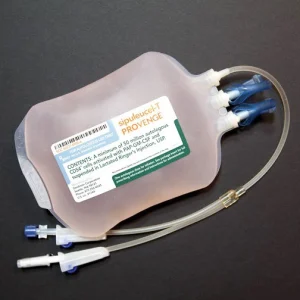
TM Owner Dendreon Pharmaceuticals
Provenge 50×10^6 cells Infusion Bag
Global Shipping : Reliable Global Distribution Network
Express Delivery : Priority Shipping for Every Order
Secure Payments : Trusted Payment Protection System
 Disclaimer

Secure Handling
24/7 Worldwide Support

Global Access
Worldwide Access to Health

Cold-Chain Expert
Excellence in Cold-Chain

Trusted Supply
Certified Medical Supply
Indications & Clinical Uses
- Provenge (sipuleucel-T) is an autologous cellular immunotherapy, not a conventional drug: it is made individually from each patient's own white blood cells and activated against prostate cancer before being infused back into the same patient.
- It is approved for the treatment of asymptomatic or minimally symptomatic metastatic castration-resistant (hormone-refractory) prostate cancer in adult men.
- Because each dose is manufactured specifically for one patient from cells collected from that same patient by leukapheresis, Provenge cannot be given to anyone else, and a missed infusion cannot simply be rescheduled without repeating cell collection.
- Provenge is given only in a hospital or specialist infusion center under close clinical supervision; it is never self-administered and there is no oral or home-use form.
Side Effects
- Provenge causes an acute infusion reaction in about 7 out of 10 patients, most often chills, fatigue, fever, back pain, nausea, joint aches and headache; the great majority of these reactions are mild to moderate and occur within the first day.
- Provenge carries no boxed warning.
- Seek urgent medical attention for signs of a severe allergic reaction, such as breathing difficulty, chest tightness or facial swelling, for symptoms of a stroke, heart attack or blood clot such as sudden weakness, chest pain or leg swelling, or for fever and chills that could indicate an infection, especially if you have a central line in place.
- Because Provenge is given only under medical supervision, you will be monitored for at least 30 minutes after each infusion so reactions can be treated promptly.
Precautions & Warnings
- Provenge must be given only by intravenous infusion in a setting equipped to manage acute infusion reactions; it is not given as an injection or bolus.
- Patients are usually premedicated with oral acetaminophen and an antihistamine such as diphenhydramine about 30 minutes before each infusion to reduce reaction risk.
- Because Provenge is manufactured from that patient's own blood cells collected by leukapheresis roughly 3 days before each of the three planned infusions, appointments for cell collection and infusion should not be missed; a missed dose cannot be given later without repeating leukapheresis.
- Extra caution and closer monitoring are needed in patients with cardiac or pulmonary disease, or with a history of blood clots, stroke or heart attack.
- Provenge should not be combined with immunosuppressive medicines such as systemic corticosteroids or chemotherapy given at the same time, as these may reduce its effectiveness.
- It is not intended for women or children.
- Store the infusion bag refrigerated at 2°C to 8°C and use before the labeled expiry date and time.
Avoid Interactions
- Because Provenge works by activating the patient's own immune cells against prostate cancer, medicines that suppress the immune system, including systemic corticosteroids, chemotherapy and other immunosuppressive drugs, may reduce how well it works if taken at the same time as treatment, so your care team will plan the timing of any such medicines around your Provenge infusions.
- There is no established interaction with standard hormonal prostate cancer therapies.
- No cell filter should be used during the infusion, as this could remove the active cells and make the dose ineffective; the infusion set and rate are managed entirely by clinical staff, so there is nothing for the patient to prepare at home.
- Always tell your care team about every medicine, including over-the-counter drugs and supplements, and about any recent or planned vaccinations, before each scheduled leukapheresis or infusion visit.
References
Frequently Asked Questions
Provenge (sipuleucel-T) is an autologous cellular immunotherapy for adult men with asymptomatic or minimally symptomatic metastatic castration-resistant prostate cancer. It is made from the patient's own immune cells, activated against prostate cancer, then infused back into that same patient in hospital.
Provenge is given as three intravenous infusions about 2 weeks apart in hospital or a specialist infusion center. Each dose is manufactured individually from cells collected from you by leukapheresis roughly 3 days before that infusion, so treatment cannot be self-administered or taken as a tablet at home.
Most people get a mild-to-moderate infusion reaction, commonly chills, fatigue, fever, back pain, nausea, joint aches or headache, affecting around 7 in 10 patients. Seek urgent care for breathing trouble, chest pain, sudden weakness, or fever with chills, especially if you have a central line.
Avoid taking immune-suppressing medicines, such as systemic corticosteroids or chemotherapy, around the time of your Provenge infusions, since they may reduce how well it works. Tell your care team about every medicine and supplement you use before each leukapheresis and infusion visit.
You are usually given acetaminophen and an antihistamine about 30 minutes beforehand, then Provenge is infused into a vein over roughly 60 minutes without a cell filter. Staff monitor you for at least 30 minutes afterward to watch for infusion reactions.
Missing a scheduled Provenge infusion is not like missing a tablet: because each dose is made specifically from your own cells collected days earlier, a missed infusion means the leukapheresis collection has to be repeated before that dose can be given.

Trusted & Reliable – Your Partner in Global Distribution.
We provide comprehensive lines of pharmaceutical products to support all your healthcare distribution needs.


