

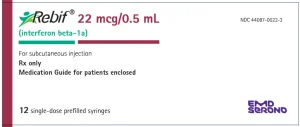
TM Owner EMD Serono / Merck KGaA
Rebif 44mcg/0.5mL Injection
Global Shipping : Reliable Global Distribution Network
Express Delivery : Priority Shipping for Every Order
Secure Payments : Trusted Payment Protection System
 Disclaimer

Secure Handling
24/7 Worldwide Support

Global Access
Worldwide Access to Health

Cold-Chain Expert
Excellence in Cold-Chain

Trusted Supply
Certified Medical Supply
Indications & Clinical Uses
- Rebif 44 mcg/0.5 mL (interferon beta-1a) is a disease-modifying biologic used to treat relapsing forms of multiple sclerosis in adults, including clinically isolated syndrome, relapsing-remitting disease, and active secondary progressive disease with relapses.
- It works by modulating the immune system to reduce how often MS relapses occur and to slow the build-up of physical disability, though it does not cure multiple sclerosis.
- Rebif is given by subcutaneous injection three times a week, self-administered at home using a prefilled syringe or the Rebif Rebidose autoinjector after training from a healthcare provider; a lower starting dose of 8.8 mcg or 22 mcg is used for the first weeks and gradually increased to the full 44 mcg dose to reduce flu-like side effects.
- It is approved for adults; other interferon beta-1a products, such as Avonex, are dosed differently and are not interchangeable with Rebif.
Side Effects
- Injection-site reactions are very common, affecting up to about 9 in 10 people, including redness, pain, swelling or, rarely, breakdown of skin tissue (necrosis) at the injection site.
- Flu-like symptoms — fever, chills, muscle aches, tiredness and headache — affect more than half of patients, especially when starting treatment, and usually ease with continued use; injecting in the evening and using paracetamol/acetaminophen can help.
- Other common effects are low white blood cell counts and raised liver enzymes, so regular blood tests are needed.
- Seek urgent medical attention for signs of depression or suicidal thoughts, yellowing of the skin or eyes, easy bruising or bleeding, seizures, or reduced urination with bruising, which can signal rare but serious reactions including liver injury, thrombotic microangiopathy or severe allergic reaction.
- Rotate injection sites to reduce skin reactions.
Precautions & Warnings
- Rebif is not recommended for people with a history of severe depression or suicidal thoughts unless closely monitored, as interferon beta can worsen mood symptoms.
- It is contraindicated in anyone with known hypersensitivity to natural or recombinant interferon beta, human albumin, or any component of the formulation.
- Before starting, and periodically during treatment, your healthcare provider will check liver function tests, complete blood counts with differential, and thyroid function, since Rebif can cause liver injury, low blood cell counts and thyroid disorders.
- Report any unusual bruising, bleeding, confusion or reduced urination promptly, as these may indicate thrombotic microangiopathy or nephrotic syndrome, rare but serious complications seen with interferon beta products.
- Tell your healthcare provider if you have epilepsy, cardiac disease, or are pregnant, planning pregnancy, or breastfeeding.
- Rebif is for subcutaneous injection only and must never be given intravenously.
Avoid Interactions
- No specific pharmacokinetic interaction studies with major drug classes have been conducted for Rebif, but caution is advised when combining it with other medicines that affect the liver or bone marrow, since interferon beta-1a itself can raise liver enzymes and lower blood cell counts, and combining it with other hepatotoxic or myelosuppressive drugs may add to this risk.
- Corticosteroids or ACTH may be used with Rebif to manage relapses under medical supervision.
- Live vaccines should generally be discussed with your healthcare provider before use during treatment, as with other immune-modulating therapies.
- Tell your healthcare provider about all prescription and over-the-counter medicines, herbal products and supplements you are taking or planning to take before and during Rebif treatment.
References
Frequently Asked Questions
Rebif (interferon beta-1a) treats relapsing forms of multiple sclerosis in adults, including relapsing-remitting MS and active secondary progressive MS. Given by injection three times a week, it lowers how often relapses happen and slows disability progression. It does not cure MS and is not approved for children.
Rebif 44 mcg/0.5 mL is injected under the skin three times a week, on the same three days each week, at least 48 hours apart. You or a caregiver can self-inject using a prefilled syringe or the Rebif Rebidose autoinjector after training. Treatment usually starts at a lower dose and increases gradually.
Most people using Rebif get injection-site reactions and flu-like symptoms — fever, chills, muscle aches and headache — especially in the first weeks. Low white blood cell counts and raised liver enzymes are also common, so regular blood tests are needed. Seek urgent care for signs of depression, liver problems, or severe allergic reaction.
Discuss live vaccines with your healthcare provider before having them during Rebif treatment, and be cautious combining Rebif with other medicines that affect your liver or blood counts. Tell your healthcare provider about all medicines and supplements you use. Never inject Rebif into a vein — it is for subcutaneous injection only.
If you miss a Rebif injection, take it as soon as you remember, then continue your normal three-times-a-week schedule, leaving at least 48 hours between doses — do not inject two doses close together. Store Rebif in the refrigerator at 2°C to 8°C; it can be kept at room temperature for up to 30 days if needed.
No. Rebif's current label carries no boxed warning. It should still be avoided by anyone allergic to interferon beta or human albumin, and mood changes, unusual bruising or reduced urination should be reported promptly, since rare serious reactions are possible.

Trusted & Reliable – Your Partner in Global Distribution.
We provide comprehensive lines of pharmaceutical products to support all your healthcare distribution needs.


