

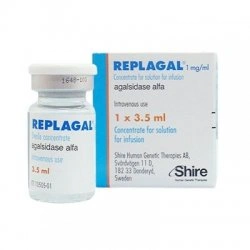
TM Owner Takeda
Replagal 1mg/ml Vial
Global Shipping : Reliable Global Distribution Network
Express Delivery : Priority Shipping for Every Order
Secure Payments : Trusted Payment Protection System
 Disclaimer

Secure Handling
24/7 Worldwide Support

Global Access
Worldwide Access to Health

Cold-Chain Expert
Excellence in Cold-Chain

Trusted Supply
Certified Medical Supply
Indications & Clinical Uses
- Replagal 1 mg/mL (agalsidase alfa) is a recombinant human alpha-galactosidase A enzyme-replacement therapy marketed by Takeda, supplied as a concentrate for intravenous infusion in single-use 3.5 mg vials.
- It is authorised in the European Union and other markets for long-term enzyme-replacement therapy in adults, adolescents and children aged 7 years and above with a confirmed diagnosis of Fabry disease, an inherited lysosomal storage disorder caused by alpha-galactosidase A deficiency that leads to build-up of globotriaosylceramide in the kidneys, heart, nerves and skin.
- Replagal has never been approved by the US FDA; in the United States the equivalent enzyme-replacement option is agalsidase beta, marketed as Fabrazyme.
- The standard dose is 0.2 mg per kg body weight given every two weeks, infused over about 40 minutes in a hospital or infusion clinic, though home infusion by a trained patient or caregiver may be arranged once tolerance is established.
Side Effects
- Infusion-related reactions are very common with Replagal (agalsidase alfa), reported in more than 1 in 10 people, and include chills, fever, headache, nausea, flushing, fatigue and shortness of breath, usually during or shortly after the infusion.
- Common reactions, affecting up to 1 in 10 people, include palpitations, fast heartbeat, high or low blood pressure, rash and muscle or joint pain.
- Replagal carries no boxed warning.
- Uncommonly, severe hypersensitivity or anaphylactic-type reactions can occur, with symptoms such as swelling of the face or throat, severe breathlessness or a marked drop in blood pressure; stop the infusion and seek emergency care immediately if these develop.
- Slowing the infusion rate, or pre-treatment with antihistamines, antipyretics or corticosteroids, can reduce reaction risk.
- Report any new or worsening symptom during or after an infusion to the treating team promptly.
Precautions & Warnings
- Before starting Replagal (agalsidase alfa), tell your healthcare provider about any known hypersensitivity to the medicine or its excipients, and about existing heart disease, since patients with advanced Fabry-related cardiac or kidney damage may have a reduced response to enzyme-replacement therapy.
- Some patients develop antibodies to agalsidase alfa, which can increase infusion-reaction frequency and should be monitored, particularly if efficacy appears to lessen over time.
- Replagal must be given only by slow intravenous infusion over approximately 40 minutes — never as a rapid injection or by any other route.
- Use in pregnancy and breastfeeding is only considered if clearly needed, and experience in patients over 65 and children under 7 is limited.
- Do not co-administer Replagal in the same infusion line as chloroquine, amiodarone, benoquin (monobenzone) or gentamicin, as these may inhibit the enzyme's activity.
Avoid Interactions
- Avoid Interactions : chloroquine, amiodarone, benoquin (monobenzone) and gentamicin can inhibit alpha-galactosidase A activity in cells and should not be given together with Replagal (agalsidase alfa), as they may reduce the enzyme's effectiveness.
- There are no known interactions that increase Replagal's toxicity through routine drug metabolism, since it is a protein broken down by normal protein-degradation pathways rather than liver enzymes.
- No formal interaction studies have been performed with other medicines, so tell your healthcare provider about every prescription and over-the-counter medicine, herbal product and supplement you take before each infusion.
- Do not mix Replagal with other medicinal products in the same infusion line; use a separate line or flush it appropriately before and after.
References
Frequently Asked Questions
Replagal (agalsidase alfa) is an enzyme-replacement therapy for Fabry disease, a rare inherited condition caused by low alpha-galactosidase A activity. It is used long-term in adults and children aged 7 and over to replace the missing enzyme and reduce harmful build-up in organs including the kidneys, heart and nerves.
Replagal is given by slow intravenous infusion over about 40 minutes, once every two weeks, at a dose of 0.2 mg per kg body weight. It is usually given in a hospital or infusion clinic, though trained patients or carers may give it at home once treatment is well tolerated.
More than 1 in 10 people get infusion-related reactions with Replagal (agalsidase alfa), such as chills, fever, headache and nausea during or after the drip. Replagal has no boxed warning. Get emergency help for facial or throat swelling, severe breathlessness or a sudden drop in blood pressure.
Do not use Replagal (agalsidase alfa) together with chloroquine, amiodarone, benoquin or gentamicin, as these can block the enzyme's activity and reduce its benefit. Tell your healthcare provider about every other medicine, supplement or herbal product you take, and mention any past infusion reaction.
A Replagal infusion takes about 40 minutes through a vein, usually in a clinic where you can be watched for reactions like fever, chills or flushing. If reactions occur, staff may slow the infusion or give antihistamines. Once well tolerated, some patients switch to supervised home infusions.
Yes. Replagal (agalsidase alfa) is approved for children and adolescents aged 7 years and older with confirmed Fabry disease, using the same 0.2 mg/kg dose every two weeks as adults. Data under 7 and over 65 are limited, so treatment is individualised by a specialist.

Trusted & Reliable – Your Partner in Global Distribution.
We provide comprehensive lines of pharmaceutical products to support all your healthcare distribution needs.


