

TM Owner West-Ward Pharmaceuticals Corp. (Hikma)
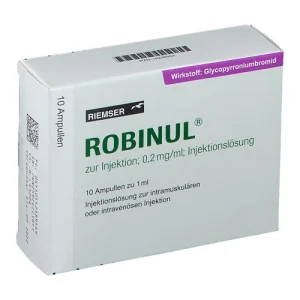
Robinul 0.2mg/mL Injection
Global Shipping : Reliable Global Distribution Network
Express Delivery : Priority Shipping for Every Order
Secure Payments : Trusted Payment Protection System
 Disclaimer

Secure Handling
24/7 Worldwide Support

Global Access
Worldwide Access to Health

Cold-Chain Expert
Excellence in Cold-Chain

Trusted Supply
Certified Medical Supply
Indications & Clinical Uses
- Robinul Injection 0.2 mg/mL (glycopyrrolate) is currently manufactured by West-Ward Pharmaceuticals Corp., a Hikma company (Eatontown, NJ, USA); it is a synthetic antimuscarinic (anticholinergic) agent used only by injection in a hospital or surgical setting, given by a healthcare professional, never self-administered.
- It is used before anaesthesia to reduce salivary, tracheobronchial and pharyngeal secretions and to protect against vagal reflexes; during surgery to counteract drug-induced or vagally mediated bradycardia and arrhythmias; and together with neostigmine or pyridostigmine to counteract muscarinic side effects when reversing neuromuscular blockade.
- It is also used as adjunctive therapy for peptic ulcer disease when rapid antimuscarinic effect is needed or oral treatment is not possible.
- This injectable form (0.2 mg/mL) must not be confused with Robinul or Robinul Forte oral tablets (1 mg and 2 mg glycopyrrolate), which are dosed very differently and taken by mouth.
Side Effects
- Common effects are predictable antimuscarinic effects: dry mouth, blurred vision, dilated pupils and light sensitivity, urinary hesitancy or retention, fast heart rate, decreased sweating, drowsiness, weakness, and, especially in older adults, confusion or excitement.
- Robinul's current US label does not carry a formal FDA boxed warning, but it does carry a prominent header caution: 'NOT FOR USE IN NEONATES - CONTAINS BENZYL ALCOHOL,' because benzyl alcohol has been linked to a fatal 'gasping syndrome' in newborns and premature infants; this is included here for safety completeness even though it is not formatted as a boxed warning.
- Seek urgent medical attention for chest pain, palpitations, severe allergic reaction (facial swelling, difficulty breathing), inability to pass urine, or eye pain with visual halos, which can signal an acute glaucoma attack.
Precautions & Warnings
- Robinul Injection is contraindicated in known hypersensitivity to glycopyrrolate; when used for peptic ulcer disease it is also contraindicated in glaucoma, obstructive disease of the gastrointestinal or urinary tract, paralytic ileus, severe ulcerative colitis, myasthenia gravis, and unstable cardiovascular status in acute haemorrhage.
- It must not be used in neonates because of the benzyl alcohol content.
- It is used with caution in autonomic neuropathy, hyperthyroidism, coronary artery disease, congestive heart failure, cardiac arrhythmias, hiatus hernia with reflux oesophagitis, and in hot or humid environments, since it reduces sweating and can contribute to heat stroke.
- Use in pregnancy and breastfeeding only if clearly needed, as safety has not been fully established.
- Because it can cause drowsiness or blurred vision, patients should not drive or operate machinery until these effects have worn off after the procedure.
Avoid Interactions
- Tell the anaesthesia or surgical team about all medicines, including over-the-counter products and supplements, before Robinul is given.
- Combining Robinul with other anticholinergic medicines (such as certain antihistamines, tricyclic antidepressants, antipsychotics, or other antispasmodics) intensifies anticholinergic effects like dry mouth, blurred vision, urinary retention and confusion.
- When used for peptic ulcer disease, concurrent potassium chloride in a wax matrix formulation may increase the severity of gastrointestinal ulceration and should be avoided.
- Robinul may alter the absorption of other oral medicines by slowing stomach emptying.
- It should not be mixed in the same syringe with other injectable drugs unless compatibility has been confirmed, and it is not given in the same line as an incompatible admixture.
References
Frequently Asked Questions
Robinul (glycopyrrolate) injection reduces saliva and airway secretions before anaesthesia and protects against slow heart rhythms during surgery. It is also combined with neostigmine to reverse muscle-relaxant effects. A doctor or nurse gives it; it is not a medicine you take home or inject yourself.
Robinul 0.2 mg/mL is given by a healthcare professional as an injection into a muscle or a vein, usually before or during a surgical or anaesthesia procedure. The dose is calculated by your weight and the reason for use, not taken on a fixed home schedule.
Robinul commonly causes dry mouth, blurred vision, a fast heart rate, urinary hesitancy and drowsiness. Its label warns it must not be used in newborns because it contains benzyl alcohol, linked to a serious 'gasping syndrome' in infants. Report chest pain or breathing difficulty urgently.
Tell your care team about all medicines you take, since combining Robinul with other anticholinergic drugs, like some antihistamines or antidepressants, can worsen dry mouth, blurred vision and confusion. Robinul is not given with potassium chloride wax-matrix tablets when used for peptic ulcer treatment.
During surgery, your heart rate, blood pressure and oxygen levels are monitored continuously while Robinul is given, since it is used specifically to prevent slow heart rhythms and reduce secretions. Staff watch for excess dryness, a very fast heart rate, or signs of urinary retention afterwards.
Robinul injection is used in children for the same anaesthesia and surgical purposes as in adults, with doses calculated by body weight, but it must never be used in neonates (newborns) because the formulation contains benzyl alcohol, which can cause serious harm in this age group.

Trusted & Reliable – Your Partner in Global Distribution.
We provide comprehensive lines of pharmaceutical products to support all your healthcare distribution needs.


