

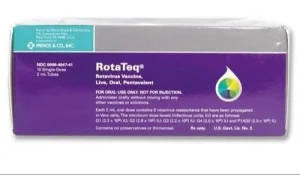
TM Owner Merck & Co.
RotaTeq 2.0–2.8 ×10⁶ IU per reassortant (5 reassortants: G1, G2, G3, G4, P1[8]), 2 mL dose Oral Solution
Global Shipping : Reliable Global Distribution Network
Express Delivery : Priority Shipping for Every Order
Secure Payments : Trusted Payment Protection System
 Disclaimer

Secure Handling
24/7 Worldwide Support

Global Access
Worldwide Access to Health

Cold-Chain Expert
Excellence in Cold-Chain

Trusted Supply
Certified Medical Supply
Indications & Clinical Uses
- RotaTeq is the brand name for Merck's pentavalent, live oral rotavirus vaccine, containing five human-bovine reassortant rotaviruses (serotypes G1, G2, G3, G4 and P1[8]) at a minimum of 2.0 to 2.8 million infectious units each per 2 mL dose.
- It is used to prevent rotavirus gastroenteritis caused by these serotypes in infants.
- In the US it is given as a 3-dose oral series, starting between 6 and 12 weeks of age, with subsequent doses 4 to 10 weeks apart, and the full series completed by 32 weeks of age; it is not approved for use beyond infancy.
- RotaTeq is administered directly into the infant's mouth by a healthcare provider during routine well-child visits, alongside other scheduled childhood vaccines; it is not self-administered or given at home.
- RotaTeq and GSK's Rotarix are both licensed rotavirus vaccines but are different products from different manufacturers and are not interchangeable.
Side Effects
- Common side effects may include diarrhea, which affects more than 1 in 10 infants (about 24%) in the days after a dose, along with vomiting (about 15%) and, in the wider vaccinated population, ear infections, fussiness and mild fever.
- Bronchospasm (wheezing) has also been reported.
- RotaTeq has NO boxed warning.
- The serious reaction to watch for is intussusception, a bowel blockage that can occur in the three weeks after a dose, especially in the first 7 days; call the healthcare provider urgently for severe abdominal pain, persistent vomiting, blood in the stool, or a swollen abdomen.
- Because RotaTeq contains live virus, the vaccine virus can occasionally be shed in the stool and passed to unvaccinated close contacts, so careful hand hygiene after nappy changes is advised, particularly around anyone who is immunocompromised.
Precautions & Warnings
- RotaTeq must not be given to infants with a history of intussusception, Severe Combined Immunodeficiency Disease (SCID), or a severe allergic reaction to a previous dose or vaccine component, including latex sensitivity to the applicator tip.
- Safety has not been established in infants with altered immunocompetence, and caution is advised in those with chronic gastrointestinal disease or recent gastrointestinal surgery.
- Vaccination should be delayed in an infant with moderate or severe acute illness, including active gastroenteritis, until they recover.
- RotaTeq does not protect against gastroenteritis from causes other than rotavirus, and it does not replace other recommended childhood immunisations, which can generally be given at the same visit.
- The vaccine must be given by mouth only and is never injected.
- Store the pre-filled oral applicator refrigerated at 2°C to 8°C, protected from light, until use.
Avoid Interactions
- There is no dietary restriction, and RotaTeq can be given regardless of feeding schedule.
- Co-administration with DTaP, inactivated poliovirus, Haemophilus influenzae type b, hepatitis B and pneumococcal conjugate vaccines at the same visit does not reduce the immune response to any of them, so RotaTeq is normally given alongside the routine infant schedule.
- Because RotaTeq contains a live vaccine virus, caution is advised if the infant lives with someone who is immunocompromised, since shedding and transmission of vaccine virus can occur.
- There are no known drug interactions with routine infant medicines.
- Tell the healthcare provider about any immune-suppressing treatment, recent blood product administration, or other vaccines the infant has recently received.
References
Frequently Asked Questions
RotaTeq is a live oral vaccine that protects infants against rotavirus gastroenteritis caused by serotypes G1, G2, G3, G4 and P1[8]. It's given to babies as part of routine immunisation, not to older children or adults. Each 2 mL dose contains a minimum of 2.0 to 2.8 million infectious units of each vaccine strain.
RotaTeq is given by mouth, squeezed directly into the infant's mouth by a healthcare provider - it is never injected. The standard US schedule is 3 doses, starting between 6 and 12 weeks of age and finishing by 32 weeks, spaced at least 4 weeks apart.
The most common side effects of RotaTeq are diarrhea (about 1 in 4 infants) and vomiting (about 1 in 7), usually mild. Watch for intussusception, a bowel blockage that can occur within 3 weeks of a dose - seek urgent care for severe belly pain, repeated vomiting, or blood in the stool.
RotaTeq should be postponed if your baby has moderate or severe acute illness, including active diarrhea or vomiting, until they recover. It must not be given to infants with a history of intussusception or severe combined immunodeficiency (SCID). Mild colds do not usually require delaying the dose - ask your provider.
Yes. Because RotaTeq contains live vaccine virus, it can be shed in your baby's stool for weeks after a dose and may spread to unvaccinated close contacts. Wash your hands thoroughly after nappy changes, especially if a household member has a weakened immune system.
No. RotaTeq and Rotarix are both rotavirus vaccines but are different products, made by different manufacturers (Merck and GSK), with different compositions and dosing schedules. They are not interchangeable, and a child should ideally complete the vaccine series with the same brand.

Trusted & Reliable – Your Partner in Global Distribution.
We provide comprehensive lines of pharmaceutical products to support all your healthcare distribution needs.


