

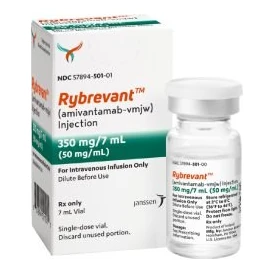
TM Owner Janssen
Rybrevant 350mg/7ml Vial
Global Shipping : Reliable Global Distribution Network
Express Delivery : Priority Shipping for Every Order
Secure Payments : Trusted Payment Protection System
 Disclaimer

Secure Handling
24/7 Worldwide Support

Global Access
Worldwide Access to Health

Cold-Chain Expert
Excellence in Cold-Chain

Trusted Supply
Certified Medical Supply
Indications & Clinical Uses
- Rybrevant 350 mg/7 mL (amivantamab-vmjw), manufactured by Janssen, is a bispecific EGFR-MET-directed monoclonal antibody given only by intravenous infusion in a hospital or specialist oncology clinic.
- It is approved for adults with locally advanced or metastatic non-small cell lung cancer (NSCLC): as first-line treatment in combination with lazertinib for tumors with EGFR exon 19 deletions or exon 21 L858R substitution mutations; in combination with carboplatin and pemetrexed for the same mutations after progression on an EGFR tyrosine kinase inhibitor; as first-line treatment with carboplatin and pemetrexed for EGFR exon 20 insertion mutations; and as a single agent for EGFR exon 20 insertion-mutated disease after platinum-based chemotherapy.
- This intravenous vial formulation is distinct from the newer subcutaneous product Rybrevant FASPRO (amivantamab and hyaluronidase-lpuj), which is dosed and administered differently - the two must not be confused or substituted for one another.
Side Effects
- Very common side effects (20% or more of patients) include rash, nail toxicity, infusion-related reactions, musculoskeletal pain, stomatitis (mouth sores) and swelling (edema).
- Infusion-related reactions occur in roughly half to two-thirds of patients depending on the regimen used, almost always around the first infusion, with symptoms such as chills, flushing, nausea, breathlessness or a drop in blood pressure; these are managed with pre-medication and, if needed, by slowing, pausing or stopping the infusion.
- Rybrevant carries no FDA boxed warning, but important warnings cover interstitial lung disease/pneumonitis (report new or worsening cough, breathlessness or fever urgently), severe dermatologic reactions including rare toxic epidermal necrolysis, and, with the lazertinib combination, a clearly increased risk of venous thromboembolism (blood clots).
Precautions & Warnings
- Because of the meaningfully increased blood clot risk when Rybrevant is combined with lazertinib, preventive anticoagulation is typically given for the first four months of that combination.
- Interrupt and report any suspected interstitial lung disease or pneumonitis immediately, since treatment may need to be withheld or permanently stopped.
- Prophylactic skin-directed therapy is often used because of the high rate of rash and nail toxicity, and new eye symptoms such as pain, redness or blurred vision (possible keratitis or uveitis) should be reported promptly.
- Effective contraception is required during treatment and for a period after the final dose, because of potential harm to a developing fetus.
- Rybrevant is administered by trained healthcare professionals only, first through a peripheral line for the first one to two doses and via central line for later doses where used; it is never self-injected at home.
Avoid Interactions
- There are no specific pharmacokinetic drug-drug interactions established for amivantamab-vmjw itself, since as a monoclonal antibody it is cleared by the immune system rather than by liver metabolism, but tell your oncology team about every medicine, herbal product and supplement you take.
- When Rybrevant is given with lazertinib, anticoagulant therapy is deliberately added for the first four months to offset the increased clot risk of that specific combination, and this is managed by your treatment team.
- Pre-medications, typically antihistamines, antipyretics and sometimes corticosteroids, are given before each infusion to reduce the chance of an infusion-related reaction.
- Rybrevant must not be mixed with other drugs in the same intravenous line and is prepared and diluted only according to the hospital pharmacy's specific protocol.
References
Frequently Asked Questions
Rybrevant (amivantamab-vmjw) treats adults with certain EGFR-mutated non-small cell lung cancers. Depending on the specific mutation (exon 19 deletion, L858R, or exon 20 insertion), it is given with lazertinib, with chemotherapy, or alone after chemotherapy. It targets both EGFR and MET on tumor cells.
Rybrevant is given only as an intravenous infusion by trained oncology staff in a hospital or clinic, never self-administered at home. Dosing follows a weekly schedule initially, then every two or three weeks depending on the regimen and the medicines it is combined with.
Very common Rybrevant side effects include rash, nail changes, infusion reactions, joint or muscle pain, mouth sores and swelling. About half of patients get an infusion reaction, mostly with the first dose. Report new cough, breathlessness or fever urgently, as it may signal lung inflammation.
You receive pre-medications before each Rybrevant infusion to lower reaction risk, then the infusion is given slowly with close monitoring, especially the first time. If chills, flushing, breathlessness or low blood pressure occur, staff can slow, pause or stop the infusion until symptoms settle.
Yes. When Rybrevant is combined with lazertinib, the risk of blood clots (venous thromboembolism) rises clearly, so preventive blood-thinning medicine is usually given for the first four months. Tell your care team immediately about leg swelling, pain, chest pain or sudden breathlessness.
No. This intravenous Rybrevant vial (amivantamab-vmjw) is a different formulation from Rybrevant FASPRO, a subcutaneous injection that also contains hyaluronidase. They have different dosing and administration methods, so the two must never be substituted for one another without your oncologist's direction.

Trusted & Reliable – Your Partner in Global Distribution.
We provide comprehensive lines of pharmaceutical products to support all your healthcare distribution needs.


