

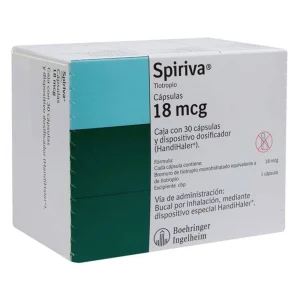
TM Owner Boehringer Ingelheim
Spiriva 18mcg/capsule Inhaler
Global Shipping : Reliable Global Distribution Network
Express Delivery : Priority Shipping for Every Order
Secure Payments : Trusted Payment Protection System
 Disclaimer

Secure Handling
24/7 Worldwide Support

Global Access
Worldwide Access to Health

Cold-Chain Expert
Excellence in Cold-Chain

Trusted Supply
Certified Medical Supply
Indications & Clinical Uses
- No FDA or EU product is approved under the standalone brand name 'Spiriva' for a capsule inhaler; the approved brand name for this 18 mcg tiotropium bromide dry-powder capsule and its inhalation device is 'Spiriva HandiHaler'.
- This entry's strength (18 mcg per capsule) and pack size (30 capsules) match the Spiriva HandiHaler product exactly, so the content below is drawn from the Spiriva HandiHaler label.
- Tiotropium bromide is a long-acting anticholinergic bronchodilator inhaled once daily through the HandiHaler device - the capsules are never swallowed.
- It is approved for long-term, once-daily maintenance treatment of bronchospasm associated with COPD, including chronic bronchitis and emphysema, and to reduce COPD exacerbations, in adults.
- It is not approved for asthma and is not a reliever for sudden breathlessness.
- This capsule-and-device product must not be confused with the separately dosed Spiriva Respimat spray (2.5 mcg per actuation).
Side Effects
- The most common side effect is dry mouth, reported in up to 16% of patients in year-long trials, along with upper respiratory tract infection, sinusitis, sore throat and urinary tract infection.
- No boxed warning appears on the label this content is based on (Spiriva HandiHaler).
- Less common but serious effects include immediate hypersensitivity reactions such as angioedema, rash or, rarely, anaphylaxis - stop the medicine and seek urgent care for facial, lip or throat swelling or breathing difficulty.
- Paradoxical bronchospasm, a sudden worsening of wheeze right after inhaling, can occur; if it does, stop the medicine, use your reliever inhaler, and contact your provider.
- Tell your provider about new eye pain, blurred vision, or difficulty passing urine.
Precautions & Warnings
- This product is contraindicated in people with known hypersensitivity to tiotropium, atropine or its derivatives.
- Use cautiously if you have narrow-angle glaucoma, since anticholinergics can worsen eye pressure, or urinary retention or bladder outlet obstruction, since it can make emptying the bladder harder.
- It is not a rescue treatment for sudden breathlessness.
- Moderate-to-severe kidney impairment increases drug exposure, so your provider may monitor you more closely.
- Pregnancy and breastfeeding data are limited - discuss with your provider.
- Load only one capsule into the HandiHaler device immediately before each use, and never swallow the capsules; they work only when inhaled as a powder.
Avoid Interactions
- Avoid combining this tiotropium capsule with other anticholinergic (antimuscarinic) medicines, such as ipratropium, since the effects can add up and increase the risk of dry mouth, urinary retention and eye problems.
- No clinically significant interactions have been found with commonly co-prescribed sympathomimetics such as salbutamol, theophylline, or inhaled or oral corticosteroids, so it can normally be combined with these standard COPD treatments.
- Tell your healthcare provider about every medicine, herbal product and supplement you take, particularly any other inhalers, to avoid unintentionally doubling up on anticholinergic treatment.
References
Frequently Asked Questions
Spiriva (tiotropium) is a once-daily inhaled capsule for long-term maintenance treatment of COPD, including chronic bronchitis and emphysema, and to reduce flare-ups. This 18 mcg capsule and 30-capsule pack match the Spiriva HandiHaler product; it's not approved for asthma or sudden breathlessness.
Load one Spiriva capsule into the HandiHaler device just before use, pierce it by pressing the button once, then inhale the powder deeply through the mouthpiece once daily. Never swallow the capsules; they work only when inhaled, not taken by mouth.
The most common side effect is dry mouth, along with respiratory and urinary tract infections and sore throat. Get urgent help for facial or throat swelling, breathing difficulty, or sudden worse wheeze right after inhaling, since these can signal a rare but serious reaction.
Avoid other anticholinergic medicines, such as ipratropium, alongside Spiriva, since their effects can add up. It's generally fine combined with salbutamol, theophylline, or inhaled and oral steroids. Tell your provider about every inhaler and medicine you use to avoid unnecessary overlap.
Yes, based on this pack's strength and size. There is no separate FDA- or EU-approved brand called just 'Spiriva' for a capsule; the approved name for this 18 mcg capsule-and-device product is Spiriva HandiHaler, and that is the label this information comes from.
No. Spiriva capsules deliver 18 mcg tiotropium through the HandiHaler device, while Spiriva Respimat is a different metered-spray inhaler delivering 2.5 mcg per puff. The two are not interchangeable, and a capsule must never be opened into a Respimat device.

Trusted & Reliable – Your Partner in Global Distribution.
We provide comprehensive lines of pharmaceutical products to support all your healthcare distribution needs.


