

TM Owner Roche / Genentech
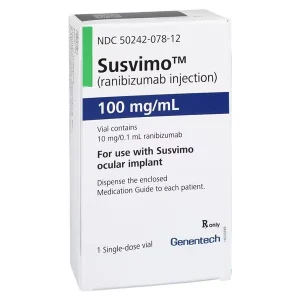
Susvimo 100mg/mL Implant
Global Shipping : Reliable Global Distribution Network
Express Delivery : Priority Shipping for Every Order
Secure Payments : Trusted Payment Protection System
 Disclaimer

Secure Handling
24/7 Worldwide Support

Global Access
Worldwide Access to Health

Cold-Chain Expert
Excellence in Cold-Chain

Trusted Supply
Certified Medical Supply
Indications & Clinical Uses
- Susvimo 100 mg/mL is the brand name for ranibizumab supplied for use only through the Susvimo ocular implant, a permanent, surgically placed, refillable port that continuously releases the anti-VEGF antibody fragment into the eye.
- It is approved in the United States for adults with neovascular (wet) age-related macular degeneration who have previously responded to at least two anti-VEGF injections, and the label has since been expanded to cover diabetic macular edema and diabetic retinopathy under the same prior-response requirement.
- A retina specialist surgically inserts the implant once and refills it with fresh ranibizumab in the clinic roughly every 24 weeks, replacing the need for monthly injections; it is not for self-treatment at home.
- Genentech voluntarily recalled the original Susvimo implant in October 2022 after reports that its internal septum could partly detach during refill, and reintroduced a redesigned implant in July 2024 after FDA review; this is a manufacturer device recall and update, not a withdrawal of the drug's approval.
Side Effects
- The most common reactions after implantation or a refill procedure are conjunctival hemorrhage, affecting the large majority of patients, along with conjunctival hyperemia (redness), eye pain, iritis, and cataract; vitreous hemorrhage is also common.
- Susvimo carries a boxed warning: the implant has been associated with up to a three-fold higher rate of endophthalmitis (serious intraocular infection) compared with monthly ranibizumab injections, and many of these infections were linked to conjunctival retraction or erosion exposing the implant.
- Seek emergency eye care immediately for new eye pain, worsening redness, light sensitivity, blurred or reduced vision, or floaters after implantation or a refill, since these can signal endophthalmitis, retinal detachment or implant-related bleeding.
- Rhegmatogenous retinal detachment and implant dislocation have also been reported and need prompt specialist assessment.
Precautions & Warnings
- Susvimo is for intravitreal use only via the surgically implanted device; it must never be given as a standard eye injection.
- Your retina specialist will examine the conjunctiva and implant position at every visit to check for erosion, retraction or septum problems, since the earlier 2022 recalled implant was linked to septum dislodgement during refill; the current implant introduced in 2024 does not share this specific defect but ongoing monitoring is still required.
- Susvimo should not be used if there is an active eye or periocular infection, uncontrolled glaucoma, or known hypersensitivity to ranibizumab.
- Blood-thinning medicines may be temporarily stopped before the implant is inserted or refilled to reduce bleeding risk; discuss this with your surgeon well before the procedure.
- Systemic absorption is low but anti-VEGF agents carry a theoretical risk in pregnancy, so effective contraception is advised during treatment; there are no pediatric data.
Avoid Interactions
- Because Susvimo acts locally within the eye, it has few systemic drug interactions, but you should still tell your eye surgeon and other doctors about every medicine you take.
- Anticoagulant and antiplatelet drugs, such as warfarin, aspirin or clopidogrel, may need to be paused for a short period around implant insertion or refill to lower the risk of bleeding at the surgical site; never stop these medicines yourself without your prescriber's guidance.
- Using other intravitreal anti-VEGF treatments in the same eye alongside Susvimo is not established and should be avoided unless your retina specialist specifically directs it.
- There is no dietary restriction, but avoid rubbing or pressing on the treated eye, and report any new eye medicine, including over-the-counter drops, before starting.
References
Frequently Asked Questions
Susvimo (ranibizumab) treats wet age-related macular degeneration, diabetic macular edema and diabetic retinopathy in adults who already responded to at least two anti-VEGF eye injections. It is delivered continuously from a permanent implant instead of repeated monthly injections into the eye.
A retina specialist surgically places the Susvimo implant in the eye once, then refills it with ranibizumab in the clinic about every 24 weeks (6 months). You do not inject it yourself, and there is no tablet, drop or at-home dose.
Common effects are eye redness, bleeding on the eye surface, pain and cataract. Susvimo carries a boxed warning: the implant raises endophthalmitis (serious eye infection) risk up to three-fold versus monthly injections. Get urgent care for eye pain, redness or vision loss.
Yes. Genentech voluntarily recalled the original Susvimo implant in October 2022 over a septum dislodgement risk during refill procedures. A redesigned implant was FDA-approved in July 2024, and Susvimo is now back on the US market with this updated device.
Your retina specialist examines the implant and surrounding eye tissue, then refills the reservoir with fresh ranibizumab through the septum, roughly every 24 weeks. You should report any new eye pain, redness or blurred vision before your next scheduled refill.
Data on ranibizumab in pregnancy are limited, and anti-VEGF treatment carries a theoretical risk to a developing fetus, so effective contraception is advised while using Susvimo. Discuss pregnancy plans and the timing of implantation or refills with your retina specialist beforehand.

Trusted & Reliable – Your Partner in Global Distribution.
We provide comprehensive lines of pharmaceutical products to support all your healthcare distribution needs.


