

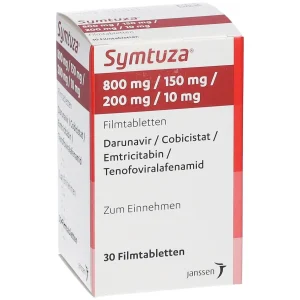
TM Owner Janssen
Symtuza 800mg + 150mg + 200mg + 10mg Tablet
Global Shipping : Reliable Global Distribution Network
Express Delivery : Priority Shipping for Every Order
Secure Payments : Trusted Payment Protection System
 Disclaimer

Secure Handling
24/7 Worldwide Support

Global Access
Worldwide Access to Health

Cold-Chain Expert
Excellence in Cold-Chain

Trusted Supply
Certified Medical Supply
Indications & Clinical Uses
- Symtuza 800 mg/150 mg/200 mg/10 mg tablets combine darunavir (a protease inhibitor), cobicistat (a boosting agent), emtricitabine, and tenofovir alafenamide (two nucleoside/nucleotide reverse transcriptase inhibitors) into a single-tablet, once-daily complete regimen for HIV-1 infection.
- It is approved in the US and EU for adults and paediatric patients weighing at least 40 kg who are either antiretroviral treatment-naive or virologically suppressed (HIV-1 RNA under 50 copies/mL) on a stable regimen for at least six months, with no history of treatment failure and no known darunavir-resistance-associated substitutions.
- Symtuza is taken as one tablet daily with food and is manufactured by Janssen (Janssen-Cilag International NV, Belgium, for the EU; Janssen Products, LP for the US).
Side Effects
- Common side effects include diarrhoea (about 9%), rash (about 8%), nausea, fatigue, and headache.
- Symtuza carries a boxed warning: severe, sometimes life-threatening flare-ups of hepatitis B can occur in people co-infected with HIV and hepatitis B virus (HBV) if Symtuza is stopped, so liver function must be monitored closely for several months after discontinuation, and re-starting anti-HBV treatment may be needed.
- Other serious but less common reactions include severe skin reactions such as Stevens-Johnson syndrome, new or worsening liver problems, and immune reconstitution syndrome (worsening of pre-existing infections as immunity recovers).
- Seek urgent medical attention for yellowing skin/eyes, severe rash, or unusual tiredness with vomiting.
Precautions & Warnings
- Symtuza is contraindicated with drugs highly dependent on CYP3A for clearance where high plasma levels are associated with serious reactions, including rifampin, carbamazepine, phenobarbital, St John's wort, simvastatin, lovastatin, oral midazolam, sildenafil for pulmonary hypertension, and alfuzosin.
- All patients should be tested for hepatitis B before starting, because of the boxed warning risk of HBV flare on stopping treatment; liver function should be monitored during and for several months after discontinuation.
- Renal function, bone density, and body weight/lipid changes should be monitored periodically.
- Symtuza is not recommended in severe hepatic impairment, and hormonal contraceptive efficacy may be reduced, so alternative or additional contraception should be used.
- Use in pregnancy should be discussed with a healthcare provider; data suggest it can be used when clinically needed.
Avoid Interactions
- Cobicistat is a strong CYP3A/P-glycoprotein inhibitor, so Symtuza increases levels of many co-administered drugs, including certain statins, corticosteroids (e.g., inhaled/intranasal fluticasone, which can cause Cushing's syndrome), PDE5 inhibitors, anticoagulants, and immunosuppressants — dose adjustment or avoidance may be required.
- St John's wort and other strong CYP3A inducers reduce darunavir levels and can cause loss of virologic response and resistance.
- Proton pump inhibitors are not recommended with Symtuza; antacids and buffered medicines should be separated by several hours.
- Tell your healthcare provider about every prescription, over-the-counter medicine, and herbal supplement you take, since many clinically significant interactions exist with this regimen.
References
Frequently Asked Questions
Symtuza is a complete, once-daily HIV-1 treatment combining darunavir, cobicistat, emtricitabine, and tenofovir alafenamide in one tablet. It is used in adults and children over 40 kg who are new to treatment or already virologically suppressed on stable therapy, with no darunavir resistance. It does not cure HIV but controls the virus long term.
Take one Symtuza tablet by mouth once daily, with food, at about the same time each day. Do not skip doses, since missed doses can allow the virus to become resistant. Swallow the tablet whole; do not chew or crush it.
Common effects are diarrhoea, rash, nausea, and headache. Symtuza carries a boxed warning: in people also infected with hepatitis B, stopping Symtuza can trigger a severe hepatitis B flare-up, so liver tests are needed for months after stopping. Report yellow skin/eyes or severe rash urgently.
Avoid rifampin, carbamazepine, St John's wort, simvastatin, lovastatin, oral midazolam, and sildenafil for pulmonary hypertension — these are contraindicated with Symtuza. Proton pump inhibitors are not recommended. Hormonal contraceptives may work less well, so use an additional method. Tell your provider about every medicine you take.
Take the missed dose with food as soon as you remember, unless it is close to your next dose, in which case skip it and continue your normal schedule — never double up. Missing doses regularly raises the risk of drug resistance, so set a daily reminder and contact your provider if you miss doses often.
Symtuza may be used in pregnancy when a healthcare provider judges it necessary, with monitoring. It is approved for children and adolescents weighing at least 40 kg who meet the same treatment criteria as adults; it is not established for lighter-weight children.

Trusted & Reliable – Your Partner in Global Distribution.
We provide comprehensive lines of pharmaceutical products to support all your healthcare distribution needs.


