

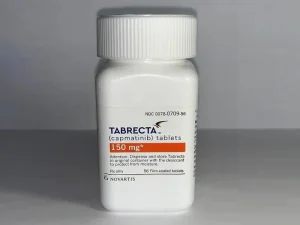
TM Owner Novartis
Tabrecta 200mg Tablet
Global Shipping : Reliable Global Distribution Network
Express Delivery : Priority Shipping for Every Order
Secure Payments : Trusted Payment Protection System
 Disclaimer

Secure Handling
24/7 Worldwide Support

Global Access
Worldwide Access to Health

Cold-Chain Expert
Excellence in Cold-Chain

Trusted Supply
Certified Medical Supply
Indications & Clinical Uses
- Tabrecta 200 mg (capmatinib) is a kinase-inhibitor tablet taken by mouth, approved in the United States for adults with metastatic non-small cell lung cancer (NSCLC) whose tumours have a mutation that leads to MET exon 14 skipping, confirmed by an FDA-approved test; capmatinib blocks the abnormal MET receptor signalling that drives tumour growth in this molecular subgroup.
- Tabrecta is also available as a 150 mg tablet, and the two strengths are not interchangeable milligram-for-milligram: the standard dose is 400 mg (two 200 mg tablets) taken twice daily, with or without food, and continued for as long as it provides benefit.
- Treatment is started and monitored by a cancer specialist, though the tablets are taken by the patient at home.
Side Effects
- The most common side effects of Tabrecta, each affecting more than 20% of patients, are swelling (oedema, about 6 in 10 people), nausea, musculoskeletal pain, fatigue, vomiting, breathlessness, cough and reduced appetite.
- Tabrecta does not carry a boxed warning, but two reactions need urgent attention: interstitial lung disease or pneumonitis, seen in about 5% of patients and potentially life-threatening, so report any new or worsening cough, shortness of breath or fever straight away; and liver injury, seen as raised liver enzymes in around 15% of patients and monitored with regular blood tests.
- Seek prompt medical advice for yellowing of the skin or eyes, dark urine, or swelling severe enough to affect breathing.
Precautions & Warnings
- Before starting Tabrecta, and periodically during treatment, your healthcare provider checks liver function tests and asks about respiratory symptoms; treatment is interrupted or permanently stopped for interstitial lung disease/pneumonitis or significant liver enzyme rises.
- Capmatinib can harm an unborn baby, so effective contraception is required during treatment and for one week after the final dose for patients and partners who could become pregnant; breastfeeding is not recommended during treatment and for one week afterwards.
- Dose adjustment is needed for moderate to severe liver impairment.
- Tabrecta tablets are swallowed whole with water, with or without food, at about the same times each day; do not crush, break or chew them.
Avoid Interactions
- Avoid taking Tabrecta with strong or moderate CYP3A4 inhibitors (such as itraconazole, clarithromycin or ritonavir) or with grapefruit and grapefruit juice, as these can raise capmatinib levels and increase the risk of side effects; if an inhibitor cannot be avoided, the dose may be reduced.
- Avoid strong or moderate CYP3A4/P-glycoprotein inducers (such as rifampicin, carbamazepine, phenytoin or St John's wort), which can lower capmatinib levels and reduce how well it works against the cancer.
- Tell your healthcare provider about every prescription and over-the-counter medicine, herbal product and supplement you take, since many drugs affect these same liver enzyme pathways.
References
Frequently Asked Questions
Tabrecta (capmatinib) treats adults with metastatic non-small cell lung cancer whose tumours have a MET exon 14 skipping mutation, confirmed by an FDA-approved test. It blocks the abnormal MET signalling that drives tumour growth in this specific molecular subgroup of lung cancer.
Tabrecta is taken by mouth as 400 mg (two 200 mg tablets) twice daily, with or without food, swallowed whole with water. Take it at about the same times each day and do not crush or chew the tablets. It is also sold as a 150 mg tablet for other dose levels.
Very common effects of Tabrecta (capmatinib) include swelling, nausea, musculoskeletal pain, fatigue and vomiting. Watch for interstitial lung disease (new cough, breathlessness or fever) and liver problems (yellowing skin, dark urine), which affect a smaller number of patients and need urgent medical review.
Avoid grapefruit and grapefruit juice while taking Tabrecta (capmatinib). Strong or moderate CYP3A4 inhibitors like clarithromycin can raise capmatinib levels, while inducers like rifampicin or St John's wort can lower them and reduce effectiveness. Tell your healthcare provider about every other medicine you use.
You'll have liver function blood tests before starting Tabrecta and regularly during treatment, since raised liver enzymes occur in around 15% of patients. Your doctor will also ask about new cough, breathlessness or fever at each visit to check for interstitial lung disease or pneumonitis.
No. Tabrecta (capmatinib) can harm an unborn baby, so effective contraception is required during treatment and for one week after the last dose, for patients and partners who could become pregnant. Breastfeeding is not recommended during treatment or for one week afterwards.

Trusted & Reliable – Your Partner in Global Distribution.
We provide comprehensive lines of pharmaceutical products to support all your healthcare distribution needs.


