

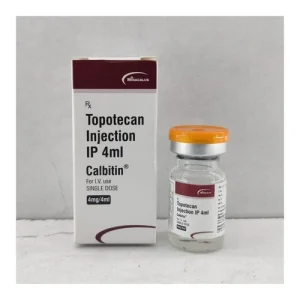
TM Owner Teva Pharmaceuticals
Topotecan 4mg/4ml Vial
Global Shipping : Reliable Global Distribution Network
Express Delivery : Priority Shipping for Every Order
Secure Payments : Trusted Payment Protection System
 Disclaimer

Secure Handling
24/7 Worldwide Support

Global Access
Worldwide Access to Health

Cold-Chain Expert
Excellence in Cold-Chain

Trusted Supply
Certified Medical Supply
Indications & Clinical Uses
- Topotecan Injection 4 mg/4 mL (1 mg/mL topotecan hydrochloride), marketed generically by Teva Pharmaceuticals among other manufacturers, contains the same active substance sold under the originator brand Hycamtin.
- It is a topoisomerase I inhibitor approved for metastatic ovarian cancer after failure of first-line or subsequent chemotherapy; for small cell lung cancer with platinum-sensitive disease that has progressed at least 60 days after starting first-line treatment; and, combined with cisplatin, for stage IV-B, recurrent or persistent cervical cancer not suitable for curative surgery or radiotherapy. 'Topotecan' as used on this sheet refers to the generic molecule name rather than a distinctive proprietary brand; this content is based on Teva's US label for the 4 mg/4 mL solution, which matches the sheet's stated manufacturer.
- Topotecan is given only in a hospital or oncology clinic, by intravenous infusion over 30 minutes; it is never self-administered.
Side Effects
- Topotecan carries a boxed warning for severe myelosuppression: the first cycle should only be started in patients with a neutrophil count of at least 1,500/mm3 and a platelet count of at least 100,000/mm3, and blood counts are monitored closely throughout treatment.
- Neutropenia occurs in most patients (about 78%) and can be severe; low platelets and anaemia are also very common.
- Hair loss affects roughly half of patients.
- Nausea (64%), vomiting (45%), fatigue (29%) and diarrhoea (32%) are frequent but usually manageable with supportive medicines.
- A rare but serious risk is interstitial lung disease, with cough, fever, breathlessness or low oxygen that can be fatal if untreated - report new breathing symptoms immediately.
- Extravasation (leakage of the drug outside the vein) usually causes only mild redness or bruising at the infusion site.
Precautions & Warnings
- Topotecan must not be given for a first cycle if the neutrophil count is below 1,500/mm3 or the platelet count below 100,000/mm3; blood counts are rechecked before every subsequent cycle and doses are adjusted or delayed for low counts.
- Topotecan can cause fetal harm, including malformations seen in animal studies, so effective contraception is required during treatment; it should be avoided in pregnancy and breastfeeding.
- Dose reduction is needed in moderate kidney impairment (creatinine clearance 20-39 mL/min); data are insufficient in severe kidney impairment.
- No dose adjustment is generally needed for mild-to-moderate liver impairment, but it should be used with caution.
- If growth-factor support (G-CSF) is used, it should not be started until at least 24 hours after finishing the topotecan infusion.
- Topotecan is prepared and given only in a hospital or oncology day-unit setting, never as a take-home or self-injected medicine.
Avoid Interactions
- When combined with a platinum agent such as cisplatin, giving topotecan and the platinum drug on the same day requires lower doses of each than giving them on separate days of the cycle, because combining them increases the risk of severe low blood counts; your oncology team follows a specific sequencing schedule.
- Laboratory studies show topotecan does not significantly inhibit the major cytochrome P450 liver enzymes, so formal drug-interaction studies with other medicines have not been required, but no medicine should be assumed to be safe with it.
- Avoid live vaccines during treatment because of chemotherapy-related immune suppression.
- If G-CSF (a white-cell growth factor) is used, it should not start until 24 hours after the topotecan infusion ends, to avoid worsening neutropenia.
- Tell your care team about every prescription, over-the-counter medicine, herbal remedy and supplement you take.
References
Frequently Asked Questions
Topotecan (topotecan hydrochloride) treats ovarian cancer that has come back after chemotherapy, small cell lung cancer that has progressed after treatment, and, with cisplatin, advanced cervical cancer. It's the generic name for the drug sold as Hycamtin; this content covers Teva's generic topotecan injection.
Topotecan is given as an intravenous infusion over 30 minutes, once daily for several days, repeated every 3 weeks, by a cancer care team in a hospital or clinic. There is no oral tablet form of this injection, and it is never given by the patient at home.
Topotecan's boxed warning is severe myelosuppression - low white cells, platelets and red cells - so blood counts are checked before every cycle. Hair loss, nausea, vomiting, fatigue and diarrhoea are also common. Rarely, it causes interstitial lung disease; report new cough, fever or breathlessness right away.
Avoid live vaccines during Topotecan treatment because chemotherapy weakens your immune response to them. Effective contraception is needed, since topotecan can harm an unborn baby. If you also need a white-cell growth factor (G-CSF), it should start at least 24 hours after your topotecan infusion ends.
Before every Topotecan cycle, your neutrophil and platelet counts are checked; the first cycle only starts if neutrophils are at least 1,500/mm3 and platelets at least 100,000/mm3. Later cycles are delayed or dose-reduced if counts are too low, to reduce infection and bleeding risk.
Yes. Topotecan is the active ingredient in the brand Hycamtin, and generic topotecan injection, such as Teva's, contains the same topotecan hydrochloride at the same 1 mg/mL strength. Storage, dosing and side effects are the same; only the manufacturer and packaging differ.

Trusted & Reliable – Your Partner in Global Distribution.
We provide comprehensive lines of pharmaceutical products to support all your healthcare distribution needs.


