

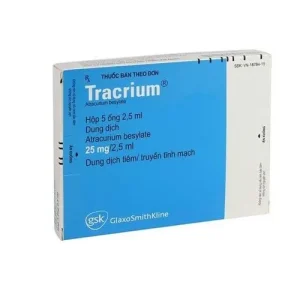
TM Owner Aspen Pharma Trading Ltd (formerly GSK)
Tracrium 10mg/mL Injection
Global Shipping : Reliable Global Distribution Network
Express Delivery : Priority Shipping for Every Order
Secure Payments : Trusted Payment Protection System
 Disclaimer

Secure Handling
24/7 Worldwide Support

Global Access
Worldwide Access to Health

Cold-Chain Expert
Excellence in Cold-Chain

Trusted Supply
Certified Medical Supply
Indications & Clinical Uses
- The Tracrium brand is discontinued in the United States (generic atracurium remains available, per RxList), but it is still listed with Aspen Pharma Trading Limited in Ireland; GSK sold its anaesthesia portfolio, including Tracrium, to Aspen in 2017.
- Tracrium 10 mg/mL (atracurium besilate, called besylate in the US) is a neuromuscular blocking agent (muscle relaxant) given by injection or infusion into a vein, only by or under the direction of experienced anaesthetists with resuscitation and ventilation equipment available.
- It is used as an adjunct to general anaesthesia to help tracheal intubation and to relax skeletal muscle during surgery and mechanical ventilation in intensive care.
- The Irish label covers adults and children over 1 month.
- It is supplied as 2.5 mL and 5 mL ampoules and 25 mL vials, and is hospital-administered only.
Side Effects
- Common effects (up to 1 in 10 people) are low blood pressure and skin flushing or reddening; bronchospasm is uncommon, hives (urticaria) rare, and very rare effects include serious allergic reactions (anaphylaxis), heart rhythm disturbances and, after prolonged use in intensive care, muscle weakness or myopathy and seizures.
- Histamine release can cause flushing, itching, wheezing and changes in heart rate, and allergic reactions can be severe.
- The US label carries no boxed warning; the Irish SmPC has none.
- Because the medicine relaxes skeletal muscle, breathing must be supported by trained staff until you fully recover, and you should report any breathing difficulty, rash or swelling immediately.
Precautions & Warnings
- Tracrium relaxes skeletal muscle, so it must only be given by experienced anaesthetists with equipment for intubation and artificial ventilation immediately available; it must never be given into a muscle.
- It is contraindicated in allergy to atracurium, cisatracurium (Nimbex) or the ingredients, and after prior severe anaesthetic reactions; do not confuse it with other neuromuscular blockers.
- Extra care is needed in myasthenia gravis and other neuromuscular disease, severe electrolyte imbalance, low blood volume, burns, asthma or allergy with histamine sensitivity, cardiovascular disease (inject slowly) and in older people (lower starting doses).
- Studies indicate it does not trigger malignant hyperthermia.
- Discuss pregnancy and breastfeeding with your anaesthetist.
- Store at 2 to 8 C, do not freeze, protect from light.
- Do not mix with thiopental or other alkaline solutions.
Avoid Interactions
- Increased or prolonged muscle-relaxant effect: volatile anaesthetics (enflurane, isoflurane, halothane), ketamine and ether, aminoglycoside and some other antibiotics, lithium, magnesium salts, procainamide, quinidine and other antiarrhythmics; the anaesthetist adjusts the dose.
- Reduced effect: anticholinesterases such as donepezil can counteract atracurium.
- Pharmacy incompatibilities: do not mix in the same syringe or line with thiopental or other alkaline solutions.
- Tell the anaesthetic team about all prescription, over-the-counter and herbal medicines you take, and about any history of allergic reactions to anaesthetics or muscle relaxants, so that the doses and monitoring can be planned around them before you are given the medicine.
References
- Tracrium 10 mg/ml solution for injection or infusion - Summary of Product Characteristics, HPRA (Ireland)
- Atracurium Besilate 10mg/ml solution for injection/infusion - Summary of Product Characteristics, eMC
- Tracrium (atracurium besylate) - RxList
- GSK confirms closure of agreement to divest anaesthesia portfolio to Aspen - GSK press release
Frequently Asked Questions
Tracrium (atracurium besilate) is a muscle relaxant given during general anaesthesia to help place a breathing tube and relax muscles during surgery or intensive care ventilation. It is used in adults and children over 1 month. Only a hospital anaesthetic team gives it.
Tracrium (atracurium) is given into a vein, as an injection or a continuous infusion, by an anaesthetist. Adults usually receive an initial dose of 0.3 to 0.6 mg/kg with further doses if needed. It is never given into a muscle.
Low blood pressure and skin flushing are common with Tracrium (atracurium). Bronchospasm is uncommon. Very rarely, serious allergic reactions, heart rhythm problems, or muscle weakness after long intensive care use occur. Your anaesthetic team watches for these and treats them. It has no boxed warning.
Tell the anaesthetist about all your medicines before Tracrium (atracurium). Volatile anaesthetics, some antibiotics, lithium, magnesium and antiarrhythmics can strengthen its effect, and donepezil can weaken it. Do not use it if you have had an allergy to atracurium or cisatracurium. It must not be mixed with thiopental.
Tracrium (atracurium) relaxes skeletal muscle, so only experienced anaesthetists should give it, with equipment for intubation and artificial ventilation immediately available. Trained staff can support your breathing until the effect wears off. It is never given into a muscle, and the dose depends on your weight and response.
Tracrium (atracurium) needs extra care in myasthenia gravis and other neuromuscular diseases, and in burns, severe electrolyte imbalance and low blood volume. Tell your anaesthetist beforehand so the dose can be adjusted. Studies indicate it does not trigger malignant hyperthermia.

Trusted & Reliable – Your Partner in Global Distribution.
We provide comprehensive lines of pharmaceutical products to support all your healthcare distribution needs.


