

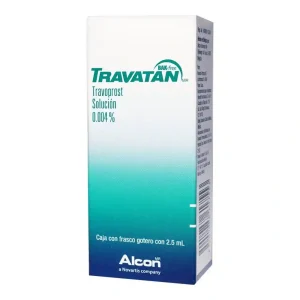
TM Owner Alcon
Travatan 0.04mg/ml Eye Drop
Global Shipping : Reliable Global Distribution Network
Express Delivery : Priority Shipping for Every Order
Secure Payments : Trusted Payment Protection System
 Disclaimer

Secure Handling
24/7 Worldwide Support

Global Access
Worldwide Access to Health

Cold-Chain Expert
Excellence in Cold-Chain

Trusted Supply
Certified Medical Supply
Indications & Clinical Uses
- Travatan (travoprost ophthalmic solution) 0.004% has been discontinued from the US market for business reasons and is no longer actively marketed there; it was Alcon's original benzalkonium chloride (BAK)-preserved formulation, approved by the FDA in 2001 (NDA 21-257) to lower elevated eye pressure in adults with open-angle glaucoma or ocular hypertension.
- It is listed on the FDA Orange Book's Discontinued Drug Product List, and a 2011 Federal Register notice confirms this was NOT a safety- or effectiveness-driven withdrawal, which is why generic travoprost 0.004% products remain approved by reference to it.
- Alcon's currently marketed BAK-free reformulation, Travatan Z, and multiple generic travoprost 0.004% eye drops have effectively replaced this original brand in US pharmacies.
- Travoprost is a prostaglandin analogue given as one drop in the affected eye(s) once daily, usually in the evening; it must not be confused with Travatan Z, which uses a different, BAK-free preservative system.
Side Effects
- The most common side effect of Travatan (travoprost) is eye redness (conjunctival hyperaemia), affecting roughly 30% to 50% of patients; decreased visual acuity, eye discomfort, a feeling of something in the eye, pain and itching occur in about 5% to 10%.
- There is no boxed warning on the label.
- Travoprost can cause a gradual, likely permanent increase in brown pigmentation of the iris, and eyelashes may become longer, thicker or more numerous, changes that are usually reversible after stopping treatment.
- Periorbital skin darkening can also occur and may lessen with continued use.
- More serious but less common effects include intraocular inflammation (uveitis), macular oedema (particularly in patients without a natural or intact lens), and bacterial keratitis linked to contaminated bottles.
- Seek prompt eye-care review for new eye pain, worsening redness, sudden vision changes, light sensitivity or discharge, rather than waiting for a routine follow-up.
Precautions & Warnings
- Travatan (BAK-preserved formulation) contains benzalkonium chloride 0.015% as a preservative, which can be absorbed by soft contact lenses; remove lenses before instilling a drop and wait at least 15 minutes before reinserting them.
- It should be used cautiously in people with intraocular inflammation, in aphakic or pseudophakic patients or those with other risk factors for macular oedema, and in anyone with a history of herpetic keratitis, since prostaglandin analogues have rarely been linked to reactivation.
- To reduce the risk of bacterial keratitis from a contaminated dropper tip, avoid letting the bottle tip touch the eye, eyelid or any surface.
- If more than one eye drop is required, space different eye medicines at least 5 minutes apart.
- Discuss use in pregnancy and breastfeeding with your eye specialist, as data are limited.
- Tell your optometrist or ophthalmologist that you use Travatan before any eye examination, since it can permanently change iris colour and eyelash appearance.
Avoid Interactions
- Tell your eye specialist about every eye drop, medicine and supplement you use before starting Travatan (travoprost).
- When more than one topical eye medicine is required, wait at least 5 minutes between different drops so each one is properly absorbed and not washed out by the next.
- There are no known clinically significant systemic drug interactions with travoprost at the low doses absorbed from an eye drop, but you should still avoid using other prostaglandin-analogue eye drops, such as latanoprost, bimatoprost or tafluprost, at the same time, since combining two drugs from this class does not improve pressure control and increases side effects.
- Do not touch the dropper tip to the eye or any surface, and do not share your eye drops with anyone else, to avoid contamination and cross-infection.
References
Frequently Asked Questions
Travatan (travoprost) 0.004% eye drops lower high eye pressure in adults with open-angle glaucoma or ocular hypertension. This original, preserved formulation has been discontinued in the US for business reasons, not safety, and has been replaced there by Travatan Z and generic travoprost drops.
Travatan is given as one drop in the affected eye or eyes, usually once daily in the evening. Wash your hands first, avoid touching the dropper tip to your eye, and wait at least 5 minutes before using any other eye drop.
Eye redness affects 30% to 50% of people using Travatan (travoprost); eye discomfort, blurred vision and a foreign-body feeling are also common. It can permanently darken the iris and lengthen eyelashes. Get urgent eye care for new pain, worsening redness or sudden vision changes.
Avoid wearing soft contact lenses when instilling Travatan (travoprost); remove them first and wait 15 minutes before putting them back in, since the drops contain a preservative lenses can absorb. Don't combine it with other prostaglandin eye drops, and don't let the bottle tip touch your eye.
Yes, in the US. The FDA confirms the original Travatan brand was discontinued for business reasons, not for safety or effectiveness. Travatan Z, a preservative-free reformulation, and generic travoprost 0.004% drops are the products currently available in its place.
Travatan contains the preservative benzalkonium chloride (BAK), which some people react to with irritation. Travatan Z is Alcon's BAK-free reformulation of the same travoprost 0.004%, made for people sensitive to BAK. Ask your eye specialist which formulation, if either, is currently available to you.

Trusted & Reliable – Your Partner in Global Distribution.
We provide comprehensive lines of pharmaceutical products to support all your healthcare distribution needs.


