

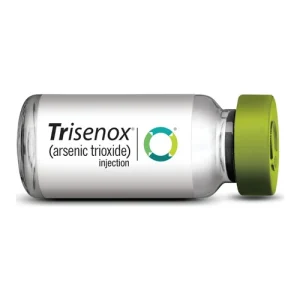
TM Owner Teva Pharmaceuticals
Trisenox 1mg/ml Injection
Global Shipping : Reliable Global Distribution Network
Express Delivery : Priority Shipping for Every Order
Secure Payments : Trusted Payment Protection System
 Disclaimer

Secure Handling
24/7 Worldwide Support

Global Access
Worldwide Access to Health

Cold-Chain Expert
Excellence in Cold-Chain

Trusted Supply
Certified Medical Supply
Indications & Clinical Uses
- Trisenox 1mg/mL (arsenic trioxide), distributed in the US by Teva Pharmaceuticals USA, Inc. (a Cephalon/Teva company), is a chemotherapy medicine approved for adults with acute promyelocytic leukaemia (APL), a rare, aggressive form of acute myeloid leukaemia.
- It is used in combination with tretinoin for newly diagnosed, low-risk APL, and alone for APL that has relapsed or not responded to earlier retinoid- and anthracycline-based chemotherapy, in patients whose leukaemia carries the characteristic t(15;17) genetic change or PML/RAR-alpha gene.
- Trisenox is given only in a hospital or specialist oncology clinic, as a slow intravenous infusion over 1 to 2 hours (up to 4 hours if reactions occur), never self-administered at home.
- It is not a treatment for other types of leukaemia or cancer and must only be prescribed by clinicians experienced in APL management, with close inpatient or outpatient monitoring.
Side Effects
- Trisenox carries a boxed warning for differentiation syndrome, cardiac conduction abnormalities and encephalopathy.
- Differentiation syndrome can cause fever, breathing difficulty, lung infiltrates, fluid around the heart or lungs, and low blood pressure, and needs immediate high-dose corticosteroid treatment.
- Trisenox can prolong the heart's QT interval, which may lead to a dangerous irregular heartbeat (torsades de pointes) or sudden cardiac death, so heart tracings and blood electrolytes are checked regularly during treatment.
- Serious encephalopathy, including Wernicke's encephalopathy, has occurred and needs urgent treatment interruption and thiamine.
- Very common reactions include nausea, vomiting, diarrhoea, fatigue, fever, headache, cough, low potassium or magnesium, and a fast heartbeat.
- Report chest pain, palpitations, breathlessness or fainting immediately.
Precautions & Warnings
- Because of its boxed warnings, Trisenox requires an ECG and blood electrolyte check before starting and regular monitoring throughout treatment; it should be avoided in patients with a prolonged QT interval or ventricular arrhythmia unless the abnormality is corrected first, and interacting QT-prolonging medicines should be stopped where possible before dosing.
- Liver function is checked twice weekly during induction.
- Arsenic trioxide is classified as a human carcinogen and can cause fetal harm; women should use effective contraception during treatment and for at least 6 months after the last dose, and men for at least 3 months after, and breastfeeding should not continue during treatment.
- Thiamine deficiency should be assessed and corrected before or during treatment to reduce encephalopathy risk.
- Trisenox must be given by, or under the direct supervision of, clinicians experienced in treating acute leukaemia, with resuscitation facilities available.
Avoid Interactions
- Avoid other medicines that prolong the QT interval - such as certain antiarrhythmics, some antipsychotics, methadone, some antibiotics (including macrolides and fluoroquinolones) and antiemetics - while receiving Trisenox, because the combined effect on heart rhythm increases the risk of a dangerous arrhythmia.
- Diuretics and other drugs that lower blood potassium or magnesium add to this same cardiac risk and electrolytes should be corrected before starting.
- There are no known clinically significant CYP450-mediated drug interactions with arsenic trioxide, but hepatotoxic drugs should be used cautiously together with it given the need for liver monitoring.
- Trisenox must not be mixed or co-infused with other medications in the same intravenous line; use a separate, compatible line.
- Tell the treating oncology team about every prescription, over-the-counter medicine and supplement, since cardiac and electrolyte effects are the main concern.
References
Frequently Asked Questions
Trisenox (arsenic trioxide) treats acute promyelocytic leukaemia (APL) in adults, a rare type of leukaemia. It's given with tretinoin for newly diagnosed low-risk APL, or alone for APL that has relapsed or not responded to earlier chemotherapy.
Trisenox is given only in hospital or a specialist clinic, as a slow intravenous infusion over 1 to 2 hours, on a schedule your oncology team sets. You cannot take it at home - it is never self-injected or taken as a tablet.
Trisenox carries a boxed warning for differentiation syndrome, dangerous heart rhythm changes (QT prolongation) and encephalopathy. Report fever, breathlessness, chest pain, palpitations or confusion immediately - these need urgent treatment and are checked for at every visit.
You'll have regular heart tracings (ECGs), blood electrolyte checks and liver function tests, often twice weekly during induction, to catch heart rhythm changes or organ effects early. Report any new symptoms between visits so your care team can act quickly.
Avoid other medicines that affect heart rhythm (QT-prolonging drugs) unless your oncology team approves them, since combined use raises arrhythmia risk. Effective contraception is required during treatment and for 6 months (women) or 3 months (men) afterward.
No. Arsenic trioxide can harm an unborn baby and is classified as a human carcinogen, so Trisenox should be avoided in pregnancy. Women and men need effective contraception during and for several months after treatment, and breastfeeding should stop during treatment.

Trusted & Reliable – Your Partner in Global Distribution.
We provide comprehensive lines of pharmaceutical products to support all your healthcare distribution needs.


