

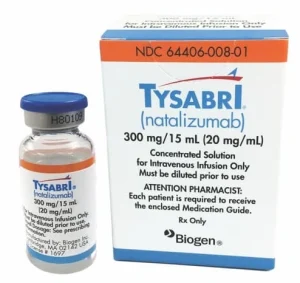
TM Owner Biogen
Tysabri 300mg Injection
Global Shipping : Reliable Global Distribution Network
Express Delivery : Priority Shipping for Every Order
Secure Payments : Trusted Payment Protection System
 Disclaimer

Secure Handling
24/7 Worldwide Support

Global Access
Worldwide Access to Health

Cold-Chain Expert
Excellence in Cold-Chain

Trusted Supply
Certified Medical Supply
Indications & Clinical Uses
- Tysabri (natalizumab) 300 mg/15 mL is a monoclonal antibody that blocks alpha-4 integrin, stopping certain immune cells from crossing into the brain and gut.
- It is approved for relapsing forms of multiple sclerosis in adults, typically after an inadequate response to, or inability to tolerate, other MS therapies, and for moderately to severely active Crohn's disease in adults who have not responded to, or cannot tolerate, conventional treatment and TNF-blocker therapy.
- Tysabri is a hospital- or infusion-centre-administered medicine only; it is never a self-injection and is never given as tablets.
- A biosimilar version of natalizumab, marketed as Tyruko, has since been approved by the FDA and EMA as an alternative to this originator brand; Tysabri remains the reference (originator) product against which the biosimilar was compared.
Side Effects
- BOXED WARNING: Tysabri increases the risk of progressive multifocal leukoencephalopathy (PML), a rare but serious brain infection that usually causes death or severe disability; risk rises with anti-JC virus antibody status, treatment beyond two years and prior immunosuppressant use.
- Very common reactions include headache, fatigue, joint pain and urinary or respiratory infections.
- Infusion reactions such as dizziness, nausea, flushing, itching or chest discomfort can occur during or shortly after the drip.
- Serious liver injury, herpes infections and hypersensitivity reactions including anaphylaxis have also been reported.
- Report any new or worsening confusion, memory problems, vision changes, weakness or clumsiness immediately, as these can be early signs of PML, and seek urgent care for facial swelling or breathing difficulty during infusion.
Precautions & Warnings
- Tysabri is available only through the restricted TOUCH Prescribing Program: prescribers, infusion centres and pharmacies must be certified, and patients are enrolled and monitored, including periodic MRI and anti-JCV antibody testing to assess PML risk before and during treatment.
- It must not be used in patients with a history of PML, active untreated infections, or in combination with other immunosuppressants or TNF-blockers for Crohn's disease.
- Dosing is withheld immediately at the first sign or symptom suggestive of PML.
- Tysabri is given only as an intravenous infusion over about one hour, every four weeks, by a healthcare provider in a certified setting - never as an intravenous push or bolus.
- Liver function is monitored, and use in pregnancy or breastfeeding should be discussed individually with the treating specialist.
Avoid Interactions
- Tell your healthcare provider about all medicines you take, especially other treatments that affect the immune system.
- Tysabri must not be combined with interferons, glatiramer acetate, other disease-modifying MS therapies, or with immunosuppressants and TNF-blockers used for Crohn's disease, because combining immune-suppressing effects further increases the risk of PML and serious infection.
- A washout period is generally required when switching from another MS therapy to Tysabri.
- Live vaccines should be avoided or discussed with the prescriber, since immune suppression can reduce vaccine effectiveness or increase infection risk.
- Tysabri is diluted only in normal saline and must not be mixed with other medicines or infused through the same line as any other agent.
References
Frequently Asked Questions
Tysabri (natalizumab) treats relapsing multiple sclerosis and moderate-to-severe Crohn's disease in adults who have not responded well to standard treatments. It blocks immune cells from entering the brain or gut. A biosimilar version, Tyruko, has also been approved as an alternative to this originator brand.
Tysabri is given only as an intravenous infusion by a healthcare provider, over about one hour, once every four weeks, at a certified TOUCH Program infusion centre. You cannot inject it yourself, and it is never given as a fast IV push.
Common Tysabri side effects include headache, fatigue, joint pain and urinary or chest infections. The most serious risk is PML, a rare brain infection linked to longer treatment duration and JC virus antibodies. Report confusion, vision changes or new weakness immediately.
Avoid combining Tysabri with other MS disease-modifying drugs, immunosuppressants or TNF-blockers for Crohn's disease, as this raises PML and infection risk. Tell your care team about any live vaccines or new infections. Report symptoms straight away rather than waiting for your next infusion.
You need regular anti-JC virus antibody blood tests and periodic MRI scans while on Tysabri, plus enrolment in the TOUCH Prescribing Program, to track PML risk. Liver function is also checked. Infusions themselves are monitored on-site for allergic or infusion reactions.
Tysabri carries a boxed warning for PML, a rare but often fatal or disabling brain infection. Risk increases with treatment beyond two years, JC virus antibodies, and prior immune-suppressing drugs. Tell your care team immediately about new confusion, vision loss or weakness.

Trusted & Reliable – Your Partner in Global Distribution.
We provide comprehensive lines of pharmaceutical products to support all your healthcare distribution needs.


