

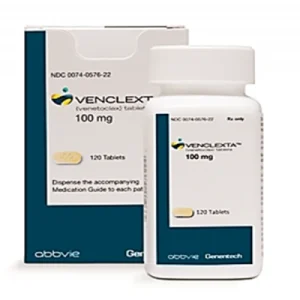
TM Owner AbbVie
Venclexta 100mg Film-coated tablet
Global Shipping : Reliable Global Distribution Network
Express Delivery : Priority Shipping for Every Order
Secure Payments : Trusted Payment Protection System
 Disclaimer

Secure Handling
24/7 Worldwide Support

Global Access
Worldwide Access to Health

Cold-Chain Expert
Excellence in Cold-Chain

Trusted Supply
Certified Medical Supply
Indications & Clinical Uses
- Venclexta 100 mg tablets contain venetoclax, an oral BCL-2 inhibitor for blood cancers (marketed as Venclyxto in the EU and UK).
- It is indicated for adults with chronic lymphocytic leukaemia (CLL) or small lymphocytic lymphoma (SLL), and, in combination with azacitidine, decitabine or low-dose cytarabine, for newly diagnosed acute myeloid leukaemia (AML) in adults aged 75 or older or those who cannot have intensive chemotherapy.
- The 100 mg tablet is one of three strengths (10 mg, 50 mg, 100 mg), and dosing starts low and increases: in CLL/SLL a 5-week ramp-up of 20, 50, 100 and 200 mg to 400 mg daily; in AML a 3-day ramp-up to 400 mg (or 600 mg with cytarabine).
- Take with a meal and water at about the same time each day.
- It is prescribed by a cancer specialist.
Side Effects
- Very common effects in CLL/SLL include low white cell, platelet and red cell counts (neutropenia, thrombocytopenia, anaemia), diarrhoea, nausea, upper respiratory infection, cough, musculoskeletal pain, tiredness and swelling.
- In AML, nausea, diarrhoea, low counts, constipation, vomiting, fever, pneumonia, breathlessness, bleeding, rash and febrile neutropenia are very common.
- Serious effects include tumour lysis syndrome (TLS), which can be fatal, and is most likely during the ramp-up; severe neutropenia (grade 3 or 4 in about 63% to 64% of CLL patients); and serious or fatal infections.
- Report fever, chills, nausea, vomiting, confusion, shortness of breath, irregular heartbeat, dark or cloudy urine, muscle cramps or unusual tiredness at once.
- Venclexta has no boxed warning.
Precautions & Warnings
- TLS prevention is central: drink 1.5 to 2 litres of fluid daily, take allopurinol starting 2 to 3 days before treatment, and expect blood tests before the first dose and at 6 to 8 hours and 24 hours after each dose increase, with intravenous fluids for higher-risk patients.
- Blood counts are monitored, and doses may be interrupted or reduced.
- Do not receive live attenuated vaccines before, during or after treatment until B-cell recovery.
- Venclexta can harm an unborn baby; use effective contraception during treatment and for 30 days after the last dose.
- Strong CYP3A inhibitors at initiation and during ramp-up are contraindicated in CLL/SLL; the EU label also contraindicates St. John's wort.
- Never start at the full dose.
- Storage details were not confirmed from the fetched labels, so follow your pack label.
Avoid Interactions
- Medicines that increase venetoclax levels or toxicity: strong CYP3A inhibitors (contraindicated at initiation and ramp-up in CLL/SLL; dose reduced afterwards, for example posaconazole needs a 70 mg dose), moderate CYP3A inhibitors and P-gp inhibitors (dose reduced by at least 50% for P-gp inhibitors), and grapefruit, Seville oranges and starfruit, which must be avoided.
- Medicines that reduce effect: CYP3A inducers should be avoided; St. John's wort is contraindicated in the EU.
- P-gp substrates should be taken at least 6 hours before Venclexta, and warfarin needs INR monitoring.
- Live vaccines should be avoided.
- Tell your healthcare provider about all medicines and supplements.
References
Frequently Asked Questions
Venclexta (venetoclax) treats chronic lymphocytic leukaemia (CLL) and small lymphocytic lymphoma (SLL) in adults. With azacitidine, decitabine or low-dose cytarabine it also treats newly diagnosed acute myeloid leukaemia in adults aged 75 or older, or those unable to have intensive chemotherapy.
Take Venclexta (venetoclax) once daily with a meal and water at about the same time each day. Treatment starts at a low dose and rises: over 5 weeks to 400 mg in CLL/SLL, or over 3 days in AML. Follow your cancer specialist's ramp-up schedule exactly.
Venclexta commonly causes low blood counts, diarrhoea, nausea, infections, cough, tiredness and swelling. It can cause tumour lysis syndrome, severe neutropenia and serious infections. Report fever, vomiting, confusion, breathlessness, dark urine or muscle cramps at once. Venclexta has no boxed warning.
Avoid grapefruit, Seville oranges and starfruit, which raise Venclexta (venetoclax) levels. Strong CYP3A inhibitors are contraindicated at the start of CLL/SLL treatment. Avoid CYP3A inducers, St. John's wort in the EU, and live vaccines before, during and after treatment until B-cell recovery.
Venclexta (venetoclax) needs blood chemistry tests before the first dose and 6 to 8 hours and 24 hours after each dose increase, to catch tumour lysis syndrome. Drink 1.5 to 2 litres of fluid daily and take allopurinol from 2 to 3 days before starting. Blood counts are also monitored.
No. Venclexta (venetoclax) can cause fetal harm. Use effective contraception during treatment and for 30 days after the last dose, and tell your healthcare provider straight away if you become pregnant. Do not start treatment without discussing contraception with your cancer specialist first.

Trusted & Reliable – Your Partner in Global Distribution.
We provide comprehensive lines of pharmaceutical products to support all your healthcare distribution needs.


