

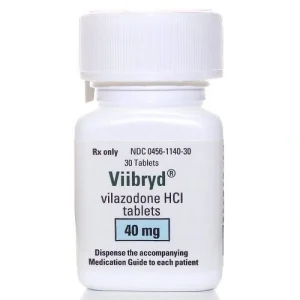
TM Owner Allergan / AbbVie
Viibryd 40mg Tablet
Global Shipping : Reliable Global Distribution Network
Express Delivery : Priority Shipping for Every Order
Secure Payments : Trusted Payment Protection System
 Disclaimer

Secure Handling
24/7 Worldwide Support

Global Access
Worldwide Access to Health

Cold-Chain Expert
Excellence in Cold-Chain

Trusted Supply
Certified Medical Supply
Indications & Clinical Uses
- Viibryd 40 mg (vilazodone hydrochloride) is a once-daily tablet antidepressant used for the treatment of major depressive disorder (MDD) in adults.
- It is not approved for use in children, because efficacy was not demonstrated in pediatric patients aged 7 to 17 years.
- The usual dose is 20 mg to 40 mg once daily, taken with food, and treatment is started at 10 mg daily for 7 days and then increased, so the 40 mg tablet is a higher-strength tablet reached by stepwise increases and is not a starting dose.
- Viibryd is available as 10 mg, 20 mg and 40 mg tablets, in bottles of 30, so check the strength on your prescription.
- The US label is held by AbbVie (Allergan) and the product is prescription only.
- Viibryd carries a boxed warning about suicidal thoughts and behaviours.
Side Effects
- Viibryd carries a boxed warning: antidepressants increased the risk of suicidal thoughts and behaviours in children, adolescents and young adults in short-term studies, so watch for new or worsening depression, agitation, unusual behaviour changes or suicidal thoughts and contact your healthcare provider immediately.
- The most common side effects (at least 5% and twice the placebo rate) are diarrhoea (about 26% to 29%), nausea (about 22% to 24%), vomiting (4% to 5%) and insomnia (6% to 7%); dry mouth and dizziness were also reported in roughly 6% to 8%.
- Serious risks include serotonin syndrome, bleeding, mania or hypomania, discontinuation symptoms, seizures, angle-closure glaucoma, low sodium (hyponatraemia, more likely in older people) and sexual dysfunction.
- Do not stop suddenly.
Precautions & Warnings
- Viibryd is contraindicated with monoamine oxidase inhibitors (MAOIs), and for 14 days after stopping one.
- Because of the boxed warning, people of all ages starting treatment should be closely watched for worsening mood and suicidal thinking.
- Use caution in people with bipolar disorder (risk of mania), seizure history, bleeding risk or a risk of narrow-angle glaucoma.
- Late-pregnancy use has been linked to neonatal complications needing prolonged hospitalisation, respiratory support and tube feeding, persistent pulmonary hypertension, and postpartum haemorrhage; there are no data on vilazodone in human milk.
- Do not drive or operate machinery until you know how Viibryd affects you.
- Avoid alcohol.
- Take it with food.
- Reduce the dose gradually when stopping.
- Store at 25°C, with excursions permitted from 15°C to 30°C.
Avoid Interactions
- Viibryd should never be combined with MAOIs (including within 14 days), and other serotonergic drugs raise the risk of serotonin syndrome, including triptans, tricyclic antidepressants and lithium.
- Antiplatelet drugs, anticoagulants and NSAIDs increase bleeding risk.
- Strong CYP3A4 inhibitors such as ketoconazole and clarithromycin raise vilazodone levels, so the dose should not exceed 20 mg once daily.
- Strong CYP3A4 inducers such as carbamazepine and rifampin lower vilazodone levels and may reduce its effect; the prescriber may consider increasing the dose over 1 to 2 weeks.
- Digoxin levels should be measured before starting Viibryd together with it.
- Avoid alcohol during treatment.
- Tell your prescriber about every prescription medicine, over-the-counter product, herbal remedy and supplement you use.
References
Frequently Asked Questions
Viibryd (vilazodone) is an antidepressant taken once daily to treat major depressive disorder in adults. It is not approved for children, because it did not show benefit in patients aged 7 to 17 in studies. Treatment usually starts at 10 mg daily and is raised stepwise to 20 mg to 40 mg daily.
Take Viibryd (vilazodone) once daily with food. Treatment starts at 10 mg for 7 days and is then increased, with the usual dose 20 mg to 40 mg once daily. The 40 mg tablet is not a starting dose, and you should not stop suddenly.
Viibryd (vilazodone) most often causes diarrhoea, nausea, vomiting and insomnia. It carries a boxed warning for suicidal thoughts and behaviours in young people. Get urgent help for suicidal thoughts, new agitation, or signs of serotonin syndrome such as fever, tremor and confusion.
Avoid MAO inhibitors and for 14 days after stopping them, and avoid alcohol. Viibryd (vilazodone) also interacts with serotonergic drugs (triptans, lithium, tricyclics), blood thinners and NSAIDs, digoxin, and CYP3A4 inhibitors or inducers such as ketoconazole, clarithromycin and carbamazepine. Tell your prescriber about every medicine you use.
No. Stopping Viibryd (vilazodone) abruptly can cause discontinuation symptoms, so the label recommends gradual tapering. Do not stop or change your dose without speaking to your healthcare provider, and report any worsening mood or suicidal thoughts straight away. Antidepressants can also change mood, so ask for help early if you feel worse.
Talk to your healthcare provider first. Late-pregnancy use of Viibryd (vilazodone) has been linked to neonatal complications needing hospital care, respiratory support and tube feeding, persistent pulmonary hypertension of the newborn, and postpartum haemorrhage. There are no data on vilazodone in breast milk.

Trusted & Reliable – Your Partner in Global Distribution.
We provide comprehensive lines of pharmaceutical products to support all your healthcare distribution needs.


