

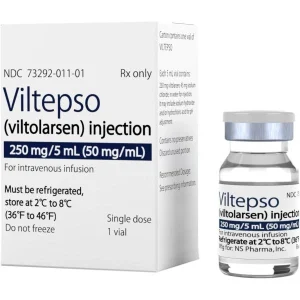
TM Owner NS Pharma
Viltepso 250mg/5ml Injection
Global Shipping : Reliable Global Distribution Network
Express Delivery : Priority Shipping for Every Order
Secure Payments : Trusted Payment Protection System
 Disclaimer

Secure Handling
24/7 Worldwide Support

Global Access
Worldwide Access to Health

Cold-Chain Expert
Excellence in Cold-Chain

Trusted Supply
Certified Medical Supply
Indications & Clinical Uses
- Viltepso 250 mg/5 mL (viltolarsen, 50 mg/mL) is an antisense oligonucleotide medicine, an exon 53 skipping therapy, for the treatment of Duchenne muscular dystrophy (DMD) in patients who have a confirmed mutation of the DMD gene that is amenable to exon 53 skipping.
- It received US accelerated approval based on an increase in dystrophin production in skeletal muscle, and continued approval for this use may be contingent on verification and description of clinical benefit in a confirmatory trial.
- The dose is 80 mg/kg once weekly as a 60-minute intravenous infusion, given by healthcare professionals.
- It is supplied in single-dose vials.
- Studies included children aged 4 to under 10 years.
- It is not suitable for DMD caused by mutations that are not amenable to exon 53 skipping.
- Viltepso is labelled by NS Pharma, Inc. in the United States.
Side Effects
- The most common side effects, seen in at least 15% of people at the recommended dose, were upper respiratory tract infection (about 63%), injection site reaction (25%), cough (19%) and fever (19%).
- Other reactions in at least 10% of people included bruising (contusion), joint pain (arthralgia), diarrhoea, vomiting, abdominal pain, decreased ejection fraction (a heart pumping measure) and hives (urticaria).
- The main serious warning is kidney toxicity: kidney toxicity was seen in animals, so kidney function must be monitored during treatment.
- There is no boxed warning on the US label.
- Report any changes in urine or signs of infection promptly, and tell the infusion team about any reaction at the infusion site or during the infusion.
Precautions & Warnings
- Kidney function must be assessed before starting treatment, with serum cystatin C, urine dipstick and urine protein-to-creatinine ratio (UPCR).
- During treatment, urine dipstick is checked monthly, and serum cystatin C and UPCR every three months; a paediatric nephrologist should be consulted if increases persist.
- Serum creatinine is not reliable for kidney function in DMD because of low muscle mass.
- The US label lists no contraindications.
- There are no human or animal data on use in pregnancy, and none on breast milk or effects on the breastfed infant.
- Viltepso is for intravenous infusion over 60 minutes only; when dilution is needed (if the volume is under 100 mL), use only 0.9% sodium chloride injection.
- Prepared solution can be kept at room temperature for up to 5 hours or refrigerated for up to 24 hours.
- Store vials at 2°C to 8°C.
- Do not freeze.
Avoid Interactions
- The US label contains no drug interactions section.
- Laboratory data indicate viltolarsen has a low potential for drug-drug interactions: it did not inhibit the major cytochrome P450 enzymes or drug transporters tested, so no specific medicines are known to increase or reduce its effect.
- Because kidney monitoring is important, tell your healthcare provider about every medicine that can affect the kidneys, and about all prescription medicines, over-the-counter products, herbal remedies and supplements you use.
- When Viltepso must be diluted, only 0.9% sodium chloride injection should be used as the diluent; do not mix with other solutions or medicines.
- Do not use a vial that has been frozen.
References
Frequently Asked Questions
Viltepso (viltolarsen) treats Duchenne muscular dystrophy in people with a confirmed DMD gene mutation that can be helped by exon 53 skipping. It was approved on an accelerated basis because it raises dystrophin production in muscle; clinical benefit still needs to be confirmed.
Viltepso (viltolarsen) is given once weekly as an intravenous infusion over 60 minutes, at 80 mg/kg. It is given by healthcare professionals. Vials are diluted with 0.9% sodium chloride only when the volume is under 100 mL. Each vial contains 250 mg in 5 mL. Store unopened vials at 2°C to 8°C and do not freeze.
Viltepso (viltolarsen) most commonly causes upper respiratory tract infection, injection site reaction, cough and fever. It can also cause kidney toxicity. Tell your care team about changes in urine or signs of infection. Other effects include bruising, joint pain, diarrhoea, vomiting, abdominal pain and hives. There is no boxed warning.
Before starting Viltepso (viltolarsen), your team measures serum cystatin C, urine dipstick and urine protein-to-creatinine ratio. During treatment, urine dipstick is checked monthly and cystatin C and urine protein-to-creatinine ratio every three months. Serum creatinine is not reliable in Duchenne.
You have a 60-minute intravenous infusion of Viltepso (viltolarsen) once a week, given by healthcare staff. Tell them right away about any reaction at the site. Regular kidney tests are done alongside the infusions. The infusion is diluted with 0.9% sodium chloride only when the volume is under 100 mL.
Studies of Viltepso (viltolarsen) enrolled children aged 4 to under 10 years, and it is labelled for people with exon 53-amenable DMD. There are no human or animal data on pregnancy or breastfeeding, so discuss any plans with your healthcare provider.

Trusted & Reliable – Your Partner in Global Distribution.
We provide comprehensive lines of pharmaceutical products to support all your healthcare distribution needs.


